
Phones like the Oppo Reno 16 exist to give you a high-end feel without the high-end price tag.
Rising tech costs make that balancing act harder to pull off than ever these days. The Reno 16 costs noticeably more than its predecessor, true, but it also brings a genuine camera upgrade. Better zoom, a significantly improved ultrawide, all adding up to a camera lineup without a real weak point.
Most mid-range phones have one obvious camera that lags behind the others. Not this one. Performance could still be sharper across the board, but the actual photos hold up well consistently.
Oddly, the Oppo Reno 16 actually feels less powerful overall than the phone it replaces. We’re firmly in a rough era for tech value right now, though that’s true industry-wide, not something specific to Oppo, and there’s no sign this pricing pressure is easing anytime soon.
Is it still a good phone? Yes. The one upgrade I was genuinely hoping for was longer battery life, and that part lands just okay, not quite what the 6000mAh capacity on paper might suggest.
Oppo Reno 16 Full Specs
Oppo Reno 16 Design
The Oppo Reno 16 essentially plays as a smaller, cheaper alternative to the Oppo Find X9 series. But your first impression won’t be of a light, slim phone, largely thanks to its noticeably thick 8.4mm profile.
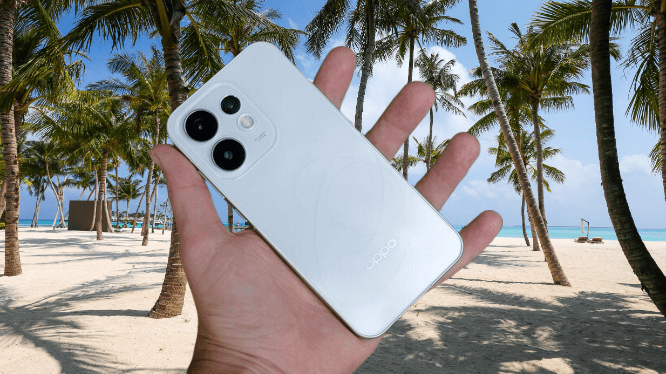
This is a chunky phone, no way around it. That said, the build quality feels genuinely uncompromised at first glance. The Reno 16 carries excellent IP68/69K water resistance, uses glass on both the front and back, with aluminum sidewalls holding it together.
You may also like: Oppo Pad 5 Review: Big Screen, Slow Chip, High Price
There’s no heavy plastic use here, which would honestly raise eyebrows at £699, though given rising cost pressures across the industry, expect more plastic creeping into future phones at this price point.
Only two color options are available, white and black, and Oppo uses an unusual lenticular layer beneath the rear glass panel. It creates a shooting star effect that appears to animate as you tilt the phone in your hand. It’s a departure from the norm, though it won’t suit everyone’s taste.
Elsewhere, the Reno 16 includes a fast in-screen fingerprint scanner, non-expandable storage, and an IR blaster. That IR blaster lets you use the phone as a universal remote through the included IR Remote app.
Speaker quality holds up well too, with loud output arranged in stereo, though missing some of the extra bass punch you’d find on the very best phones out there.
Oppo Reno 16 Screen
The Oppo Reno 16 packs a 6.32-inch OLED screen that closely mirrors what you’ll find on the step-up Reno 16 Pro, and I’ve had both sitting side by side to compare directly.
Resolution comes in at 2640 x 1216 pixels, closer to an elongated 1080p than true 1440p, but the smaller panel size still makes everything look genuinely sharp.
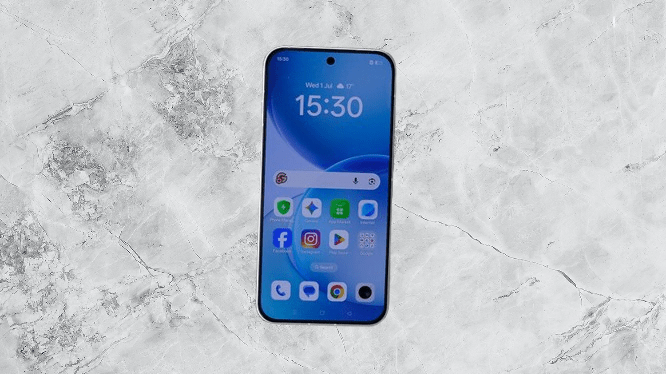
Color output is flexible too; you can dial it toward accuracy and restraint, or lean fully into the OLED panel’s natural vibrancy, whichever mode suits your preference.
You may also like: Oppo Could Join Samsung and Apple in Wide Foldable Race
Brightness holds up well throughout testing. Oppo rates it at 600 nits normally, climbing to 1800 nits in high brightness mode, triggered automatically by the ambient light sensor in bright environments. My colorimeter measured 580 nits normally, 1200 nits under intense lighting, and up to 1700 nits when playing HDR video.
Refresh rate tops out at 120Hz, which marks the main difference from the Reno 16 Pro’s 144Hz panel. In actual use, though, that gap isn’t especially noticeable.
Oppo Reno 16 Performance
The Oppo Reno 16 runs a Qualcomm Snapdragon chip, generally the more desirable brand, but this particular one sits far from Qualcomm’s best. The Snapdragon 7 Gen 4 is a common choice across mid-tier phones right now.
CPU power holds up solidly here, but graphics performance falls well short of what Qualcomm’s flagship chips deliver. This class of chip suits people who want good everyday performance without chasing serious gaming muscle.
If gaming power matters more to you, something like the Xiaomi Poco F8 makes a stronger case.
That phone delivers roughly triple the gaming performance of the Reno 16 and double the CPU power. It’s a genuine outlier when it comes to price-to-performance ratio, though.
The Honor 600 shares the same Snapdragon 7 Gen 4, as do the Motorola Edge 70 and Nothing 4a Pro. Interestingly, the more budget-focused brands here, Honor and Nothing, charge less for identical hardware, while Motorola matches Oppo’s pricing.
You may also like: Google Pixel 11 Pro XL Review: Great AI, Weak Gaming Chops
Oppo’s chip choice here isn’t especially exciting, but it lands roughly where you’d expect for the money in 2026. Here’s the genuinely odd part, though: the Reno 16 is actually weaker for gaming than 2025’s Reno 13, which used a MediaTek Dimensity 8350 packing considerably more GPU power.
That said, Fortnite runs fine on the Reno 16. You’ll only notice its limits pushing visuals to maximum settings, where frame rates drop noticeably below 60fps, particularly in scenes with more landscape detail on screen. As we’ll get into later, the more obvious performance compromise actually shows up in the camera rather than day-to-day navigation or gaming.
Oppo Reno 16 Software
The Oppo Reno 16 runs Android with Oppo’s ColorOS layered on top. One notable downside right out of the box: it comes preloaded with a handful of apps that presumably net Oppo a small commission somewhere along the line.
You’ll find AliExpress, Amazon Music, a low-effort ad-driven game called Block Blast!, and a few others cluttering things up. They’re all deletable, so it’s not a dealbreaker, but stuffing a phone with third-party apps like this doesn’t feel especially classy, even if it’s fairly common practice across the industry.
Oppo also brings its own take on the AI trend everyone’s chasing right now. It shows up mainly through Mind Pilot, a chatbot-style assistant, and Mind Space, which pulls together your recent activity to act as a kind of memory jog and help organize your day.
You may also like: Fairphone 6 Plus Review: Repairable, Not Fast
That second feature has drawn real controversy in similar forms elsewhere, Microsoft Recall being the obvious comparison. But there’s no requirement to actually use it if data collection concerns you or the whole concept just feels a bit uncomfortable.
Overall, this remains a familiar, easy-to-navigate interface, and the more debatable parts are either deletable or easy enough to simply ignore.
Oppo Reno 16 Camera
One of the cuts Oppo made moving from the Pro model down to the standard Reno 16 shows up in the camera, though interestingly, not where you’d typically expect.
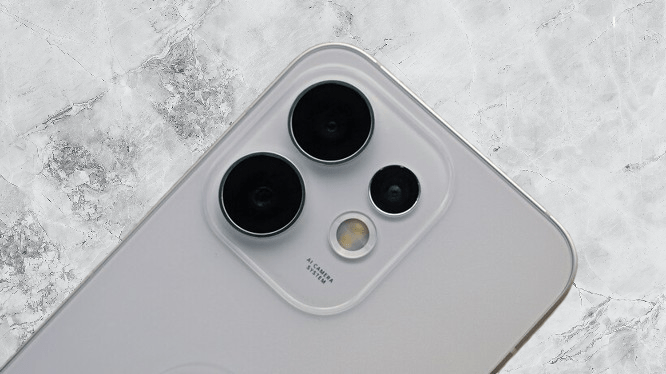
Over the years, I’ve seen plenty of phones drastically downgrade their zoom lens, sometimes swapping it out entirely for a cheap, largely useless depth sensor.
The Reno 16 flips that pattern. It uses a lower-spec main camera than the Reno 16 Pro, while the 50MP 3.5x zoom, 50MP ultrawide, and 50MP selfie camera all appear to carry over with the same hardware as the Pro model.
The main sensor drops to 50MP here, compared to 200MP on the Pro. That’s a real difference, for sure, but the lower-resolution sensor still produces genuinely detailed images, including solid low-light shots. It’s a good reminder that software processing carries a lot of weight in the final result, not just raw hardware specs alone.
You may also like: Samsung Galaxy Z Fold 8 Review: Lighter, Smarter Design
The zoom lens stands out as a real highlight, though. It’s not a periscope-style lens with folded optics extending the light path, but images hold up impressively well at 3.5x zoom and a bit beyond that too. Push further into pixel-level detail, though, and softness creeps in noticeably faster.
I’ve noticed a real difference in the pixel-level character between zoom shots on the Reno 16 versus the Pro; they’re clearly running different processing profiles. Pro shots often look a touch more polished, though sometimes at the cost of feeling more digitally manipulated. The standard Reno 16 felt a bit less forgiving in comparison, often needing multiple shots or a steadier hand to pull out maximum detail from zoomed images.
I can’t say for certain whether this comes down to the imaging engine and OIS setup, both phones do include optical image stabilization on their zoom lenses, or if it’s more anecdotal than anything measurable, but it’s a pattern I picked up on consistently throughout testing.
Overall, the Oppo Reno 16’s camera is genuinely fun to use, offering flexibility that only significantly pricier phones tend to beat.
Video capture tops out at 4K resolution and 60fps in standard mode, and it generally looks great, with well-resolved detail and reasonably controlled noise even shooting indoors under imperfect lighting.
You may also like: Xiaomi Redmi Note 17 Pro Max Review: Best Battery Ever
There’s also a Pro video mode that lets you avoid jarring automatic exposure shifts mid-recording. There’s no equivalent Pro photo mode, though; you get exposure control and a few other adjustments, but manual focus doesn’t seem to be an option.
I ran into a couple of other camera frustrations too, both tied to performance rather than image quality. The Reno 16 takes noticeably long to finish processing photos, which slows down how quickly you can actually share them afterward.
Camera app startup speed can also get genuinely frustrating, particularly if you’re doing something like listening to a podcast or streaming radio in the background. I missed several photo opportunities simply because the camera took too long to launch properly.
You may also like: Nothing Phone 4(b) Review: Budget Phone With Real Flair
Switching between camera lenses can lag too, especially with other background processes running. This wasn’t nearly as noticeable on the Reno 16 Pro, and it’s a genuine disappointment on a £699 phone where the actual camera hardware otherwise performs well.
Oppo Reno 16 Battery Life
The Oppo Reno 16 packs a large 6000mAh battery, using silicon-carbon tech to squeeze more capacity into a smaller physical footprint. Some regions actually get an even bigger 6700mAh battery instead, so it’s worth checking exactly which version you’re buying.

Similar to the Reno 16 Pro I reviewed, which came with the 6700mAh battery, real-world battery life here landed at okay rather than genuinely great. I never came close to the 50% end-of-day remaining charge I’d typically expect from a phone boasting this kind of capacity.
You may also like: Oppo Find X10 Pro Max: Triple 200MP Camera Leak
Instead, what I got felt closer to a more ordinary 5000mAh phone experience. Running the Reno 16 down over a full day wasn’t difficult at all, and I occasionally needed a top-up charge before heading out for the evening.
You might see better results during darker months, when the screen isn’t working as hard as often. But it’s worth tempering expectations rather than assuming stamina here will blow you away.
Charging comes via an included 80W charger, though speeds felt a bit slower than expected given what I’ve seen from similar charging standards in the past. In my first charging test, the Reno 16 took 37 minutes to reach 50%, and a full 78 minutes to hit 100%.
That’s a bit surprising, not just because it’s a fairly long time for fast charging, but because you’d typically expect a more gradual pace drop-off across the second half of the charge cycle rather than an even slowdown throughout. It’s possibly more a sign of how sensitive the Reno 16’s charging is to heat, worth noting this test happened on a particularly warm day.
You may also like: Xiaomi 18 Ultra Camera Leaks: Bigger Sensor, Better Zoom
In the name of science, I tried the charging test again, this time keeping the phone in the fridge beforehand. Under those cooler conditions, the Oppo Reno 16 reached 50% in just 21 minutes, and hit 67% by the 30-minute mark.
That’s a noticeable improvement, though still not blazing fast given the stated 80W charging power. Still, it does show just how sensitive this charging system is to elevated temperatures, which isn’t great news for long-term battery health either. Wireless charging isn’t supported here, and it’s absent on the Reno 16 Pro too.
Oppo Reno 16 Verdict
Like plenty of the best mid-range phones out there, the Oppo Reno 16 delivers core flagship benefits at a lower price, including a camera capable of handling nearly any scene and a genuine glass and metal build. It does come with some camera performance quirks, though, and battery life falls short of what its capacity suggests.
Pros |
Cons |
| Camera with good zoom and selfies | Upgrades does not justify price jump |
| Metal and glass build | A gaming downgrade from last gen |
| Respectable display brightness | Camera start-up is slow, and battery life is shorter |
Final Thoughts
The Oppo Reno 16 costs meaningfully more than its predecessor, and it’s honestly not an upgrade across the board. That said, a substantially improved camera setup pulls this phone much closer to feeling like a genuine flagship alternative for budget-conscious buyers.
You also get a proper metal and glass build here. Even though you’ll probably want a case for it, that construction quality adds real confidence that you’re getting decent value during this genuinely turbulent stretch for tech pricing.
A few things do disappoint, though. Battery life falls short of what you’d expect from a 6000mAh cell this large, and the camera’s real-world responsiveness really should be sharper for what you’re paying here.