
Redmi, Xiaomi’s budget sub-brand, has built its reputation on borrowing bits of flagship tech and handing them down to phones that cost far less. The Redmi Note 17 Pro Max 5G continues that trend at £499, promising battery life that lasts and a build that holds up better than most phones in this price bracket.
It backs that up too with a massive 9210mAh silicon-carbon battery that sits inside, paired with Gorilla Glass Victus 2, the kind of protection you’d normally only find on phones costing twice as much. Together, they mean you can realistically get three days out of a single charge, and the phone should hold up well over several years of daily use. If you want an Android phone that won’t die on you by dinner time, this is a strong pick.
That said, it’s not perfect. The design is plain, the dual camera setup is inconsistent, and the software feels more complicated than it needs to be. Even so, the Redmi Note 17 Pro Max earns its place as a mid-range phone with battery life that beats pretty much everything else in its class.
Xiaomi Redmi Note 17 Pro Max Full Specs
Xiaomi Redmi Note 17 Pro Max Design
Last year’s Redmi Note 15 Pro tried to hide the fact it only had two rear cameras by dressing up the back with a four-circle design, complete with a fake black circle and flash to fill out the look.
This year’s model, the 17 Pro Max, drops that trick. Xiaomi skipped the “16” name entirely, following the same jump the iPhone and Xiaomi 17 made, and this time the back openly shows two cameras instead of hiding them.
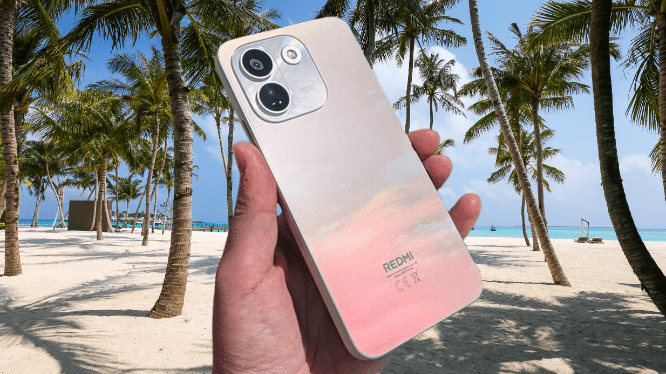
The result looks a lot like an iPhone 12 at a glance, with a flash sitting next to the lenses on a slightly raised camera bump. My review unit came in Cloud Blush, a color that looks almost plain white indoors but shows off a pink, cloud-like pattern once sunlight hits it.
It walks right up to the edge of flashy without going overboard, though you can also get it in black, green, or purple if you’d rather keep things simple.
You may also like: Oppo Reno 16 Review: Great Cameras, Middling Battery
Size-wise, this is a big phone, close in dimensions to the Pixel 11 Pro XL I reviewed recently. It’s on the thick side too, at 8.6mm, and weighs a good 225g. You’ll always know it’s in your pocket. And despite that eye-catching color option, the phone ends up feeling fairly ordinary once you’ve used it for a while.
Xiaomi calls this its toughest phone yet, rated to survive drops from three meters. It also carries IP66, IP68, IP69, and IP69K ratings, covering about as much dust and water protection as any phone can have right now.
That means it should handle accidental dunks and even blasts from a high-pressure hose, though I wouldn’t recommend actually testing that on purpose. At the very least, you won’t need to worry about it in heavy rain.
One thing that genuinely impressed me is the haptics, the little taps and buzzes you feel from calls, notifications, and typing. The keyboard vibration stood out especially, giving a tight, satisfying “pip” instead of the loose, rattly buzz you often get on cheaper phones. Xiaomi got that detail right.
Xiaomi Redmi Note 17 Pro Max Screen
True to its name, the Note 17 Pro Max goes big on screen size too, packing a 6.83-inch AMOLED display. It runs at 1.5K resolution, 2772 by 1280, with a 120Hz refresh rate, and for a phone at this price, that’s genuinely impressive.
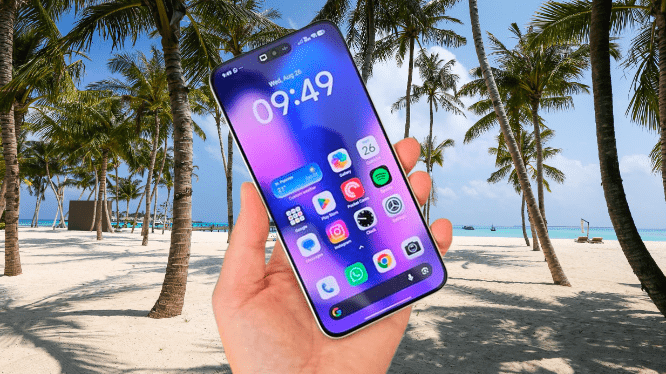
There’s a catch, though. This isn’t an LTPO panel, so it can’t drop all the way down to 1Hz to save battery. I also noticed the automatic refresh rate setting wasn’t perfectly smooth, with some scrolling and actions feeling choppier than I expected given the numbers on paper.
You may also like: Google Pixel 11 Pro XL Review: Great AI, Weak Gaming Chops
Brightness makes up for a lot of that. The screen can hit 3,500 nits in direct sunlight, which means you can read it clearly even on the brightest days. Xiaomi also added 3,840Hz PWM dimming, meant to cut down on flicker across all brightness levels and ease eye strain over long use.
There’s a reading mode too, which strips out some blue light for more comfortable use at night. If you like reading e-books in bed or you’re just someone who stares at their phone constantly, that feature earns its keep.
Is this screen as sharp or well-tuned as what you’d find on the Pixel 11 Pro XL or Galaxy S26 Ultra? No, not quite. But for a mid-range Android phone, it holds up well, backed by HDR10+ support and Dolby Vision certification.
Xiaomi Redmi Note 17 Pro Max Cameras
I like that Xiaomi stopped pretending this phone has more cameras than it does, but the 8MP ultra-wide feels like an afterthought. Shots from it come out soft on detail, and you’ll notice blur creeping in unless you’re shooting in really bright light.
The main camera is where things get good. It’s a 50MP sensor with an f/1.5 aperture, and it’s capable of some genuinely nice shots. It won’t match what Xiaomi’s own 17T Pro can do, but for a Redmi phone, this is an excellent performer, with a filmic look baked into the default settings.
Xiaomi even added two “Film” filters, Positive and Negative, plus a handful of other creative filters if you want to play around.
Optical image stabilization on that main lens helped me get sharp shots even when I wasn’t holding perfectly still, though photos of people occasionally came out washed out. This camera clearly favors bold colors in good light over anything more subtle.
You may also like: Fairphone 6 Plus Review: Repairable, Not Fast
If you’re tired of Samsung phones pushing oversaturated, overly glossy-looking photos, the Note 17 Pro Max offers something different, and honestly, a bit more satisfying creatively.
The 32MP front camera holds up well too, sharp enough for group photos and video calls without complaint.
Video is where the phone shows its limits. Walking while filming has a noticeable shake and jitter, though colors still look vibrant. For casual use, birthdays, concerts, clips you’re sending to friends or posting online, it gets the job done. The main camera tops out at 4K video at 30 frames per second.
Xiaomi Redmi Note 17 Pro Max Performance
Something has to give to keep a mid-range phone at this price, and here it’s the performance. It’s fine, but it doesn’t push past average.
Even doing basic stuff day to day, I picked up on some stutter when switching between apps, and the keyboard occasionally lagged during fast typing right after opening. That’s likely down to the 8GB of RAM combined with the Snapdragon 6 Gen 5, a chipset that sits firmly in the middle of the pack.
Still, I adjusted to the slower pace after a few days, and it never left me genuinely frustrated. Apps open quickly enough, and for my usual lineup, WhatsApp, Spotify, Google Tasks, and Pocket Casts, there’s plenty of power to go around.
You may also like: Samsung Galaxy Z Fold 8 Review: Lighter, Smarter Design
My unit shipped with 256GB of storage, which covers my needs fine, but if you plan on storing a lot of files locally or downloading several big mobile games, you might want to think about how much space those eat up.
Gaming turned out better than I expected given the specs. Demanding titles like Call of Duty Mobile and Genshin Impact ran smoothly. Serious mobile gamers who want max frame rates held steady over long sessions might notice the phone getting warm after about ten minutes of heavy play, but for anyone gaming casually, this phone handles it without issue.
You’re also covered on connectivity, with NFC for payments, eSIM support, Wi-Fi 6, and Bluetooth 6.0.
Xiaomi Redmi Note 17 Pro Max Software & AI
Whether you like a manufacturer’s take on Android usually comes down to personal taste, but Xiaomi’s HyperOS isn’t for me. It reshapes a lot of the visual language compared to what’s left of “stock” Android these days, and honestly leans a bit too close to copying iOS for my comfort.
The swipe-down menus split apart just like on iPhone, with notifications living on the left and a control center tucked on the right.
What really bothered me was how notifications work. I’m used to swiping down on a notification to expand it, whether that’s on the home screen or in the shade.
On this phone, that gesture doesn’t work. You have to tap a tiny arrow instead to see the full text. Sounds minor, but when you’re going through notifications throughout the day, that extra tap slows things down and makes the whole experience less pleasant.
You may also like: Nothing Phone 4(b) Review: Budget Phone With Real Flair
That said, I adapted to most of HyperOS’s quirks within a few days. I personally prefer the simpler feel of Pixel software, but to be fair, most Android manufacturers, Samsung, Oppo, Vivo, all reshape the experience in their own ways too. If this sounds like nitpicking to you, you’ll probably adjust fine and not think twice about it.
What bugged me more is the amount of preinstalled bloatware. TikTok, AliExpress, Booking.com, Amazon Music, Facebook, and a stack of games all come installed on the phone from the start. You can remove all of them, so it’s not a dealbreaker, but it still feels unnecessary.
There’s also a strange limitation with the always-on display: you can’t actually keep it always on. The settings only let you show the time, date, battery, and notifications for 10 seconds after tapping the screen.
That’s an odd restriction to not offer alternatives for, and I have to wonder if it’s a bug that gets patched later, or if Redmi is just that determined to protect battery life at all costs.
On the AI front, Google Gemini comes built in and covers most people’s needs just fine. I also got some use out of the photo editing tools in the Gallery app, including Xiaomi’s own AI Beautify feature, though you’ll need to sign into a Xiaomi Account through settings to unlock every editing option.
Xiaomi’s own HyperAI mostly stays out of the way unless you go digging for it. It’s tucked into the Settings app, offering writing help, speech recognition, translation, an interpreter tool, and subtitles, but you have to turn each one on manually before it does anything.
Xiaomi Redmi Note 17 Pro Max Battery Life
Battery is where the Note 17 Pro Max really shines, and it’s not close. Xiaomi crammed a massive 9210mAh battery into a normal-sized phone, made possible by silicon carbon technology, which packs more energy into less space than the lithium-ion batteries most phones still use. Other regions get a 10,000mAh version, though the UK model tops out at 9210mAh.
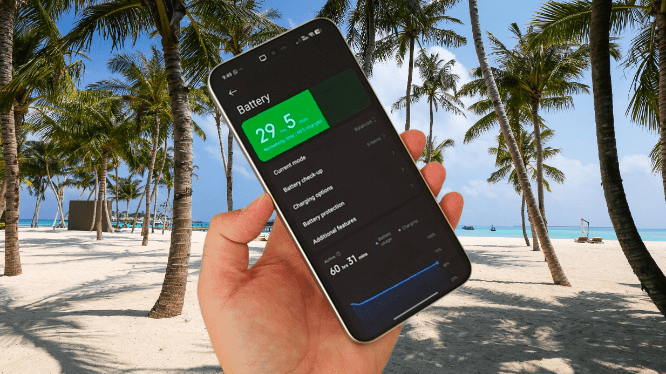
Even at that size, it’s still one of the largest batteries you’ll find on any phone sold today, and Xiaomi backs it up with 100W fast charging.
You may also like: Xiaomi 18 Ultra Camera Leaks: Bigger Sensor, Better Zoom
Killing this battery in a single day is basically not possible. Using it as my everyday phone, I never once saw it drop below 70% by the end of the day. Combine that with 100W charging that can top up the whole battery in a little over an hour, and this is the phone to grab if you’re sick of watching your battery icon turn red.
Testing the charging with an EU charger, I went from 1% to 19% in 15 minutes, a bit behind the 22% Xiaomi advertises for that same window. That gap might just come down to the adapter. It reached 50% at the 44-minute mark, and by the 64-minute point where Xiaomi claims a full charge, mine was sitting at 70% instead. A complete charge took about 90 minutes total.
I got a full three days out of the phone with fairly heavy use, since I was testing everything it offers. With lighter use, a fourth day feels within reach. That kind of battery life is hard to find anywhere else right now.
Xiaomi says the battery will “last 6 years without significant degradation,” which is obviously a claim built on projections rather than years of real-world proof.
Every battery wears down eventually, and silicon carbon technology hasn’t been around long enough for anyone to really know how it ages over the long haul.
Still, whatever happens down the line, there’s no arguing with how good this battery is right now, fresh out of the box.
You may also like: Infinix Note 60 Ultra Review: Pininfarina Design on a Budget
That massive capacity comes in handy elsewhere too. The phone supports 27W reverse wired charging, so you can use it to charge other devices. With a battery this big, you can top off your earbuds or lend some power to a friend’s phone and barely notice the dent it leaves.
Xiaomi Redmi Note 17 Pro Max Verdict
The Redmi Note 17 Pro Max 5G has the best battery life I have come across on any smartphone, full stop. On top of that, you get a tough build and a screen that’s both bright and sharp. The camera falls a bit short of the rest of the package, but overall this phone is a dependable, no-nonsense mid-range option that takes battery anxiety off the table, even if you’re glued to your phone all day.
Pros |
Cons |
| Excellent battery life | Uninspiring design |
| Good performance for the price | Passable camera system |
| Best possible IP ratings | HyperOS can be annoying |
Final Thoughts
The Redmi Note 17 Pro Max has its weak points, an average camera setup and performance that doesn’t quite match flagship phones, but it’s hard to knock it too hard when it delivers exactly what it promises: seriously long battery life and a build that can take a beating.
If multi-day battery life matters more to you than anything else, and you don’t want to baby your phone or wrap it in a case to keep it safe, this phone earns its price tag.
HyperOS takes some getting used to at first, and you’ll want to clear out the bloatware the moment you set it up, but once you’re past that, it works well enough for daily use. Xiaomi is also promising the battery won’t noticeably decline for six years.
I can’t verify that six-year claim myself, obviously, but right now, the Note 17 Pro Max stands as a good mid-range Android pick if you want more battery life and durability than something like the Google Pixel 10a offers. That said, if a cleaner software experience and longer software support matter more to you, the Pixel is still the better call.