
Fairphone is skipping a full Gen 7 launch for 2026. Instead, the company is giving the Fairphone 6 a mid-cycle refresh with the Fairphone 6 Plus.
The headline changes come down to a new Snapdragon 7s Gen 4 chip and 12GB of RAM, giving it a bit more power under the hood, along with a jump to Android 16 and a new Cobalt Blue color option.
Plenty stays the same, though. The dual camera setup carries over, as does the 4415mAh battery and the chunkier plastic frame. At $649.99, that price feels reasonable given what you’re getting for repairability, especially set against more conventional mid-range phones like the Xiaomi 17T and Honor 600.
Fairphone 6 Plus Design
The standout addition on the Fairphone 6 Plus is a new color option. My review unit shipped in Cobalt Blue, joining the returning Horizon Black and Forest Green.
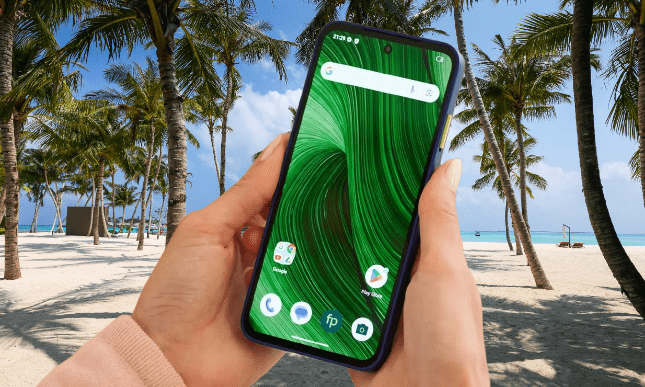
That Cobalt Blue name isn’t random, according to Fairphone. It’s a nod to the brand’s origins as a campaign against conflict minerals in consumer electronics, and to Fairphone’s role as a co-founder of the Fair Cobalt Alliance. The company was also the first electronics manufacturer to introduce Fair Cobalt Credits, paying a fair premium for the cobalt used in its phones based on those credits.
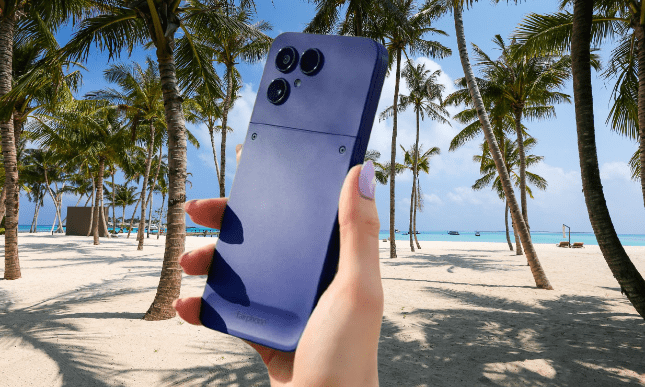
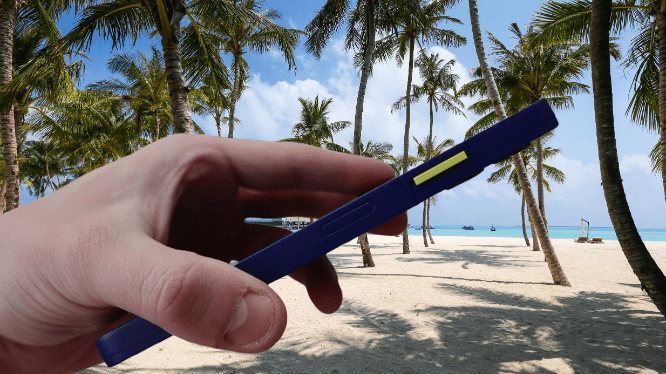
Beyond the meaning behind it, Cobalt Blue also gives the phone a bolder, more distinctive look than most competitors. It’s a deep, rich blue nicely set off by the yellow toggle switch on the right edge. I’m also a fan of the understated camera bump and the exposed screw holes on the back, both signs of just how repairable this phone actually is. Two screws, and the back panel comes right off.
You may also like: Nothing Phone 4(b) Review: Budget Phone With Real Flair
That repairability is really the whole point of this phone. Fairphone sells spare parts covering nearly everything, the USB-C port, camera modules, loudspeaker, rear covers, earpiece, battery, screen, and the SIM/SD combo tray.
The matte finish on the Fairphone 6 Plus picks up fingerprints fairly easily, but it feels good in hand overall, with a grippy texture and a compact frame that doesn’t feel bulky. There’s barely any camera bump either, so the phone sits nearly flush on a table without wobbling, a small detail that’s genuinely nice to have. The plastic build means it doesn’t feel quite as premium as some rivals, but it holds up fine day to day.
Flat edges keep this phone in line with what most flagships are doing this year, now that curved edges have largely fallen out of fashion again. The bezels around the screen run a bit thick at the top and bottom, though.
Ports along the bottom are standard: a USB-C port and a pop-out SIM tray that doubles as a microSD slot, a nice touch for expandable storage. Buttons sit where you’d expect on the right side, a volume rocker and power button, plus a dedicated toggle switch for the Essentials software mode.
IP55 dust and splash resistance is a reasonable tradeoff given how repairable this phone is designed to be. You can find phones rated IP68 for tougher protection, but they typically give up the easy part-swapping that makes a Fairphone what it is.
Fairphone 6 Plus Screen
Fairphone left the screen untouched from the previous generation, sticking with a 6.31-inch OLED panel running at 120Hz and a sharp 1116×2484 resolution, which delivers good detail on a smaller display.
It’s not as large as what you’ll find on some similarly priced phones, but that doesn’t bother me. There’s still plenty of screen real estate for most everyday use, and honestly, it’s been refreshing to carry a smaller phone as my daily driver for once.
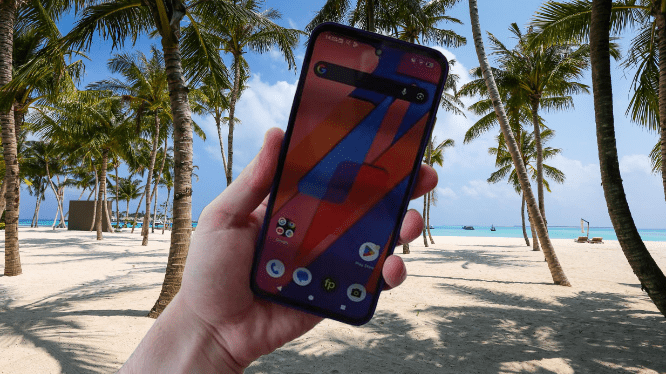
Fairphone rates peak brightness at up to 1400 nits, which keeps the screen readable both indoors and out. During testing through some genuinely sunny weather, that peak brightness held up well, though other phones on the market do get brighter still.
You may also like: Infinix Note 60 Ultra Review: Pininfarina Design on a Budget
That 120Hz refresh rate adds a real sense of smoothness, especially coming from a standard 60Hz screen or something only slightly higher. It’s also an LTPO panel, meaning the refresh rate adjusts dynamically based on what’s on screen, ranging anywhere from 10Hz up to 120Hz.
The fingerprint sensor skips the screen entirely and lives on the power button instead. I actually prefer this placement given how I typically hold my phone, and enrolling a finger or unlocking quickly feels simple and reliable.
Fairphone 6 Plus Cameras
The camera setup on the Fairphone 6 Plus hasn’t changed from the standard Gen 6, which is a little disappointing given this is meant to be the upgraded version. You’re still looking at a 50MP main sensor at f/1.88 with a 1/1.56-inch size, paired with a 13MP f/2.2 ultrawide.
Shots from the main camera look decent enough, with good dynamic range and colors that come through nicely punchy. Detail holds up reasonably well too, though zoom in and you’ll spot some softness creeping in. Overall, it feels more like a budget camera setup than something you’d expect from a mid-range phone.
The 13MP ultrawide actually comes out with punchier colors than the main sensor, somewhat surprisingly, and detail stays mostly solid. Zoom into the corners, though, and things get noticeably fuzzier.
Low-light shots are fine, if a bit underwhelming for what you’re paying. Noise shows up in places, and images tend to come out slightly soft.
You may also like: Xiaomi 17T Pro Review: Big Battery, Familiar Design
The real weak point is the missing telephoto lens. Push past a basic 2x or 3x zoom and detail falls off fast. I took several shots of pub signs around, and anything beyond the recommended 2x zoom looked rough; the digital crop just can’t compete with proper optical zoom. A dedicated telephoto lens would have solved this and given the camera a lot more range to work with.
Selfies come out fine from the 32MP front camera, with rich, pleasant color tones. Video maxes out at 1080p/60fps or 4K/30fps across the board, which does the job without standing out in any way.
Fairphone 6 Plus Performance
The real upgrade on the Fairphone 6 Plus happens under the hood, with a move to Qualcomm’s Snapdragon 7s Gen 4 chip and a bump to 12GB of RAM. That’s a step up from the Gen 3 chip in the standard model, and a third more memory than the 8GB the older phone shipped with.
Even with that upgrade, the higher price tag pushes this phone into upper-mid-range territory rather than the more budget-friendly space Fairphone has typically occupied.
Single-core performance held up fine in my testing. Where things slow down is heavier multi-threaded work, where the Fairphone 6 Plus falls behind beefier mid-rangers like the Xiaomi 17T or the Honor 600, the latter running the Snapdragon 7 Gen 4, which honestly feels like it might have suited this phone better.
Overall performance lands closer to phones costing roughly half as much, like the Nothing Phone 4b, and it actually trails the Xiaomi Redmi Note 15 4G in benchmarks.
You may also like: Motorola Razr 70 Review: Price, Performance and Verdict
Day-to-day, though, things feel better than the numbers suggest. Navigating the OS, streaming music or video, and scrolling through social media all felt smooth and responsive in my regular use.
Storage starts at 256GB of UFS 3.1 out of the box, and a microSD slot lets you expand that up to 1TB if needed. Just be ready to pay a premium for microSD cards right now, given where flash storage pricing currently sits.
Gaming performance holds up fine for casual titles like COD Mobile or PUBG, as long as you’re willing to dial back some graphics settings for smoother frame rates. That said, this is one of the few phones where I couldn’t even get the 3DMark benchmark suite to run properly. It wasn’t locked out or anything; it just kept erroring out repeatedly.
Under sustained heavy load, the phone does warm up noticeably, though never to a point where I felt the need to set it down. The cooling setup inside the Fairphone 6 Plus seems to manage heat reasonably well overall.
Fairphone 6 Plus Software & AI
Software-wise, the Fairphone 6 Plus runs a clean, refreshingly simple version of Android 16. It feels a lot like Google’s own Pixel launcher, no bloat, straightforward to navigate, with Fairphone adding its own touches on top.
That touch shows up mainly as a pleasant green default color scheme and quick access to the My Fairphone app sitting in the bottom row. Everything else lives in the app drawer, Pixel-style. The My Fairphone app itself lets you check device health, browse spare parts and accessories, and pull up video tutorials.
There’s a social side to it too, with access to the Fairphone community forum and a Stories section built in.
One other Fairphone-specific app worth mentioning is the Gallery app, which now lets you store photos and videos locally without leaning on a third-party service, a genuinely nice bit of control over your own images.
I really like the slider switch on the right side of the phone, which reminded me of the old notification slider OnePlus phones used to have.
By default, that slider flips the phone into an “Essentials” mode, stripping the interface down to just apps like Camera, Phone, and Maps. It essentially turns the phone into something closer to a Light Phone if you are after a digital detox, and switching back to the full Android experience takes seconds whenever you want it.
You may also like: Motorola Signature Review: A Flagship Done Right
Google’s newer AI features are here too, including Circle to Search and Gemini as the built-in assistant.
Fairphone is committing to software support through 2033 on this phone, which works out to six years of Android updates, backed by a five-year warranty.
Fairphone 6 Plus Battery Life
Battery capacity stays at 4415mAh, unchanged from the standard Gen 6, and that was enough to get me through a day or two of normal multitasking and typical daily use.
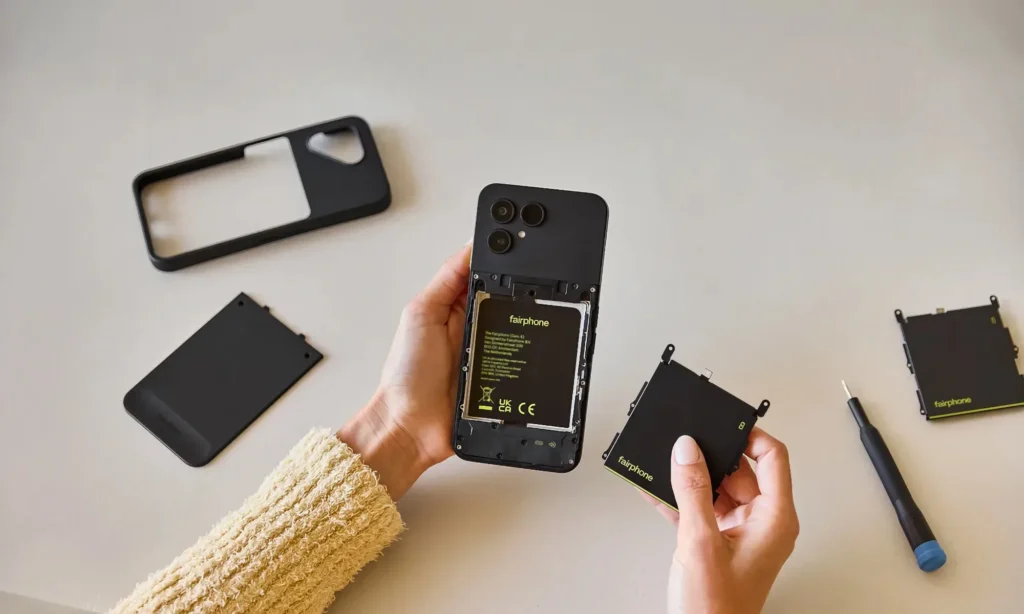
That’s a smaller cell than plenty of rivals at this price offer, but it comes with a real advantage: it’s easily replaceable, same as most other components on this phone.
In terms of screen-on time, I got somewhere between five and six hours out of it while scrolling social media, streaming music through Tidal and Plexamp, snapping photos out and about, and occasionally using Google Docs for work.
For a more controlled test, running PCMark’s Work V3.0 battery benchmark at 50% brightness returned around 15 and a half hours, a solid result.
You may also like: Nothing Phone 4a Pro Review: Worth Buying in 2026?
Charging tops out at 30W wired, getting the phone to 50% in about 33 minutes with a compatible fast charger, and a full charge in roughly 75 minutes. There’s no wireless charging here, though that’s still fairly uncommon in the mid-range space overall.
Fairphone 6 Plus Verdict
The Fairphone 6 Plus puts repairability above raw performance, and it backs that priority up with a display that’s genuinely sharp and bright, plus battery life that holds its own. The new Snapdragon 7s Gen 4 chip is a real improvement over what came before, though it still falls short of several mid-range phones at similar prices. The camera setup suffers too, mainly from skipping a telephoto lens entirely.
Pros |
Cons |
| Funky new colourway | Meagre camera system |
| Good battery life | Underpowered for the price |
| Easily repairable | A fair chunk than its predecessor |
Final Thoughts
The Fairphone 6 Plus leads with repairability first, performance second. It backs up that screwdriver-friendly design with a genuinely sharp, bright OLED display and good battery life. The Snapdragon 7s Gen 4 chip inside marks a real step up from its predecessor, though it still falls behind several mid-rangers at a similar price, and the camera setup suffers from the missing telephoto lens.
Stack it against the Honor 600, which runs the punchier Snapdragon 7 Gen 4, and the 6 Plus can’t keep up on raw power. Overall performance actually lands closer to budget phones like the Nothing Phone 4(b) than true mid-range competitors, despite costing more than either one. It even loses out to the considerably cheaper Xiaomi Redmi Note 15 4G, which makes the asking price a tougher sell.
Where it wins ground is everywhere else. A clean, bloat-free take on Android, a genuinely handy Essentials toggle, and six years of software support backed by a five-year warranty all count for a lot.
This isn’t the phone to buy if raw performance is your priority, but for anyone who wants a phone built to be repaired and kept for years rather than replaced, it’s one of the few actually doing that right.