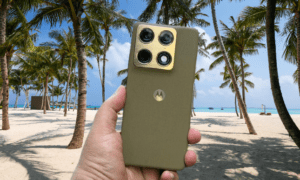

The Motorola Razr 70 is not the flashiest foldable you can buy right now, but it makes a case for itself on price alone. At £799.99 in the UK and €899.99 in Europe, it comes in $250 cheaper than the Samsung Galaxy Z Flip 7.
It even undercuts the £849 Samsung Galaxy Z Flip 7 FE. In the US, the same phone sells as the Motorola Razr 2026 at $799.99.
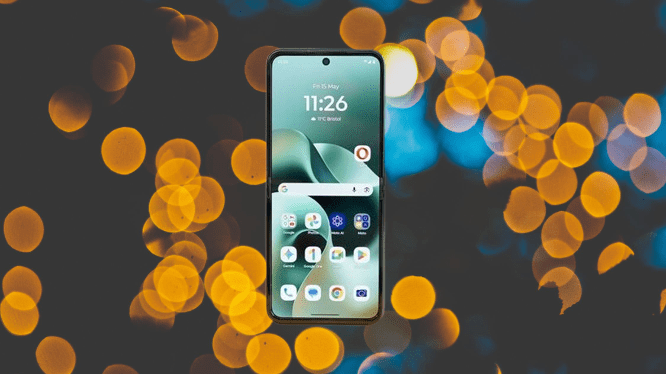
Hitting that price point in 2026 is not easy. Margins across the smartphone market are tight, and something has to give when a company pushes costs aggressively.
With the Razr 70, the tradeoffs are noticeable. Put it side by side with its predecessor, the Razr 60, and the generational jump is not obvious. Whether that matters depends on what you are coming from and what you actually need the phone to do.
Motorola Razr 70 Full Specs
Motorola Razr 70 Design
If there is one area where Motorola consistently delivers, it is color and finish options. That matters here because without them, differentiating the Razr 70 from the Razr 60 would be a real challenge.
You may also like: Moto Razr 2026 Swarovski Edition Leak: What Changed
The dimensions are identical at 171.3 x 74 x 7.3mm when open, and the weight is exactly the same at 188g. It folds down to a compact size that fits comfortably in a pocket, which remains one of the strongest practical arguments for the flip form factor.
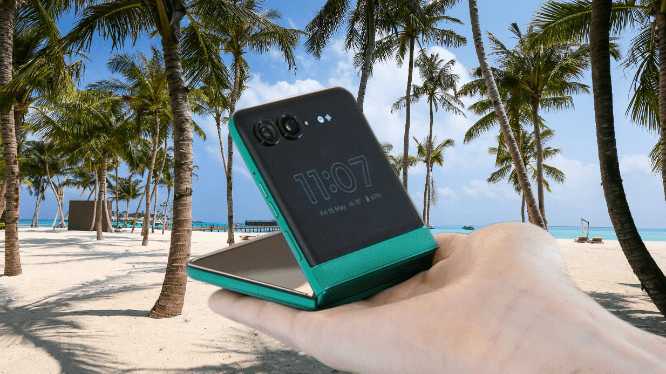
Compared to the Samsung Galaxy Z Flip 7 FE, its closest competitor, the Razr 70, is slightly larger but lands at roughly the same weight.
You may also like: Samsung Galaxy S26 FE: Specs, Chip and Release Date
On colors, you get three choices. Pantone Hematite comes with a woven texture on the back. Pantone Sporting Green uses what Motorola calls a soft luxe finish, and the review unit in this finish has a slight turquoise tint with a diamond ridge texture on the plastic back.
The third option is Pantone Bright White with an acetate finish. All three feel considered rather than generic, which goes a long way when the hardware itself has not changed much from the previous generation.
It does not quite match the visual sharpness of Samsung’s flip phone design, but it is more comfortable to hold and easier to use day to day. The textured back gives you a more secure grip, and the rounded edges make flipping the phone open a natural, one-handed motion.
You may also like: Samsung Galaxy Z Flip 8: Price, Specs, and Release Date Leaks
The titanium hinge is not stiff, but it stays open at any angle between 60 and 120 degrees when resting on a flat surface, which is useful for hands-free situations. Dust and water resistance sit at IP48, matching the Samsung Galaxy Z Flip 7 FE.
The lower dust rating comes down to the hinge itself. Mechanical hinges are a known weak point for flip foldables, and fully sealing them against fine particles remains an unsolved problem across the category.
The fingerprint sensor sits behind the power button on the right edge. It is fast, consistent, and easy to reach whether the phone is open or closed.
You may also like: Motorola Edge 70 Pro+ Coming with Periscope Camera
One issue that carries over from previous Motorola flip phones is the NFC placement. The antenna sits in the lower half of the device, which means you essentially need to keep the phone folded when tapping to pay. Samsung handles this better, and it is a small but recurring frustration that Motorola has not addressed.
Motorola Razr 70 Screen
For the third generation in a row, Motorola has carried over the same display setup on the Razr. That tells you two things. First, the company has not pushed forward here. Second, component costs are clearly influencing decisions across the board for manufacturers right now.
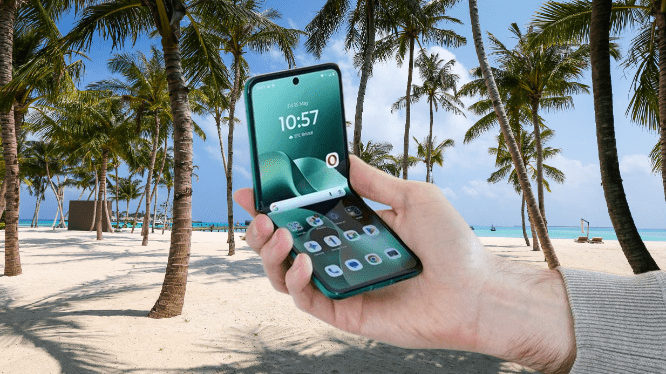
That said, these screens still hold up well and actually outperform their Samsung Galaxy Z Flip 7 FE counterparts across the main display metrics.
The internal screen measures 6.9 inches, runs at FHD+ resolution (2,640 x 1,080), and refreshes at 120Hz. Peak brightness hits 3,000 nits, which handles direct sunlight reasonably well.
The plastic screen protector, which cannot be removed, does attract smudges and can dull the clarity slightly, a trade-off that comes with the foldable form factor regardless of brand.
You may also like: Samsung Galaxy Z Fold 8 Display Upgrade: 20% Crease Reduction With Dual UTG Technology
The crease at the fold is still there and still noticeable. Motorola has not made meaningful progress on reducing it. When the screen is full of content, it fades into the background, but it is hard to miss on plain or static backgrounds. It is not a dealbreaker, but it is also not something you stop noticing entirely.
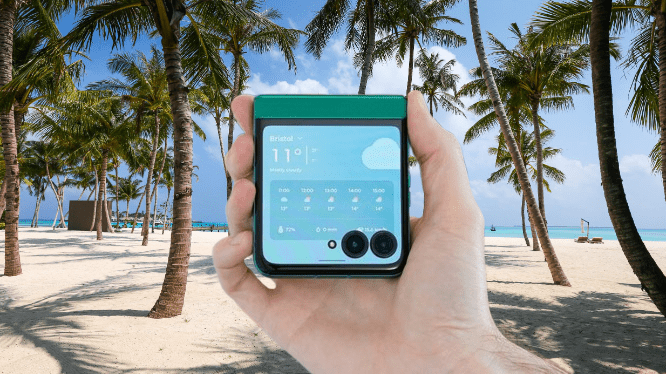
The external display is a 3.63-inch OLED running at 1066 x 1056 resolution with a 90Hz refresh rate. It beats the Samsung Galaxy Z Flip 7 FE’s cover screen on nearly every spec, though it falls short on brightness at 1,700 nits compared to Samsung’s offering.
In practical use, the Razr 70’s cover screen is noticeably more usable than its rival’s. It is larger, sharper, and more consistent across the panel. You can type out a short message on the virtual keyboard without opening the phone, and while that is not something you would want to do regularly, it works well enough in a pinch.
You may also like: Motorola Signature 27 Debuts With 200MP Camera and AI
Motorola’s software also allows more app types to run on the external display, though functionality is still limited compared to the full open-phone experience.
Motorola Razr 70 Camera
The main camera on the Razr 70 is unchanged from previous generations. Motorola has kept the same 50MP sensor with a 1/1.95-inch size and f/1.7 aperture that appeared on both the Razr 60 and Razr 50. That is a straight carry-over with no meaningful upgrade.
It is a disappointing call. This sensor was not particularly impressive on earlier models, and it still shows the same limitations here. For a phone at this price, the output lacks the sharpness and contrast you get from non-foldable competitors in the same range. It also trails the Galaxy Z Flip 7 FE’s main camera in real-world results.
Indoor photography is where the cracks show most clearly. Images come out noticeably soft, and the camera struggles when strong light sources are in the frame. Whether that comes down to the lens itself or the image processing is hard to say, but the result is the same.
A window letting in daylight can wash out a significant portion of the shot, which is the kind of basic situation a camera at this price point should handle more reliably.
You may also like: Samsung Galaxy Z TriFold US Release Date: $2,899 Price, January 30 Launch Date
Low light performance follows the same pattern. Night shots carry visible grain and a general murkiness that is passable but below what you would expect from a phone in this price range, especially if you are used to what traditional smartphones deliver at $800.
Zoom is another weak spot. Without a dedicated telephoto lens, the camera crops into the main sensor, and the quality drops fast. Detail falls off noticeably at 2x, and by 4x and 10x, the images take on a soft, bloomy quality that makes the lack of optical zoom very apparent.
The ultra-wide is where Motorola has made a genuine improvement. The new 1/2.76-inch 50MP sensor replaces the older 1/3.0-inch 13MP unit from previous models, and the difference is real. Last year’s ultra-wide produced a significant drop in quality compared to the main camera.
The new one still sits below the main sensor in terms of color warmth and dynamic range, but the detail gap is much smaller than before.
You may also like: Motorola Edge 70 Max Leak: Specs Reveal Bigger Ambitions Keywords
The 32MP front camera produces decent selfies, but the more useful option is to flip the phone around and use the main camera instead. The camera app detects your face automatically and turns the cover screen into a live viewfinder.
The results are better than what most flagship non-foldables can offer for self-portraits. You can also set it to shoot when you smile or trigger a timer by holding up your palm, and both features work consistently.
One new addition to the camera software is Frame Match. The idea is that you set up your shot first, positioning the frame exactly how you want it, then hand the phone to someone else to take the photo while you step into the scene. They line up the live view with the ghost image overlay and tap the shutter.
It is a thoughtful feature in principle. In practice, it raises an obvious question. If the person taking your photo lacks the instinct to frame a decent shot on their own, will they follow a ghost image overlay any more successfully? The real-world usefulness depends entirely on who is holding the phone, which limits how often this feature will actually get used.
Motorola Razr 70 Performance
The Razr 70 runs on a MediaTek Dimensity 7450X, which is a small step up from the Dimensity 7400X in the Razr 60. The CPU and GPU configurations are identical between the two chips. The main differences are a minor bump in AI processing capability and an updated 5G modem, which is a thin justification for a new model number.
Paired with 8GB of RAM, the real-world performance gap between the Razr 70 and its predecessor is minimal. Geekbench 6 results show roughly an 8% improvement in CPU multi-core scores, though it is worth noting these tests were run about a year apart, so software and driver updates likely account for some of that difference.
You may also like: Samsung One UI 8.5 Beta Hits Galaxy Z Fold 7 Now
For context, the Samsung Galaxy Z Flip 7 FE scored 78% higher in the same benchmark. That is a substantial gap, and at $800, mid-range performance is a harder sell when the competition at a similar price delivers significantly more headroom.
Day-to-day use feels smooth enough for standard tasks, and 256GB of storage gives you plenty of room for apps and media. Gaming is possible but limited. Destiny Rising, for example, runs only at medium graphics settings and is locked to the standard frame rate mode.
The 3DMark Wild Life Extreme test failed to run during this review, so direct GPU comparisons are not available. Based on previous experience with the Razr 60, though, it is reasonable to expect the Razr 70 to fall behind the Flip 7 FE in graphics performance as well.
Motorola Razr 70 Software and AI
The Razr 70 ships with Android 16, and Motorola keeps its own additions relatively restrained compared to some manufacturers. That said, it is no longer the near-stock Android experience the company was once known for.
The Moto app remains a genuine highlight. It pulls all of Motorola’s custom features into one place and presents them clearly, which makes finding and enabling shortcuts simple. The gesture-based controls are among the best available on any Android phone right now.
You may also like: Moto Buds 2 Plus Leak Shows Redesigned Case and Bose Partnership
The bloatware situation is a different story. The home screen arrives loaded with pre-installed third-party apps, including LinkedIn, Amazon Music, Facebook, Instagram, Disney+, and Prime Video. Opera sits alongside Google Chrome for no clear reason. There is also a folder of low-quality games that nobody asked for.
On the AI side, Motorola has taken a quantity-over-quality approach. Perplexity and Microsoft Copilot both come pre-installed, and Google Gemini is there too, giving you three separate AI assistants out of the box. Having options is fine, but three competing AI tools on a fresh install feel more like a cluttered mess than a considered feature set.
Then there is Moto AI, Motorola’s own suite that pulls from various third-party tools to offer things like note transcription and contextual screenshots. So in total, you have four AI options on a single phone.
Motorola would likely argue that each one serves a different purpose. In practice, the overlap is hard to ignore. Three of the four were perfectly capable of generating an image of a newt in a sombrero reading a book when asked, which gives you a sense of how distinct these tools actually are from each other.
Software support is another area where the Razr 70 comes up short. You get three major Android OS upgrades and four years of security updates. Compare that to the Samsung Galaxy Z Flip 7 FE, which promises seven years of both, and the gap is significant.
For a phone you are expected to keep for several years, that difference in long-term support is worth factoring into your decision.
Motorola Razr 70 Battery Life
Despite carrying over the same dimensions and weight, Motorola has managed to fit a larger battery into the Razr 70. The cell sits at 4,800mAh, which is modest by non-foldable standards but significantly larger than the 4,000mAh battery in the Samsung Galaxy Z Flip 7 FE.
In daily use, it holds up well. A light to moderate work-from-home day, around two and a half hours of screen time with roughly 30 minutes of gaming mixed in, left the phone at about 40% by the end of the day.
Gaming is about as demanding as it gets for battery draw, so that result is encouraging. The overall experience is good and dependable rather than impressive, but for most users, that is exactly what you need.
You may also like: Motorola Signature Review: A Flagship Done Right
Wired charging tops out at 30W. In testing with a Samsung 65W charger, the phone reached 67% in around 30 minutes, with a full charge taking just over 50 minutes.
That is a useful detail because it means you are not locked into using a Motorola charger to hit full speeds. That flexibility matters given that no charger comes in the box. Wireless charging is available at 15W for those who prefer it.
Motorola Razr 70 Verdict
The Razr 70 is a clean, well-built flip phone that keeps the price accessible. The problem is that it barely moves the needle from the Razr 60, and the mid-range performance and camera limitations are hard to overlook at this price point.
Pros |
Cons |
| Good price | Iffy cameras |
| Appealing, tactile design | Poor performance |
| Good quality screens | Unfocused AI and limited software support |
Final Thoughts
Motorola has not gone quite as far as releasing an identical phone twice, the way Google effectively did with the Pixel 10a, but the Razr 70 comes close. The design, performance, and camera setup are all carried over from the Razr 60 with minimal change. Depending on what you care about, that cuts both ways.
The positive side is real. The Razr 70 is the most affordable foldable you can buy right now, and it backs that price up with a genuinely nice build, a textured finish that feels good in hand, and display quality that holds up well against direct competitors.
The drawbacks are just as real. Performance and camera output sit firmly in mid-range territory, which is a noticeable compromise at $800. The Samsung Galaxy Z Flip 7 FE sits in the same position. Both phones are cheaper than flagship foldables, but neither one feels like a strong value proposition when you weigh up what you are actually getting for the money.