
The JBL Go series has built a reputation on doing a lot with a little. Compact, tough, and consistently better than you’d expect for the price. The Go 5 is the newest version, and it brings a few notable additions: a reshaped body, an ambient edge light, lossless USB-C audio, and a tap-to-pair feature JBL calls AirTouch.
That said, this isn’t a complete overhaul. The driver is still 45mm, the same size as the Go 4. The IP68 water and dust resistance carries over unchanged. So does the $54.95 price, which has held steady since the Go 3.
The real additions are in how you use it. AirTouch lets you pair two Go 5 units into a stereo setup by tapping them together. Bluetooth 6.0 with Auracast support also lets you connect more speakers for a wider soundstage.
Anyone who has used a Go before knows how limited a single unit sounds at this size. Mono playback at 45mm gets you only so far. The bigger question here is whether a stereo pair solves that problem in a meaningful way, and whether the Go 5 still makes sense as a purchase when JBL’s own Clip 5 sits just above it in price and capability.
JBL Go 5 Full Specs
JBL Go 5 Design
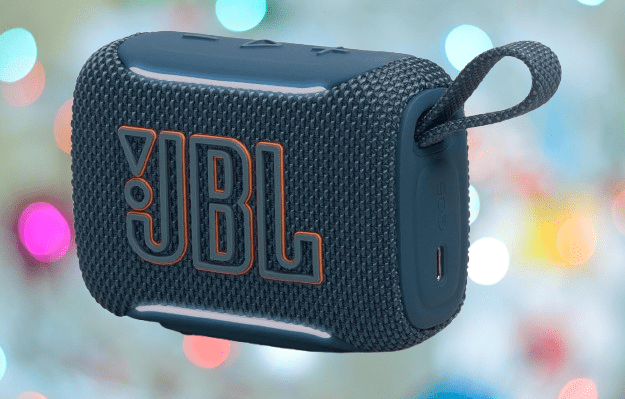
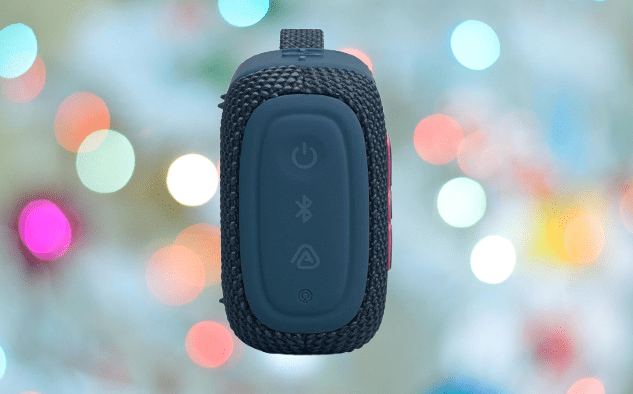
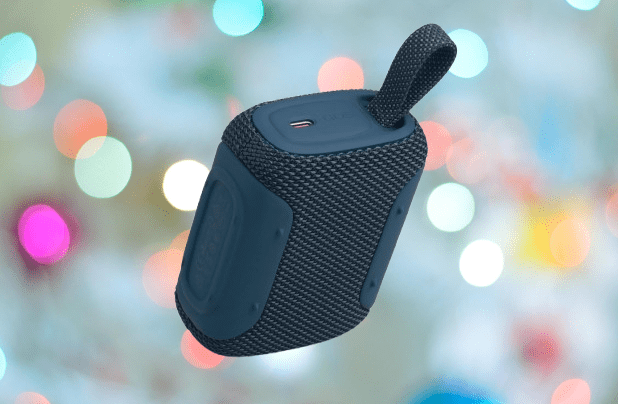
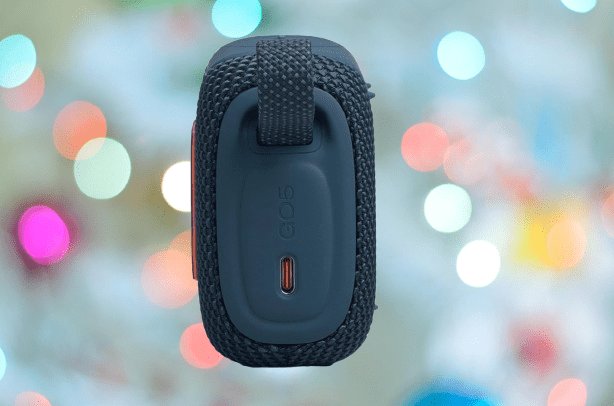
Pick up the Go 5, and you’ll recognize it immediately. Fabric grille, thick plastic body, JBL logo front and center, loop strap on the side. It’s clearly a Go. But look closer, and the shape is different. The corners are rounder, the strap is wider and made from softer TPE material, and the side panel sits more comfortably in your hand.
The size hasn’t changed much. At 230g and roughly 101 x 77 x 43mm, it fits in a coat pocket without issue. It feels solid when you hold it, not hollow or cheap. The IP68 rating means water isn’t a concern. Sink, puddle, paddling pool, it handles all of it.
JBL also claims some drop resistance now, and while there’s no official spec behind that, the speaker survived a few accidental falls onto a hard kitchen floor without any visible damage or audio problems.
You may also like: Denon Home 2.0 Series: Dolby Atmos Speakers Tested
The most visible new addition is the edge lighting. A thin LED strip runs along the top and bottom of the grille, and it pulses through a few preset patterns, Bounce, Loop, and Switch, which you select through the JBL Portable app.
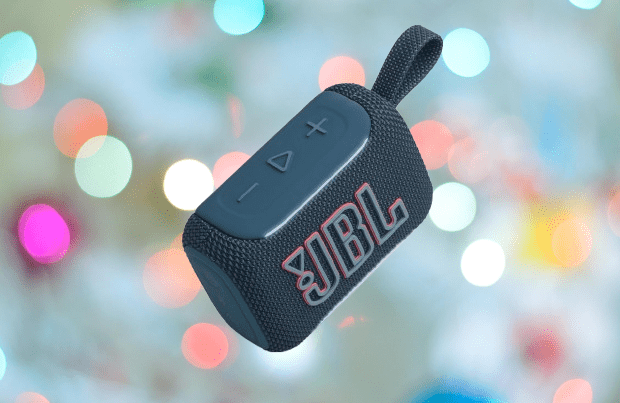
It also serves a practical purpose. The light changes to signal what the speaker is doing, whether that’s powering on, pairing, running low on battery, or entering Auracast mode. If you don’t want any of it, you can turn it off completely, which is the right call for anyone who finds status lights more annoying than useful.
JBL put some thought into materials this time. The fabric grille is made from fully recycled fabric, the plastic body uses 80 percent recycled plastic, and even the magnet contains recycled material.
JBL Go 5 Features
AirTouch is the feature JBL wants you to notice first. Press two Go 5 units together, give them a quick tap, and they pair automatically into a stereo setup. One takes the left channel, the other takes the right. No app required, no settings to adjust. You hear a chime, see a flash of light, and it’s done. It works exactly as described.
Auracast adds another layer to this. If your source device supports Auracast, the Go 5 can join a shared audio broadcast alongside other compatible JBL speakers, including the Charge 6, Flip 7, Xtreme 5, and Pulse 6.
The idea is that you’re not locked into a proprietary system, and in theory, speakers from other brands could join the same broadcast, too. In practice, multi-brand Auracast is still more of a future promise than a current reality. For now, multi-JBL is the realistic use case.
You may also like: The Sonos Era 300 Is $379 Right Now, and That $100 Discount Makes It Worth Buying
Day-to-day reliability held up well. When you power the two speakers back on after a previous pairing, they find each other without any input from you. Switching between solo and stereo mode takes one tap.
Bluetooth 6.0 kept a stable connection throughout a flat with doors closed, and swapping audio playback between a phone and laptop through the JBL Portable app was simple and quick.
USB-C audio is one of the more surprising additions at this price point, though it requires a specific setup to activate. With the speaker on, hold the Play button while plugging in a USB-C cable.
You may also like: JBL Quantum 120: $50 Headset With Flagship Drivers
A confirmation tone tells you the direct digital connection is active. From that point, lossless audio from supported apps plays through the speaker without going through Bluetooth at all. You won’t find that on many speakers for under $60.
The JBL Portable app covers the remaining settings. Inside, you get three LED light themes, a Playtime Boost mode, firmware updates, and access to the Party Together multi-speaker grid. There’s also a 7-band custom EQ, though that gets disabled when you’re running two Go 5 units in stereo mode.
The app isn’t particularly deep, but it’s clean, stable, and does what it needs to do without getting in the way. One extra: the Go 5 works with JBL’s EasySing Mic Mini, which turns it into a basic karaoke setup. That accessory is sold separately, and availability varies by region, so it’s more of a bonus feature than a core selling point.
JBL Go 5 Sound Quality
The Go 5 is not a party speaker, and JBL hasn’t tried to make it one. Instead, the tuning focuses on sounding musical rather than punching above its weight on bass numbers.
The 4.8W amplifier paired with the 45mm driver produces a warm sound. Vocals come through clearly, acoustic guitars sound natural, and the treble stays clean without turning harsh, which is a common problem with small speakers at this price.
You may also like: Echo Dot 5th Gen Drops to $39.99: Is It Worth Buying Now?
The frequency response runs from 100Hz to 19kHz at -6dB, so deep bass is not something you’ll get here. That said, there’s enough body in the low end to feel the energy on bass-driven tracks. Leftfield’s Pulse is a good example where the bassline still carries weight without falling apart.
On a single unit, volume above 80 percent is where things start to strain. The driver starts to sound compressed, and the speaker noticeably runs out of room.
This is where a second Go 5 makes a real difference. Two units in stereo spread the sound across a wider space and reduce the load on each driver, so both can run more comfortably at a given volume.
You may also like: JBL Cove Speakers Bring Whole-Home Audio to Wi-Fi
USB-C lossless audio does make a difference, though it’s a modest one. Compared to Bluetooth, tracks from Apple Music, Tidal, and Qobuz sound slightly cleaner, with better transient detail and a fuller midrange. It won’t change how you feel about the speaker, but it’s a feature that will matter to listeners who care about audio quality at this price.
As a solo speaker, the Go 5 handles small spaces well. A desk, a kitchen counter, a bathroom shelf. The sound is direct and clear, and the tuning works particularly well for vocals and acoustic music, which come across as open rather than boxed in.
Two units together is where the speaker shows what it’s actually built for. Tapping them together through AirTouch took about two seconds during testing. The result is a noticeably wider soundstage, more presence in the room, and more volume than a single unit can produce on its own.
Set them roughly a meter apart on a surface, and you get a genuine left-right stereo image. It’s most obvious on recordings that use strong stereo separation. Voodoo Child (Slight Return) by Jimi Hendrix is a clear example where the two speakers create a convincing sense of space between the channels.
JBL Go 5 Battery Life
JBL rates the Go 5 at up to eight hours of playback with the edge lighting off, and up to 10 hours with Playtime Boost enabled in the app. Both figures hold up at moderate volume levels. If you run one of the more active LED themes, expect to lose roughly an hour from either estimate.
You may also like: Sennheiser HD 650 Just Dropped to $314.69 in an Amazon Deal Today
Charging from empty takes around three hours via USB-C. There’s no fast charging, and no cable included in the box, which is standard at this price.
When running two units as a stereo pair, battery drain stays roughly the same as it would on a single speaker. Each unit draws at its own rate, so you don’t lose significant playtime by using both together.
There’s no option to charge other devices from the Go 5. That feature exists on JBL’s larger Charge and Xtreme models, but not here. For a speaker this size, though, 10 hours is enough. It covers a long afternoon outside, a day at the beach, or a full weekend of casual listening in the garden without needing a top-up.
JBL Go 5 Verdict
The JBL Go 5 is the smallest speaker in JBL’s current lineup, and it comes with more going on than its size suggests. You get IP68 protection, ambient edge lighting, lossless USB-C audio, and AirTouch, a feature that lets you tap two Go 5 units together and have them automatically set up as a stereo pair.
You may also like: Tribit Stormbox Micro 3 Review: A Worthy Sequel
Battery life reaches up to 10 hours with Playtime Boost turned on, the build feels more refined than previous versions, and the price stays at $54.95. For what you get, it’s one of the more straightforward buying decisions in portable audio right now.
Pros |
Cons |
| Excellent battery life | Ad-riddled OS leaves a sour taste |
| Reasonable price to performance | Much more expensive than its predecessor |
| Vivid, detailed OLED screen |
Final Thoughts
The Go 5 is a small speaker that does exactly what a small speaker should do, and does it well. But AirTouch adds something the Go series has never had before: a clear reason to buy two. Pair them up, and you have a portable stereo system that fits in your pockets.
You may also like: Top 5 Gadget Reviews You Can Trust
Everything else about the package holds up, too. IP68 means you stop thinking about where you place it or whether rain is coming. The use of recycled materials puts it ahead of most competitors under $60. The JBL Portable app is clean and easy to use. And lossless USB-C audio is not something you’d typically find at this price point.
One Go 5 on its own still sounds like a compact mono speaker. There’s nothing wrong with it, but if you’re only buying one unit, the Clip 5 gives you a bit more volume and presence, plus a carabiner clip for attaching it to a bag. At a similar price, it’s the stronger solo option.
If you’re buying two Go 5s, or you already own one and want to add a second, the value proposition changes. The stereo pairing through AirTouch is quick, reliable, and makes a clear difference to how the speaker sounds. As a pair, it becomes a genuinely useful portable stereo setup at a price that’s hard to argue with.
The Go 5 also fits into JBL’s broader Auracast speaker lineup if you ever want to expand further. The Charge 6, Flip 7, and Xtreme 5 all work within the same ecosystem. If you’re still weighing your options, it’s worth checking out a wider roundup of Bluetooth speakers and outdoor speakers before committing.