
Google I/O 2026 kicks off today, May 19, at the Shoreline Amphitheatre in Mountain View, California. CEO Sundar Pichai will lead the keynote, and the event will stream live on Google’s official I/O site and YouTube for anyone who wants to follow along remotely.
This year, the conference leans heavily into artificial intelligence, Android 17, and where Google’s broader ecosystem is heading next. Google I/O has historically been a developer-focused event, but the announcements expected this year reach well beyond that audience.
If you use an Android phone, Google Search, Chrome, Workspace, or any Google smart device, there is a good chance something announced today will show up in your daily experience sooner rather than later.
Google and AI are the main discussion topics at Google I/O 2026
Gemini AI is the central topic at Google I/O 2026. Over the past year, Google has already pushed Gemini into Gmail, Search, Android, and Workspace, but this event is expected to show just how far the company plans to take that integration across its full product lineup.
You may also like: Google Chrome Installs 4GB AI Model Without Your Permission
The announcement drawing the most attention is what comes next for Gemini inside Android 17. Based on reports leading up to the event, Android is moving away from functioning as a traditional operating system.
The direction is toward something more context-aware, a platform that can automate tasks, generate widgets on the fly, handle voice interactions, and step in with help across different apps without you having to ask. That is a meaningful shift in how the OS is designed to work with you day to day.
Google is also expected to pull back the curtain on something called “Gemini Omni,” a model built around advanced video generation and editing. If the reports are accurate, this puts Google in direct competition with OpenAI’s Sora and Adobe’s generative AI tools, two names that have set a high bar in that space.
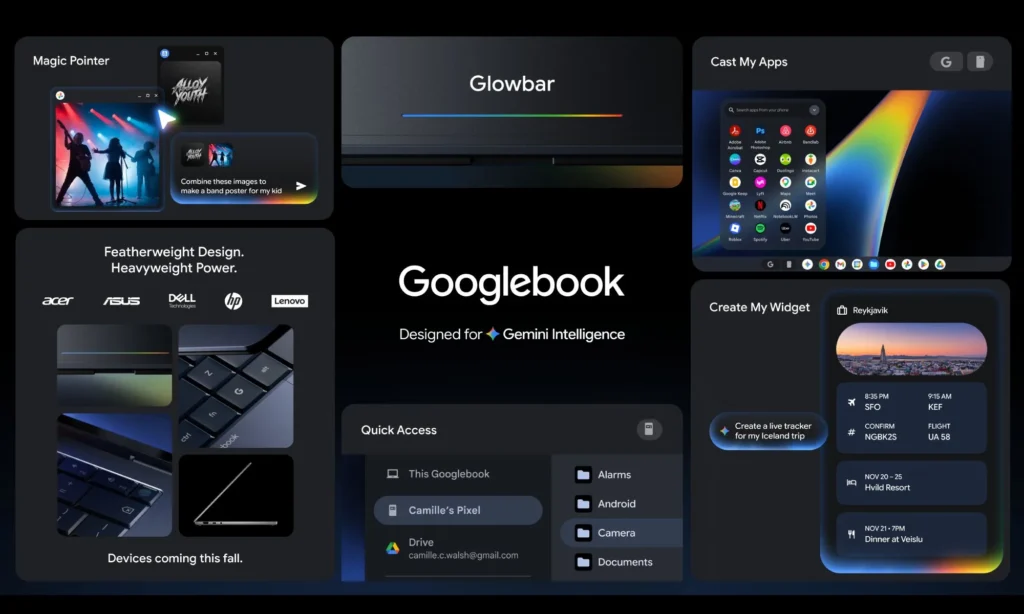
The AI push does not stop at phones. Several reports show Google formally announcing “Googlebook,” a new laptop platform built with AI at its core. The idea is for it to eventually replace Chromebooks, pulling together elements of Android and ChromeOS into a single experience with Gemini deeply built in from the start.
It is positioned less as an incremental update and more as a clean break from how Google has approached laptops up to this point.
Android 17 and XR might be discussed at Google I/O 2026
Android 17 is expected to bring a good round of updates covering personalization, multitasking, and AI-driven features. Leaks ahead of the event have pointed to redesigned widgets, stronger voice input, new digital wellbeing tools, and improvements to Android Auto.
You may also like: Grok Is Coming to CarPlay as AI Assistants Pile In
Google is also likely to give a progress update on Android XR, its platform for augmented and mixed reality. Smart glasses and wearable AI hardware have become a serious focus across the industry, with Meta, Apple, and Samsung all making visible moves in that direction.
Google already offered an early look at Android XR hardware before I/O, and this event could be where the company lays out a clearer picture of where it is taking that technology over the long term.
Google I/O 2026 matters
Google I/O 2026 is arriving at a genuinely pressured moment for the company. The past two years have seen OpenAI, Microsoft, Apple, and Meta all moving fast to shape how people use and think about AI. Google is not behind, but it is no longer the only name in the room.
This event carries more weight than a typical product announcement cycle. The real question Google needs to answer is whether Gemini can become the actual foundation of its products, not just a feature bolted onto things that already exist. That is a different and harder thing to demonstrate.
You may also like: Claude Gets 15 New App Connectors for iPhone and Android
There is also real scrutiny of Google at this conference. AI-generated search summaries have drawn criticism, concerns around misinformation have grown louder, and publishers have raised serious questions about what AI-driven search results mean for the open web. Those are not small issues, and how Google addresses them, or whether it does at all, will be watched closely.
What happens at Google I/O 2026
Google I/O 2026 starts today, May 19, with announcements expected to cover Android, Gemini AI, XR devices, Search, Workspace, and possibly new hardware categories that have not been part of the conversation before.
If the reports leading up to this event hold up, this could be the most significant strategic shift Google has made in years.
The throughline across everything is Gemini, and the picture being painted is one where Android, laptops, search, and productivity tools are all built around it rather than running alongside it.