
Marshall clearly isn’t in a rush to push out new products just to hit a release schedule. Something new does show up every few months, but each release covers different ground, which is evident in how varied its lineup of speakers and headphones has become over the years.
It’s been seven years since the Stockwell II came out, and the Stockwell III arrives with a real list of upgrades that include longer battery life, better repairability, sturdier build quality, an improved IP rating, plus the usual promises around sound and overall performance.
Marshall Stockwell III Full Specs
Marshall Stockwell III Designs
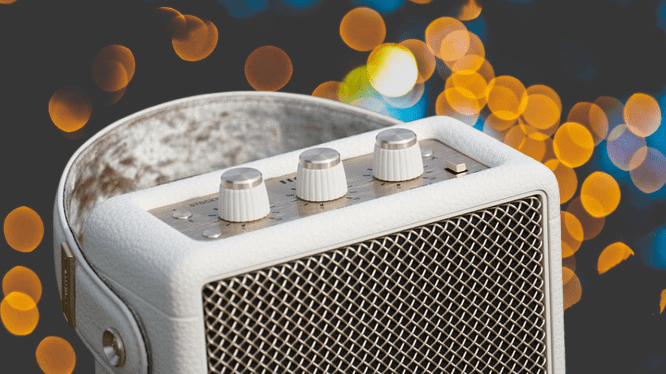
Two colors are available for the Stockwell III: Black and Brass, and Cream. The overall look sticks close to the previous generation, with a handful of tweaks. You still carry it around like a bag thanks to the detachable handle.
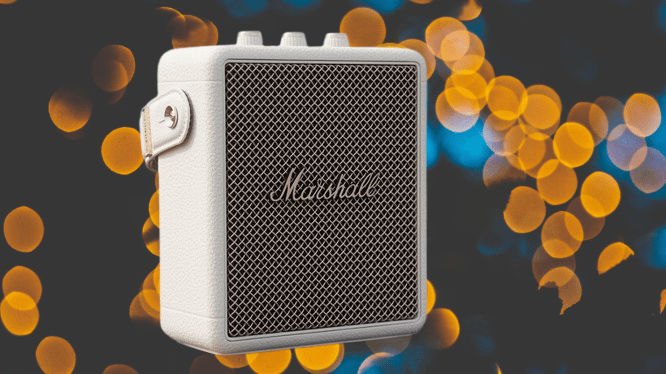
That netted front grille and gold detailing that runs through Marshall’s whole portable speaker range are here too, still one of the things that makes their speakers instantly recognizable. Eco-conscious buyers get something as well; this speaker uses recycled materials in its build.
You may also like: Marshall Woburn III Now $499: Best Bluetooth Speaker for Living Room Audio
Size stays roughly the same as before, though it’s shed a bit of weight, down from 1.4kg to 1.3kg. USB-C and aux inputs remain on the side, just swapped to opposite positions for some reason. The IP rating jumps from IPX4 to IP55, which doesn’t make it fully waterproof since the USB and aux ports stay exposed, but it does handle dust and water intrusion noticeably better than before.
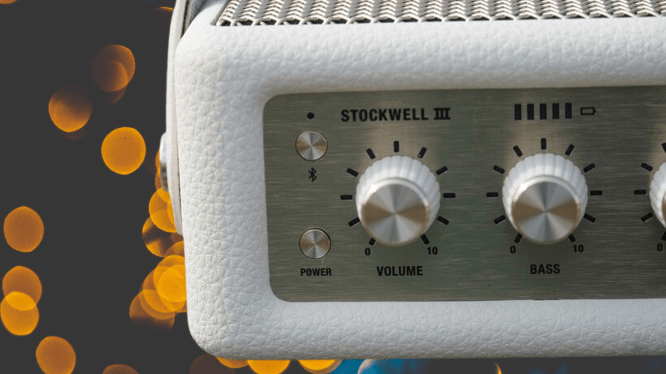
Those improvements show up most clearly in the controls. Power and Bluetooth now get separate dedicated buttons, so you no longer have to twist the volume knob just to turn the speaker on, a small change that simplifies things nicely. There’s also a media jog dial for playback and skipping tracks, along with a customizable M-button.
Marshall Stockwell III Features
Feature-wise, the Stockwell II felt a bit sparse, and the Stockwell III catches up considerably, putting it roughly on par with the Kilburn III.
The Stockwell III comes with Marshall’s True Stereophonic Sound, which claims to deliver consistent audio regardless of where you are sitting relative to the speaker.
Dynamic Loudness aims to keep the sound clear, balanced, and distortion-free no matter what volume you are listening at. Soundstage mode gives you two directions to take things: narrow it for a tighter, punchier sound, or widen it for something airier and more detailed.
Open up the companion app, and the customizable M-button doesn’t offer a huge range of options. You can set it as an EQ shortcut or leave it doing nothing. Choose the EQ route, and you’re picking between Marshall Sound or whatever EQ preset you’ve assigned to the second slot.
You may also like: Marshall Milton ANC: Specs, Battery Life and Price
EQ options themselves include Bass Boost, Mid Boost, Treble Boost, Mid Reduction, and a five-band custom setting if you want full control. If fiddling with EQ isn’t your thing, Placement Compensation offers a shortcut. It’s not automatic like Sonos’ Trueplay, but answering a few quick questions lets it adjust the sound accordingly; you’ll just need to remember to run through it again whenever you move the speaker.
The Stockwell III also supports Auracast, so you can broadcast audio out to another compatible speaker or tune into a stream someone else is already broadcasting.
That USB-C port pulls double duty. It works as a power bank for charging your phone, and similar to what JBL does on the Charge 6, you can also plug a device in directly and route audio through the speaker.
You can even blend sources, running Bluetooth and a wired connection at the same time. To do that, you’ll need to have the Stockwell III in USB-C mode, which also opens it up for watching movies, TV, or even gaming through a wired connection.
Firmware updates come standard, as expected. The Stockwell III supports Bluetooth 5.3 with multipoint for connecting two devices simultaneously; nothing groundbreaking there, though it’s worth noting the streaming codec support actually took a step back. AptX, present on the Stockwell II, is gone here, leaving just SBC and AAC.
That said, Bluetooth performance itself is genuinely strong. Playing audio at full volume and walking from one end of the garden to the other, the connection never dropped or struggled across the distance.
Marshall Stockwell III Battery Life
Marshall claims up to 40+ hours out of the Stockwell III, and figures like that from portable speakers have a habit of not quite matching real-world results; we’ve seen it with JBL recently, and even the Kilburn III fell short of its claimed number in our own testing. So how does the Stockwell III hold up?

It genuinely lasts a long time. Running a shuffled Spotify playlist at 50% volume, the battery sat at 98% after three hours and dropped to 93% after five. Keep that rate of drain going, and 40 hours, maybe even close to 50, seems entirely realistic.
You may also like: Marshall Milton ANC Review: Best On-Ear Headphones Yet?
As mentioned earlier, the USB-C port doubles as a power bank for your phone. A quick 20-minute charge adds a solid seven hours of extra battery when using a 30W USB-C PD charger, and if you don’t already own one, they’re inexpensive and easy to find online.
The bigger shift here is repairability. Marshall now sells replacement batteries directly, meaning this speaker is built to last considerably longer than it otherwise would.
The Marshall Bluetooth app also lets you tweak charging behavior through Battery Preservation, which caps maximum charge level or slows down charging speed to help protect long-term battery health.
Marshall Stockwell III Sound Quality
The Stockwell III sounds like a real jump forward from the Stockwell II. Maybe the older speaker’s sound has just faded a bit with age, but either way, loudness has clearly improved. Getting the Stockwell II up to a comparable volume means cranking it all the way, while the Stockwell III hits that same level at half volume.
Bass output feels stronger on the new model too. Vocals project more clearly, the midrange and treble come through cleaner, more detail surfaces within tracks, and the overall sound feels bigger.
The sharper tone the Stockwell II was known for gives way to something warmer and smoother here, which suits the added bass weight well. It’s not the punchiest low end around, more of a warm, rounded, slightly rich presentation, something I noticed clearly on Katy B’s “On A Mission” and Genesis’ “Justice.”
Bass isn’t one-dimensional either; there’s real variation in how deep and full it sounds depending on the track. It handles the low end in Warren G’s “Regulate” reasonably well, though the character leans more toward richness than raw power. Lows here don’t hit with quite the same punch or energy you’d get from the JBL Charge 6.
You may also like: New JBL Sense Pro and Sense Lite open-ear earbuds
On Hard Life’s “Skeletons,” the bass sounds pleasant enough, but it’s missing some of the power, depth, and energy I was hoping to hear. Adjusting the bass EQ setting shifts things too; it thickens up the midrange and pushes vocals forward, so while bass gets a boost, midrange clarity takes a slight hit in exchange.
Midrange performance is where the Stockwell III really shines, especially with vocals. Smooth, clear, expressive, whether it’s Phoebe Bridgers on “Garden Song,” Chris Cornell on “Black Hole Sun,” or Todd Edwards’ vocal work on Daft Punk’s “Fragments of Time,” vocals come through with real character. Overall detail retrieval takes a small hit from that smoothness, though, so it’s not the most revealing sound out there.
Treble holds up decently, not the sharpest presentation, but capable of a bright performance when needed. That said, the speaker’s overall warmth tends to soften some detail and definition up top, something that became clear listening to GoGo Penguin’s “Ascent.”
The JBL Charge 6 pulls out more detail thanks to its crisper sound signature. Highs feel more precise and defined on the JBL, and bass hits with more punch and energy compared to the weightier, richer approach the Stockwell III takes. The JBL also fills the midrange with more detail than the Marshall manages.
Switching to the USB-C input doesn’t fundamentally change the speaker’s character; it’s still a smooth sound overall, but it does come through clearer, tighter, and more controlled when fed higher-quality audio than Bluetooth typically allows.
That’s a genuinely useful feature to have, especially since the speaker remembers separate volume, bass, and treble settings per source, letting you run different EQ profiles for wired versus wireless listening.
Soundstage mode sounds decent, though your take on it will probably depend on what you’re playing. Turning it on widens the soundstage and adds airiness, but it also thins out the sound and sharpens it; more detailed isn’t necessarily the word I would use. It can actually come across as a little harsh and bright. I generally preferred sticking with the tighter, smoother default setting.
You may also like: Bluesound Pulse Cinema Mini Review: Is It Worth the Price?
True Stereophonic Sound is one I’ve gone back and forth on with Marshall’s outdoor speakers before, and mostly landed unimpressed again here. There’s real depth to the Stockwell III’s soundstage from the front and back, but stand off to the side, and that depth disappears; it just feels like something’s missing from that angle.
One last practical note: volume operates on two levels, the source device and the speaker itself. Crank your phone’s volume all the way up, and the speaker might still sound quieter than expected. To get the Stockwell III’s full volume, you need to turn the dial on the speaker itself, not just rely on your device.
Marshall Stockwell III Verdict
The Marshall Stockwell III steps up its predecessor across the board, with better features, a refined design, and stronger sound, proving it’s got real substance behind the style.
Pros |
Cons |
| Better sound than previous one | Not fully waterproof |
| Improved IP rating and repairability | True Stereophonic Sound isn’t that immersive |
| USB-C audio and extended battery life | JBL Charge 6 sounds better |
Final Thoughts
The portable speaker market hasn’t gotten any less crowded since I reviewed the Stockwell II; if anything, there are more options now than ever. Still, the good ones manage to stand out, and the Stockwell III earns that distinction for a handful of solid reasons.
It looks great, no argument there. It sounds noticeably better than its predecessor too. Day-to-day usability has improved as well, and Marshall clearly leaned into repairability this time, giving the speaker a longer realistic lifespan on top of genuinely longer battery life.
A handful of added features round things out, making this a meaningful upgrade over the Stockwell II. If you’ve been holding off on buying one, this is worth pulling the trigger on.
That said, nothing exists in isolation, and on pure sound quality, the JBL Charge 6 still comes out ahead. It costs less too, and comes with proper waterproofing if that matters to you. It doesn’t pack in as many features as the Marshall, but if sound quality tops your priority list, the JBL is the one I’d point you toward.
None of that takes anything away from the Stockwell III, though. It keeps Marshall’s recent streak of strong outdoor speakers going, delivering plenty of style backed by genuine substance underneath.