
Claude is edging closer to being an AI assistant that handles tasks directly, rather than just walking users through them. Anthropic has expanded Claude’s Gmail integration, and now the AI can reply to, send, and forward emails on a user’s behalf, without needing approval for every single message.
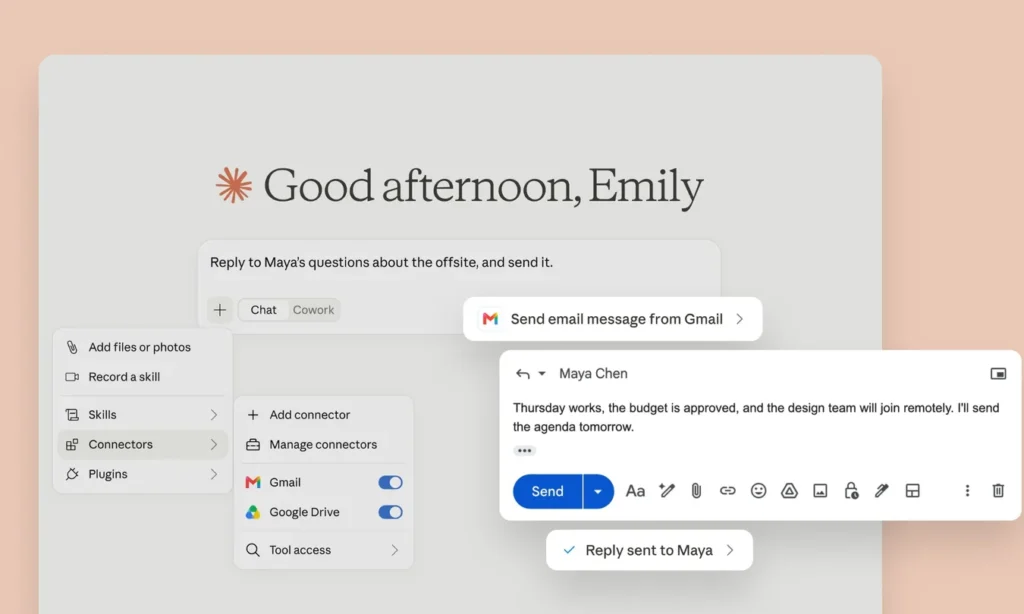
This builds on an existing Claude connector for Google Workspace, which already let users work across Gmail, Google Calendar, and Google Drive. Sending emails independently was the one obvious gap left. That gap closes with this update, though users still decide whether Claude needs permission before hitting send.
Claude Gmail Integration
Ask Claude to respond to an email thread, and it can draft that reply and send it off. The real shift here is that Claude no longer has to pause or wait for manual approval on every outgoing message, as long as the right setting is turned on.
Anthropic says approval still stays on by default. Users decide for themselves whether Claude needs confirmation before sending anything, and Team and Enterprise admins get to set whether their members can skip repeated approval altogether. This feature is limited to paid Claude plans only.
You may also like: Anthropic Launches Claude for Healthcare with Personal Health Data Integration
Claude can also forward emails now, not just reply to them. That pushes the Gmail integration further into acting like an assistant working inside your inbox, rather than something that just summarizes messages or drafts suggested responses for you to review.
That distinction actually matters quite a bit. Writing an email and sending one are fundamentally different things. A chatbot can hand you a perfectly written draft and let you make the final call. An agent that can actually hit send has crossed into taking real action on your behalf.
Claude Gmail Integration and Risk
For anyone drowning in repetitive email, this could genuinely save time. Routine replies, follow-ups, forwarding messages along, these are exactly the kinds of tasks an AI agent can take on without much hand-holding.
Handing an AI the ability to actually send messages raises an obvious concern, though: what happens when Claude gets the context wrong? A poorly worded draft is a quick fix while it’s still sitting in your compose window. A message that’s already gone out is a different problem entirely.
You may also like: Anthropic Brings Claude to MS Word: What It Can Do
Anthropic’s approval setting acts as a safety net here, but choosing to turn that checkpoint off shifts more responsibility onto users, and for workplace accounts, onto the admins managing them.
This update also points toward a broader direction for AI assistants generally. The goal isn’t just answering questions anymore; it’s interacting directly with the tools people already use and getting tasks done inside them.
For now, Claude’s Gmail capabilities stay limited to paid plans, with approval settings that shift depending on the account type. But for users comfortable handing over more autonomy, email could end up being one of the first everyday tasks where AI moves from suggesting what to do to just doing it.