
A great gaming phone takes more than the latest Snapdragon chip. Many flagships post impressive benchmark scores. Keeping demanding games smooth without turning the phone into a pocket warmer is a different challenge.
That is where the RedMagic 12 Pro excels. It pairs Qualcomm’s Snapdragon 8 Elite Extreme Gen 6 with an upgraded dual-loop liquid cooling system and a built-in fan.
The goal is to keep performing long after other phones start to heat up. It also has a notch-free 185Hz AMOLED screen, shoulder triggers, and a huge 8400mAh battery.
The more interesting question is whether you will enjoy using it when you are not gaming. RedMagic has been closing that gap for years. After using the 12 Pro as my main phone, I think this is its most convincing effort yet, though a few familiar compromises remain.
RedMagic 12 Pro Full Specs
RedMagic 12 Pro Design
RedMagic did not change the design much with the 12 Pro, but it is still one of the most visually interesting phones around.
It may be less in-your-face than older RedMagic phones, yet the gaming focus stays front and center.
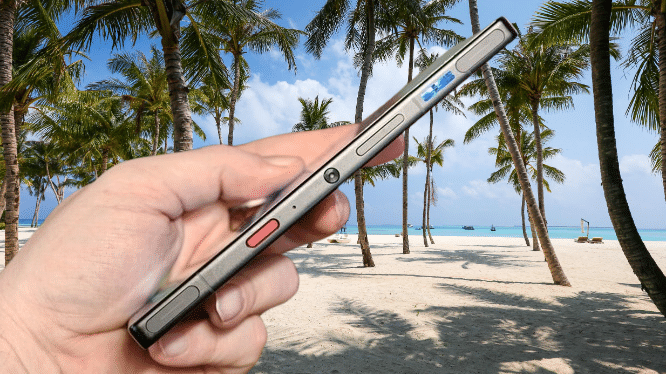
A boosted dual liquid loop system sits on the back, and you can see the liquid move around the battery and chipset housing when the phone is working. The LED micro fan system also returns. It blows air across the internals to maintain performance.
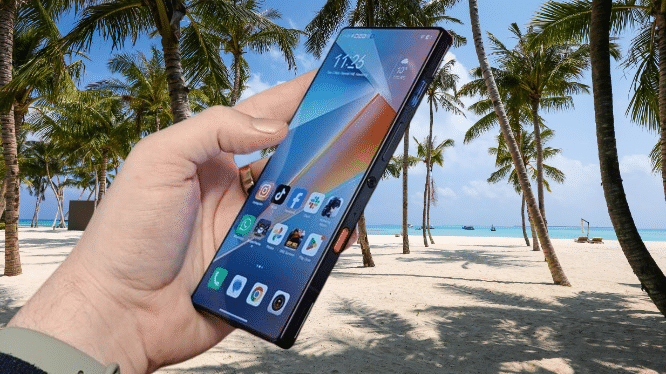
The fan is now rated IPX8, and RedMagic says that gives the phone an overall IP68/69 rating. I am not sure how far I would trust that in practice, because the phone has fairly big vents on both sides for air to pass through.
You may also like: RedMagic Astra 2 Review: Liquid-Cooled Gaming Tablet
RedMagic has toned down the RGB lighting this year. The RedMagic logo no longer lights up. The RGB lights in the triggers are much smaller, and the left side has no LED strips.
How much that matters depends on your taste. The parts that still light up can be fully customized with different patterns and colors for different situations. It is a bit like Google’s Pixel Glow, but actually useful.
The Game Space Switch has changed too. It used to be a physical sliding switch that turned on the built-in Game Space, which I cover a little later. It has been replaced by the Magic Key. The key is still red and still has a rough texture, so you can find it without looking. Now you can customize what it does.
The new button can open Game Space, which it does by default, or it can trigger functions like the torch or the camera. I kept it as my Game Space key because that makes sense on a gaming phone. I like having the option to use it for something else, even if it suggests RedMagic is diluting the gaming-first nature of its gaming phone.
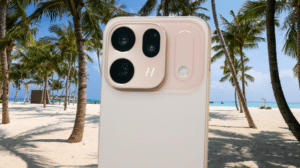
In general, the boxy shape reminds me of older Samsung S Ultra and Note models. The completely flat back is welcome, because there is no camera bump. The phone does not wobble on a desk, though the slippery finish means it can slide around if the surface is not perfectly level.
You may also like: Red Magic 12 Pro+ Launched: 8,400mAh Battery and RGB Cooling
It is still a fairly thick and heavy phone, even though RedMagic has slimmed the frame down over the past few generations.
At 8.6mm thick and 223g, it is not in the same competition with the iPhone Air. It is thinner and lighter than the top-end iPhone 18 Pro Max, which is impressive given how much tech is packed inside.
You can choose Nightfreeze, Subzero, or Skyfrost. All three have the signature transparent back. Despite the slimmer body, the box still includes a plastic cover to keep the phone in good condition. It is a no-frills case, but it does the job in the early days, when third-party cases may be hard to find.
RedMagic 12 Pro Screen
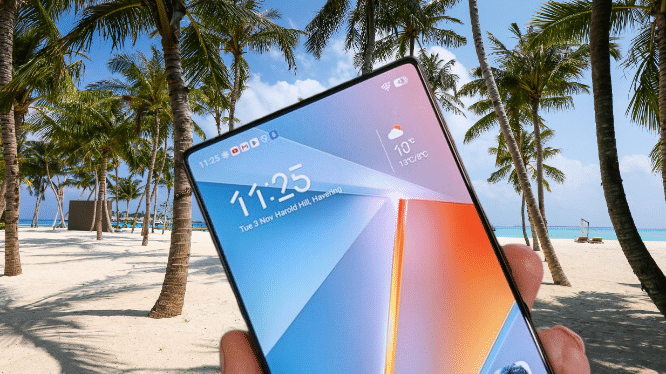
The screen is a key part of the RedMagic 12 Pro’s appeal, and not only for gaming. Very slim bezels frame a spacious 6.85-inch AMOLED display, with no notch or punch-hole interrupting what you watch or play. It is a clean look, and no other phone on the market offers it right now, flagship or not.
There is a selfie camera, but RedMagic hides it well beneath the screen. The iPhone Duo recently took the same approach with its inner foldable screen, yet the camera there is still easy to spot.
On the RedMagic, you have to go hunting for it. In normal use, that patch barely differs from the rest of the AMOLED panel. You only notice it when the screen shows pure black, which looks slightly less black than the surrounding pixels. It is a small detail, but it makes the screen feel more immersive, whether you are gaming or settling in for a film.
You may also like: Google Pixel 11 Pro Review: Great Software, Weak Chip
The jump to 185Hz raises the frame rate ceiling above the 144Hz of its predecessor. How much that matters depends on game support, and few games run at up to 185fps.
Brightness gets a big boost too. The screen is rated for 1,900 nits in high-brightness mode and up to 5,000 nits at its peak. Do not confuse the peak figure with sustained full-screen brightness. Either way, I had no trouble using it outdoors.
Gaming is clearly the priority, but the screen suits Netflix and Prime Video just as well. Widevine L1 certification means you are not stuck with low-resolution streams, and HDR support helps compatible shows and films look their best.
In short, the RedMagic 12 Pro’s display is near-flawless. It is vibrant and pixel-packed, with a fast refresh rate and response rate, and it looks as good in games as it does when you scroll social media. Most people will struggle to find a flaw here.
RedMagic 12 Pro Performance
The RedMagic 12 Pro is built for speed, and its chip shows it. It runs on the Snapdragon 8 Elite Extreme Gen 6, the top version of Qualcomm’s flagship processor. Few phones outside China carry this chip yet, so this phone gives you an early look at what Qualcomm’s hardware can do over the next year. The early results are strong.
Inside, the phone pairs that chip with RedMagic’s own RedCore R5 chip. You can choose 12GB or 16GB of RAM and storage up to 1TB. In testing, this setup produced some of the best numbers we have seen from an Android phone.
Here are the scores:
- Geekbench 7 single-core: 3475
- Geekbench 7 multi-core: 11,563
- Geekbench AI: 7788
- 3DMark Solar Bay: 15,869
Each of the Geekbench results is the highest we have recorded on an Android phone. The Oppo Find X10 Pro Max costs $1,499 and uses MediaTek’s rival Dimensity 9600 Pro chip. The RedMagic beats it by a clear margin.
You may also like: Google Pixel 11 Pro XL Review: Great AI, Weak Gaming Chops
The 3DMark Solar Bay result is also the top score of any phone we have tested this year, which points to strong graphics performance. Apple’s iPhone 18 Pro range, powered by the A20 Pro, has long set the pace in mobile benchmarks.
Very few Android phones get close to it. The RedMagic 12 Pro does, and in a couple of tests it moves ahead.
The RedMagic 12 Pro beats the iPhone 18 Pro and Pro Max in two tests: Geekbench 7 multi-core and Solar Bay. Apple still wins overall. The A20 Pro posts higher single-core and AI scores, and it holds a large lead in Geekbench 6 GPU, 63,688 against 35,200. That part is normal. What stands out is how much the gap has shrunk in other areas.
I think the cooling system explains a lot of that. Actually, it is several systems working together, all built to keep this chip from overheating during play.
Compared to the RedMagic 11S Pro, nothing here is new, but every part has been upgraded. The liquid cooling is now a dual-loop design. It covers both the chipset and the battery, whereas the old version focused only on the battery. The fan spins faster, up to 25,500RPM, and it now has an IPX8 water resistance rating.
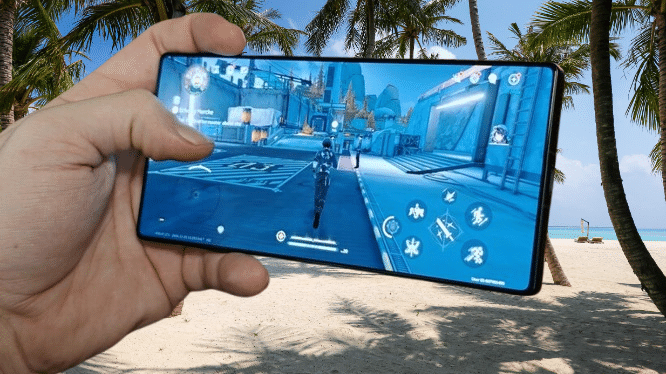
The phone did get hot during our Wildlife Extreme stress test, which is a very demanding benchmark. I never saw that during real gameplay, and I pushed the phone hard for about a week.
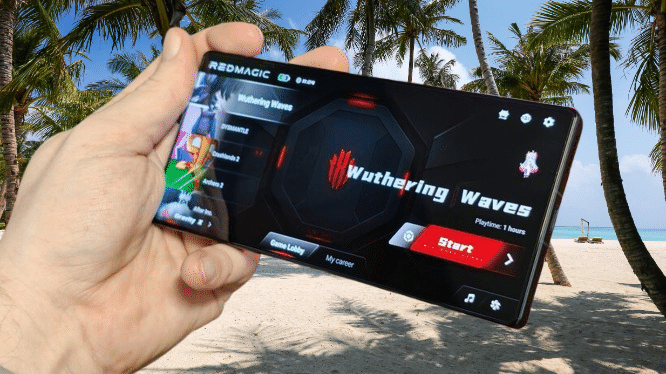
It handles long sessions of Wuthering Waves with every graphics setting at maximum and still holds at least 60fps. The game even warned me that the phone would overheat and lag. It was wrong.
I played for almost an hour on battery power with no stutter or lag. The phone only ever felt slightly warm in my hand. Very few phones manage that, even with similar top-end chips. Raw power means little if the phone cannot control its heat, and this one can.
The fan does get loud at full speed. You can turn it down, but cooling gets weaker when you do. The noise is close to what you hear from a handheld game console. It is not extreme, but you will notice it in a quiet room.
You may also like: Nothing Phone 4(b) Review: Budget Phone With Real Flair
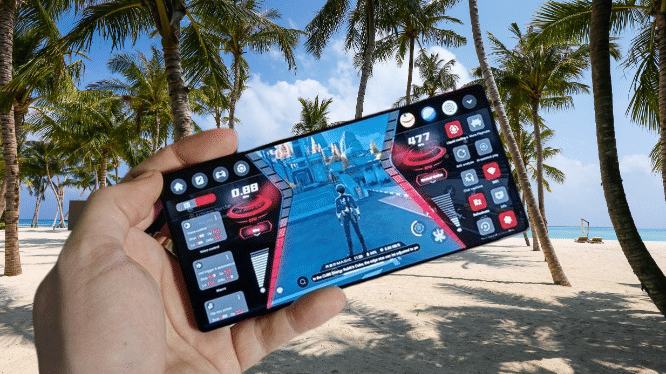
The phone also has touch-sensitive shoulder triggers on the long edge. You can map them to on-screen controls, even in games that do not support controllers or triggers. The feature is not new, but it still matters. In online shooters like CoD Mobile, it gave me such a clear advantage that it felt close to cheating.
If you want to play the most demanding games on Android, the RedMagic 12 Pro meets every need and then some.
RedMagic 12 Pro Software
The RedMagic 12 Pro is the first phone in the range to ship with RedMagic OS 12, which runs on Android 17. It looks and works much like recent versions, so if you have used RedMagic before, you will feel ok with it.
RedMagic OS used to look cluttered and overdone, with gaming styling everywhere. It has improved a lot over the past few years. It still lacks the polish of Oppo’s ColorOS or Samsung’s One UI, but the gap is small. I like the cleaner layout. It sits closer to a Pixel, with extra options to customise it.
You may also like: Oppo Find X10 Review: The Flagship Most People Should Buy
The gaming tools no longer crowd the screen, but they are still there. Most of them live in Game Space, a library that works like a game console menu. It gives you quick access to every installed game and a set of optional settings.
Here is what you can do in Game Space:
- Change the chipset’s performance mode for each game
- Turn on Scout Mode and Hunter Mode for an edge in competitive titles
- Cut down distractions by limiting notifications and calls during play
- Use bypass charging to reduce heat and slow battery wear
Scout Mode and Hunter Mode can feel like cheating, as I said earlier. If you want that extra help in mobile games, few brands offer it. The list of features is long, and most types of players will find something useful.
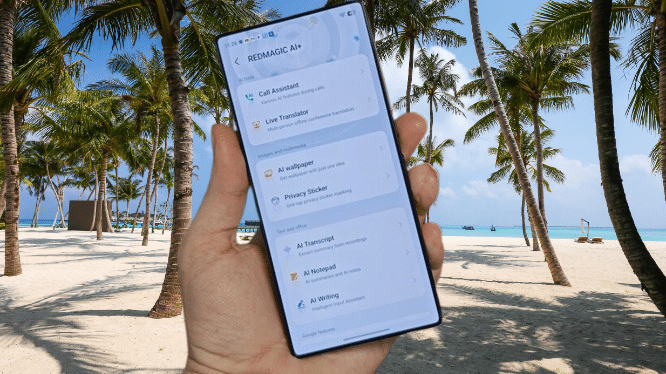
Outside of gaming, the phone includes several AI tools, some from RedMagic and some from Google. You can ignore most of them if you do not need them. They are far less pushy than the AI features on Samsung phones.
The main letdown is software support. You get two years of OS upgrades and five years of security patches. Similarly priced phones like the Google Pixel 11 offer seven years, and some cheaper phones do too.
RedMagic 12 Pro Cameras
Camera quality usually comes last on a gaming phone, but the RedMagic 12 Pro has a better rear camera setup than you might expect. It will not match the best camera phones, though it has more going for it than most gaming phones.
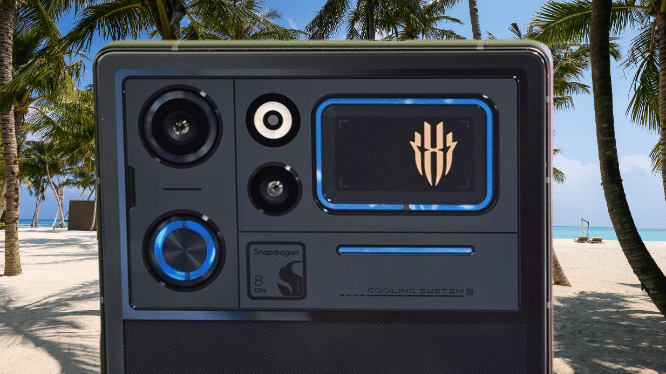
The setup is almost the same as the RedMagic 11S Pro. The one change is that the 2MP macro lens is gone. I do not miss it. It had little real use, and two good cameras beat three where one only fills out the spec sheet.
You may also like: Pixel 11 Pro Fold Leak: Same Design, New Pine Colo
The main camera is the better of the two. Its 1/1.55-inch sensor is fairly large and gives good photos in most lighting. It is dependable and not exciting, but you will not feel stuck with it just because you wanted the gaming hardware.
I am less sold on the default processing. Like the last model, it pushes colors and contrast too hard for my taste, and it often gets reds wrong. You can tone it down. The phone offers customizable filters similar to Apple’s, plus Pro mode and RAW capture.
The 50MP ultrawide pairs well with the main camera, and it has autofocus. Use it to fit a whole group into a photo or to capture a wide view. Switch back to the main camera when daylight fades. The ultrawide has a smaller sensor, so in low light you will often see visible noise, soft details, or both.
Zoom is the weakest point, because there is no dedicated zoom lens. You get a 2x optical-quality zoom that brings you a bit closer. In good light, you can push to 3x. Past that, the heavy processing becomes easy to spot. The results are acceptable, but you can get better zoom for the same money elsewhere.
The 16MP under-display selfie camera needs some context. Some months ago, I would have dismissed its image quality. Then I saw what the iPhone Duo’s version produces, and now I give RedMagic more credit. Its selfies are still not great, but they look better than Apple’s.
The processing is heavy, and photos can look a bit artificial. A regular selfie camera is still the better pick for anyone who takes a lot of selfies, even one with lower resolution. The trade-off is easier to accept than it used to be.
You may also like: Samsung Galaxy Z Flip 8: Price, Specs, and Release Date Leaks
For video, both rear cameras record 4K at 60fps. There is also an 8K option at 30fps. I would stay with 4K. You get better stabilization and smaller files, and almost nobody needs 8K footage. The front camera records up to 1080p. Given its image quality, I would not use it for video either.
RedMagic 12 Pro Battery Life
The RedMagic 12 Pro has an 8400mAh battery. That is 900mAh more than the 11S Pro, and it makes this one of the largest batteries in any smartphone today. The Oppo Find X10 Pro Max comes close with 8000mAh, but buyers in the EU do not get that version. Their model is capped at 7150mAh.
Battery life matches the numbers. On days when I played demanding games now and then, with the liquid cooling and fan running, I still finished the evening with plenty of charge left. Two days of use is realistic, even if you use your phone heavily.
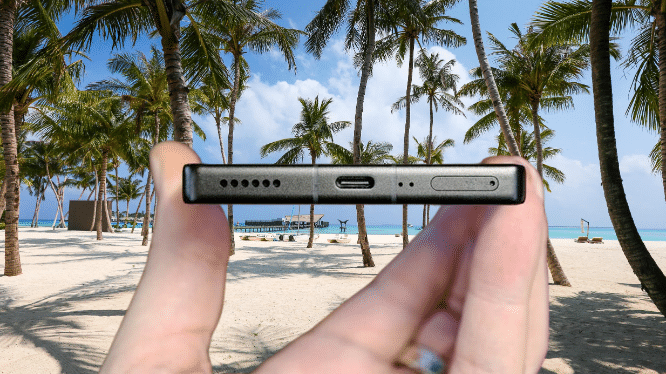
Charging is fast too. The phone supports 80W wired charging, 80W wireless charging and 22.5W reverse charging. The box no longer includes a wired charger.
I tested with the Anker Prime 250W and reached 60W. The phone hit 50% in 25 minutes and a full charge in 75 minutes. The iPhone 18 Pro is only 13 minutes quicker, even though the RedMagic has a much bigger battery to fill.
You may also like: Red Magic Astra 2: Liquid-Cooled Gaming Tablet Goes Global
To reach the full 80W, you need a RedMagic charger, which you can buy separately. It also uses the phone’s cooling system to keep heat down during fast charging.
If you play for long stretches at home, bypass charging helps. The phone runs directly from the charger, so the battery does not wear down from charging while you play. It also keeps the phone cooler than usual.
RedMagic 12 Pro Verdict
The RedMagic 12 Pro is the best gaming phone on Android right now. It delivers top performance, and its cooling system keeps demanding games smooth through long sessions.
The screen has no notch and runs at 185Hz. The 8400mAh battery lasts long enough to make this a better daily phone than any RedMagic before it. A few trade-offs remain. The under-display selfie camera is weak, software support is short, and there is no telephoto lens.
Pros | Cons |
| Excellent gaming performance | Under-display selfie camera still lags behind |
| Stunning notch-free 185Hz display | Only two years of OS upgrades |
| Big battery with 80W wired and wireless charging with customisable shoulder triggers and Game Space tools | No telephoto lens and fan can get loud |
Final Thoughts
After years of small changes, the RedMagic 12 Pro makes a strong case for choosing a gaming phone over a regular flagship.
The benchmark scores are impressive, but they are not the main reason. What matters more is that you can play demanding games for long sessions without stuttering or overheating. The shoulder triggers, the uninterrupted screen and the huge battery make that experience even better.
The phone also holds up well when you are not gaming. The screen works just as well for watching films. The battery means you rarely worry about charge during a normal day. The main camera is good enough for everyday photos. You no longer have to pick between a gaming phone and a solid all-round flagship.
Some compromises remain. The under-display selfie camera does not always deliver. The cooling fan can get loud. The short software support is also hard to ignore if you plan to keep the phone for several years.