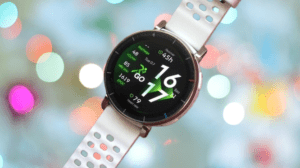

The Suunto Run 2 picks up where the original Run left off, Suunto’s budget-friendly smartwatch made with runners in mind. Just like before, it handles more than running alone, but this version leans harder into tracking features for people who care most about accuracy and data.
That means a new version of Suunto’s dual-band GPS, promising sharper outdoor tracking, plus an upgraded heart rate sensor and, maybe the biggest addition, free offline maps.
It’s pretty clear who Suunto is aiming at here: Garmin and Coros. But all these new features come with a higher price tag, which puts the Run 2 in a different pricing bracket than its predecessor.
Suunto Run 2 Design and Screen
The original Suunto Run stuck to a lightweight, compact build, which made it a good pick for runners who wanted to avoid bulkier watches on their wrist. Suunto didn’t mess with that formula much for the Run 2, and honestly, that’s the right call.
You may also like: Best Fitness Trackers 2026: Top Picks Tested and Ranked
You’re still looking at a 46mm polymer case with a stainless steel bezel and three physical buttons lined up on one side. The front has a 1.32-inch AMOLED touchscreen, same size as before, reaching up to 2,000 nits of peak brightness. It’s not the brightest screen out there, but it held up fine in direct sunlight without disappearing on me.
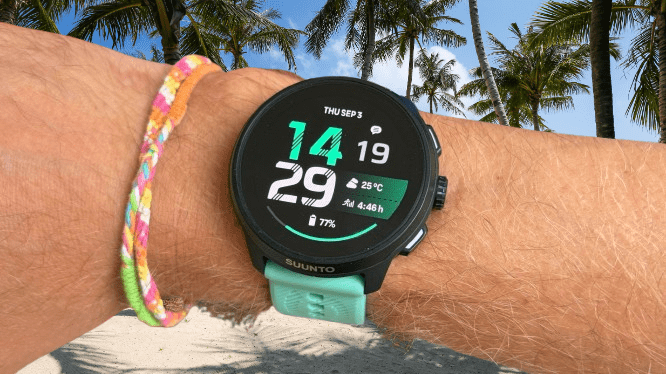
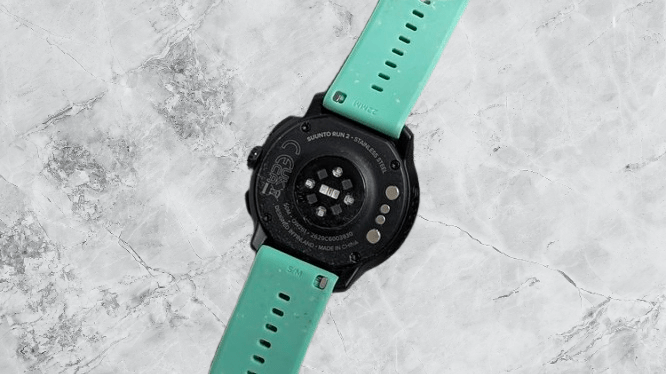
There are three color choices: all-black, feather gold, or the aloe green version, which I tested. The color mostly comes down to the strap, which pops off easily when you need to swap it. The strap itself has decent stretch to it, though I noticed the clasp popping loose from the strap a few times during wear.
The real change this time is storage. Suunto now offers the Run 2 in two versions, a 4GB model and a 64GB model. Everything else about the design stays identical between them. You’re just paying more for extra room to store maps, music, and watch faces.
Suunto Run 2 Performance and Software
Software has long been Suunto’s weak spot, especially stacked up against Garmin, Coros, and Polar.
On the watch itself, though, things have gotten noticeably smoother. Suunto won’t say what’s driving the improvement under the hood, but whatever it is, it’s clearly fixing the lag that plagued earlier Suunto watches.
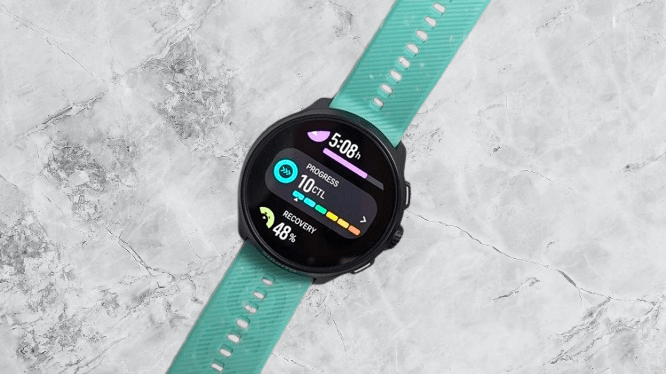
Getting around the interface is simple enough. Swipe up from the main watch face and you land on your widget stream. Swipe right from there and you’re at the sports tracking screen. The companion phone app got a speed boost too. It responds faster now, even if it still reads a bit too much like a wall of text in places.
You may also like: Pixel Watch 5 vs Galaxy Watch 8: Which Should You Buy?
As far as everyday smartwatch stuff goes, you can check the weather, set timers, use the flashlight, and control media playback. Music syncing works through the Suunto app, but don’t expect support for Spotify or Apple Music.
You’ll need to drag files over from a computer manually, since the phone app doesn’t handle that yet. Transferring audio files was quick enough in practice, and Bluetooth pairing worked fine with both Apple and Anker headphones.
There’s a decent lineup of watch faces to pick from, and you can even build your own using photos through the app. One thing missing is Suunto’s Plus app store, which is locked to the pricier watches in the lineup.
Put it all together and you get a smartwatch where the non-fitness features still feel like they’re catching up to the competition. It hasn’t quite nailed the balance between sports tracking and everyday smartwatch use yet, but the direction it’s heading in looks promising.
Suunto Run 2 Tracking and Features
Running sits at the center of what the Run 2 does, just like the name implies. Beyond the standard outdoor and treadmill run modes, there are dedicated race day modes that give you a projected finish time and surface the real-time numbers that matter mid-run.
There’s also a Ghost Runner mode, which has you racing against a virtual competitor for days when you want some competitive pressure without an actual race on the calendar. None of this reinvents anything in the smartwatch space, but it adds up to plenty of ways to track a run.
You may also like: Google Pixel Watch 5 Review: Refined, Not Reinvented
The bigger upgrade is accuracy. Suunto added a newer dual-band GPS sensor aimed at holding up better in tricky signal conditions, think tall buildings downtown or dense tree cover on trail runs.
Alongside that, the optical heart rate sensor got reworked too, now sitting on curved glass to improve how reliably it reads your heart rate from the wrist.
Just like with the original Suunto Run, the dual-band GPS on the Run 2 impressed me. Suunto’s version of this tech competes with the best in the business, and it’s nice to see it show up on one of the brand’s cheaper watches. The heart rate sensor held its own too, staying accurate even during high-intensity efforts, which is usually where optical sensors start to struggle.
I also used it to track swims, walks, indoor cycling, and general gym sessions. The one hiccup came during a swim, where the distance reading was way off compared to two other swim trackers I had running at the same time. Outside of that, it handled other activity types well.
Maps are probably the standout new feature here. You sync them from the Suunto app to the watch, which means putting the watch on its charger and connecting to Wi-Fi. Once synced, the maps are detailed and smart enough to kick in automatically when you’re running a looped route.
Where I think Suunto still has work to do is training insights. The watch tracks training load, recovery time, and overall progress, and the numbers lined up with what I have seen from competing watches. But the way that information gets presented could use some polish. It reads a little dry and technical when it could be more approachable.
You may also like: Whoop vs Apple Watch: Full Comparison 2026
Same goes for the Suunto app, where you’ll find the brand’s new training plans, currently in beta. They’re AI-generated and built around running, triathlon training, and general fitness goals.
Suunto Run 2 Battery Life
Suunto claims better battery life overall compared to the first Run, and the numbers back that up in part: capacity went up by 29%. Oddly enough, smartwatch mode battery life actually dropped by 2 days compared to the original.
From my time with it, the Run 2 easily lasts over a week if you turn off the always-on display, which is brighter now than before. Leave the display on constantly and you’ll lose about 15-20% battery per day, putting you around 4-5 days total. Stick with raise-to-wake instead, and daily drain settles closer to 10%.
GPS battery life actually improved. In the most accurate GPS mode, battery life went from 20 hours up to 24 hours. That’s the mode I used most during testing, and I saw roughly 6-7% drain per hour of use.
You may also like: Samsung Galaxy Watch 9 Review: Refined Health Tracking, Weak Battery
So it’s a mixed bag of better GPS tracking, battery life, and slightly worse everyday battery life.
Charging happens through one of Suunto’s proprietary cables, and it’s not particularly fast. Going from completely dead to full charge took around two hours in my experience.
Suunto Run 2 Verdict
The Suunto Run 2 stands out as one of the better mid-range smartwatches you can get for sports tracking. The catch is that steep price increase, which means it’s no longer the automatic budget pick the first Run used to be.
Pros |
Cons |
| Excellent GPS and heart rate tracking performance | More expensive than Suunto Run |
| Added full colour maps | Training analysis presentation needs simplifying |
| Smooth-running watch software | Drop in daily battery life performance |
Final Thoughts
The Run 2 adds another good entry to Suunto’s growing lineup of sport-focused smartwatches. The disappointing part is the price jump from the original Run, which means it no longer undercuts the competition the way it used to. That doesn’t make it a bad watch. It just makes it a tougher sell against everything else out there in the same price range.