

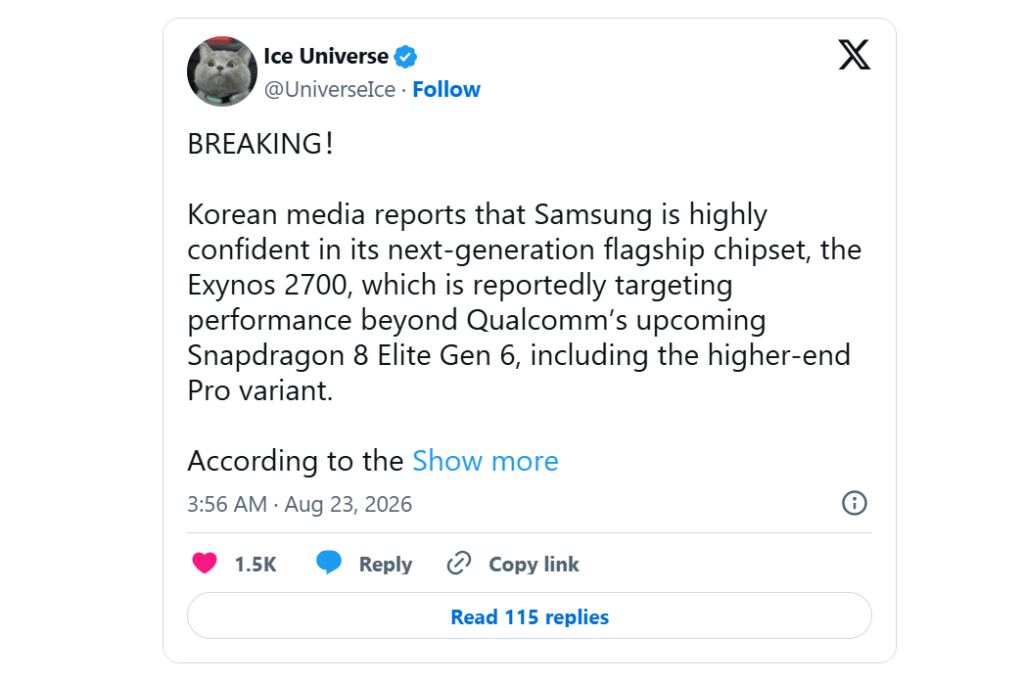
Samsung may be gearing up to make its boldest Exynos claim in years. A new report shared by industry analyst Ice Universe, citing Korean media, suggests Samsung is genuinely confident that its next-gen Exynos 2700 chip can outperform Qualcomm’s upcoming Snapdragon 8 Elite Gen 6, including the higher-end Pro variant.

The numbers being reported are ambitious enough to raise real eyebrows. If they actually hold up in production hardware, the Galaxy S27 could mark a genuine turnaround for Samsung’s in-house chip business. For now, though, these figures remain early estimates rather than independently confirmed benchmark results.
Samsung’s Exynos Vs Qualcomm Reports
The report Ice Universe highlighted claims the Exynos 2700 is targeting a 19% advantage over the standard Snapdragon 8 Elite Gen 6 in Geekbench 6.5 multi-core testing, with a reported 9.5% lead over the Snapdragon 8 Elite Gen 6 Pro as well.
Graphics performance could matter even more for actual smartphone use. At peak output, the Exynos 2700 is said to run around 5% faster than Qualcomm’s Pro chip. But under a 2.5W power limit, that gap widens noticeably, with Samsung’s chip reportedly delivering 24% better GPU performance than the standard Snapdragon and 22% better than the Pro variant.
You may also like: Snapdragon 8 Elite Gen 6 Pro Leak: 6GHz Speed with Samsung Cooling Tech
That distinction actually carries real weight, since phones rarely run at their absolute performance ceiling for long stretches. Gaming, camera processing, and AI tasks all generate heat, which forces chips to throttle down. A processor that performs better under lower power constraints could translate into stronger sustained gaming performance while using less battery in the process.
The report also claims an AI performance edge. In Llama 3.1 8B testing, the Exynos 2700 reportedly generated responses 18% faster than the Snapdragon 8 Elite Gen 6 Pro, with prompt processing coming in roughly 5% quicker as well.
Samsung’s freeing itself from Qualcomm
Efficiency might be the most compelling claim in the whole report. In a test designed to mimic real-world smartphone use, the Exynos 2700 reportedly consumed 161mA compared to 185mA on the Snapdragon 8 Elite Gen 6 Pro, roughly 12.7% lower power draw.
Samsung is expected to build this chip on its second-generation 2nm GAA process, known as SF2P. Strong results here would benefit more than just Samsung’s mobile division too; they’d give Samsung Foundry real proof that its latest manufacturing tech can compete at the top level.
You may also like: Qualcomm Snapdragon C: Specs, Battery Life and Release Date
There’s a financial incentive at play as well. The report notes Samsung spent roughly KRW 13.8272 trillion on mobile application processors in 2023. Leaning more heavily on Exynos chips across the Galaxy S27 lineup could reduce Samsung’s reliance on Qualcomm and cut costs on sourcing flagship processors.
Of course, a winning Exynos chip needs more than good benchmark numbers to actually matter. Samsung will still need to prove these claimed advantages hold up in real shipping phones, where thermals, sustained gaming performance, battery life, and camera processing carry far more weight than a lab score.
If Ice Universe’s figures turn out to be even roughly accurate, the Exynos 2700 could end up being Samsung’s strongest flagship chip in years. The real test comes once production hardware actually ships, and once Qualcomm gets its own chance to respond.