
Anyone who has worked outdoors in summer heat knows how fast sweat adds up. That sweat carries useful information about your body, and researchers at Tokyo University of Science have been working to read it.
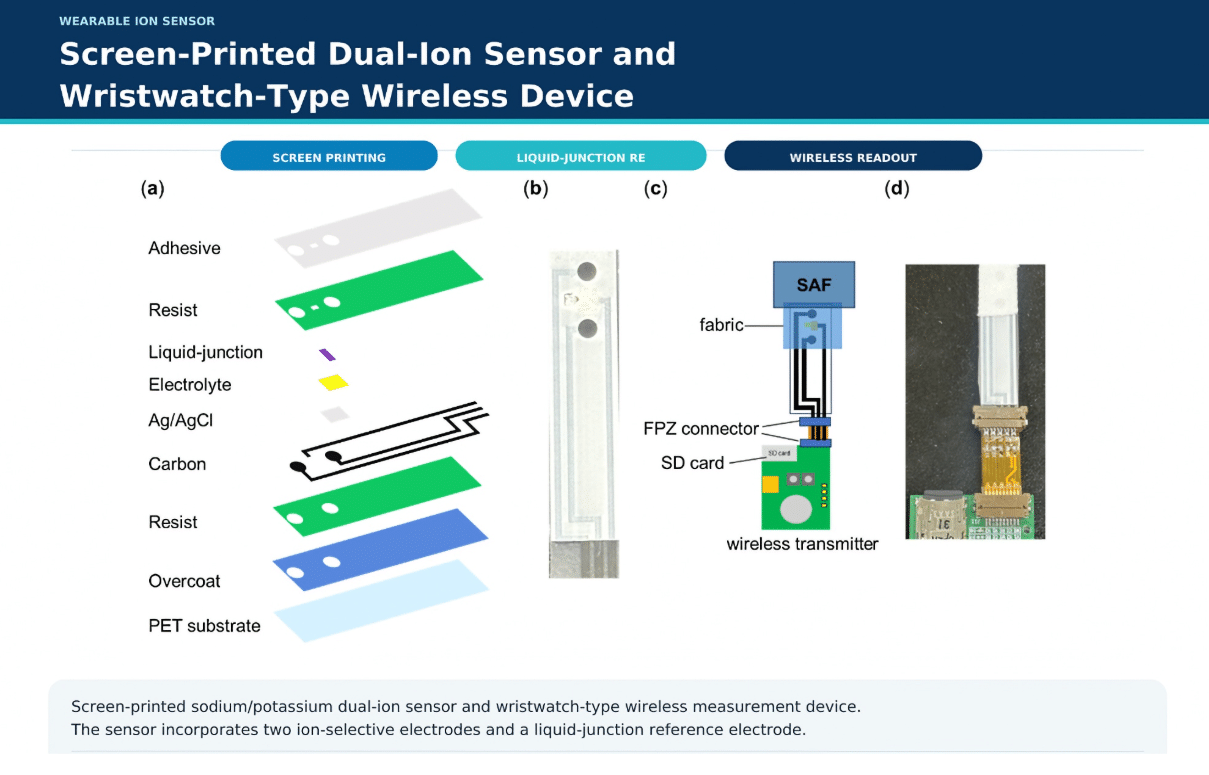
In 2023, Associate Professor Isao Shitanda and his team made a chloride sensor that could be heat-pressed onto a T-shirt or a wristband. Their newest device, described in a study published online in ACS Omega, takes the idea further. It is a wristwatch that tracks the sodium and potassium levels in your sweat as they change, in real time.
Why is reading sweat harder compared to reading sounds?
Most wearable ion sensors work by reading a voltage. That voltage changes with the amount of a specific ion in your sweat, but it only means something when you compare it against a steady reference electrode.
Printed reference electrodes take a long time to settle before they give a reliable reading. Nobody wants to wait around for a watch to warm up.
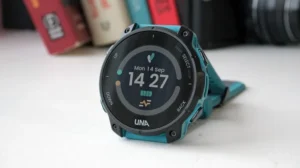
You may also like: Una Watch Review: A Repairable Smartwatch With Flaws
Tokyo University of Science reports that Shitanda’s team solved this with a new printed reference electrode that needs no long setup. They added silica gel, which lets water move into the electrolyte layer faster. The electrode stabilizes within a short time as a result.
The sensors also sit under a layer of fabric and superabsorbent fiber. This layer soaks up your sweat and carries it across the sensing area. The watch then processes the readings and sends them wirelessly to a computer. It also saves them to a micro-SD card.
How did the sweat sensor watch hold up on a construction site?
To see how the watch holds up outside a lab, the researchers tested it at an active construction site. One worker wore it through a normal workday. That meant moving around, taking breaks, eating meals, and drinking water.
You may also like: Pixel Watch 5 vs Galaxy Watch 8: Which Should You Buy?
The watch tracked sodium and potassium in the worker’s sweat for about 2 hours and 45 minutes. It sent the readings wirelessly to a computer and saved a copy on the device itself.
Is Sweat Sensor Watch Ready for your wrist yet?
The answer for now is no. The researchers say getting precise sweat readings will take more experiments in controlled sweating conditions, along with further validation.
Dr. Shitanda sees this watch as a first step toward tracking electrolytes at work sites, in factories, during sports, and in other outdoor settings, all without making anyone stop what they are doing.
He also suggests pairing it with data on how much you sweat and how much water you drink, which could help people stay hydrated in hot environments. Nobody has tested that idea yet.