
Solar-powered vehicles have mostly stayed stuck in the prototype stage for years, showing up at university demos or concept reveals but never really proving themselves.
That changed recently, when one completed a test that actually matters: it drove hundreds of miles across rough terrain, carried medical equipment the whole way, and generated all its own power without any outside help.
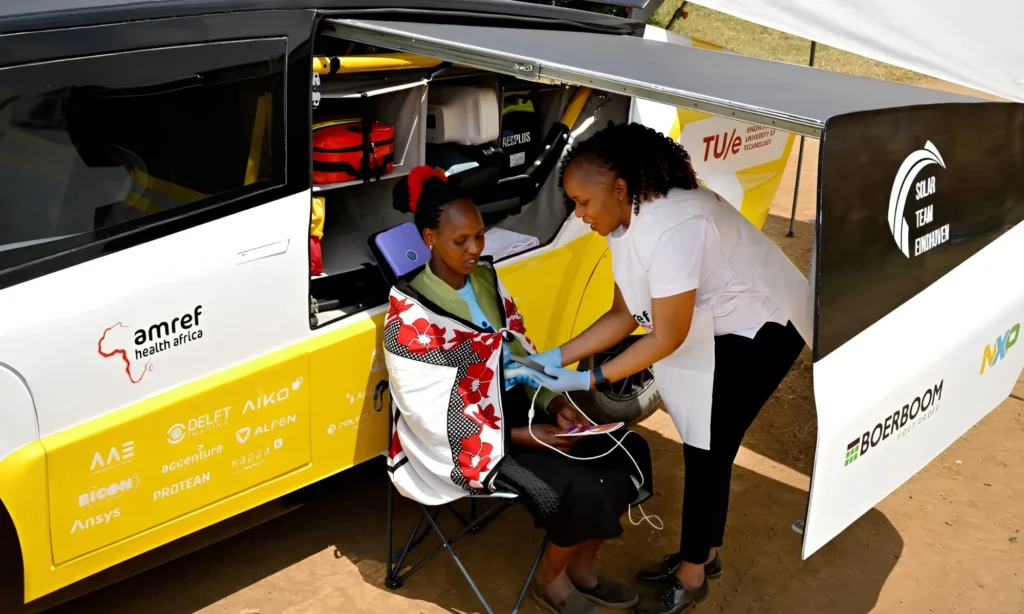
The vehicle is called Stella Juva, built by Solar Team Eindhoven, a group of 23 students from Eindhoven University of Technology and two partner schools.
CNN reported that the team calls it the world’s first solar ambulance. But don’t picture a typical ambulance racing someone to a hospital. Stella Juva does the opposite. It’s built to bring medical care directly to people who can’t easily get to it themselves.
That’s what sets this project apart. It’s not just another solar car built to impress people at a demo. It solves an actual problem.
Stella Juva Solar Ambulance Test
The team took Stella Juva to Kenya for a real field test with Amref Health Africa, checking whether it could handle long distances on rough roads while still powering medical gear at remote sites.
It passed. The students drove the vehicle more than 800 kilometers, roughly 500 miles, across Kenya, including a stop at a health clinic in Mosiro, in the Narok region, that has no electricity at all. Much of the route ran through dusty, pothole-riddled clay roads. Even so, the team said the vehicle held up better than they expected.
You may also like: Anker SOLIX C1000 Gen 2 Bundle Deal: $699.98 With Solar
Onboard, Stella Juva carries an X-ray machine, an ultrasound scanner, and a refrigerator that keeps vaccines cold. Solar panels on the roof charge the vehicle as it drives, and extra panels fold out once it’s parked, adding even more charging capacity.
Here’s the key result: while parked and running every piece of medical equipment at once, the ambulance generated more power than it used. No real patients were treated during this test, but Solar Team Eindhoven and Amref estimated the vehicle could have handled care for around 200 people over two days.
Reason behind Stella Juva Solar Ambulance Innovation
This project lands in a region where reliable power is still one of healthcare’s biggest obstacles. CNN reports that roughly one-third of people in Africa live more than two hours from any health service, and plenty of medical facilities across the continent still struggle to get consistent electricity.
You may also like: Anker Solix E10 Launches as World’s First Smart Hybrid Home Backup System
That’s what makes Stella Juva’s success mean more than just “we built a solar car that drives.” Solar Team Eindhoven has spent years, since 2013, working on sustainable vehicles, including earlier solar and off-road builds.
Some of those efforts have already found their way into real products. Lightyear, a company started by five Solar Team Eindhoven alumni, recently showed off a demonstration EV built with Nissan using solar-charging tech.
There’s still a big gap between prototype and actual deployment. Kenya’s healthcare system already struggles with funding, and Stella Juva is headed back to the Netherlands once testing wraps up.
Even so, this Kenya trial shifts the conversation. This wasn’t a solar vehicle parked under studio lights for a photo. It handled rough roads, reached a clinic with no power grid, and produced enough energy to run its own equipment. For solar transportation, that might be the first result that actually proves the concept works.