
Hotel rooms and rental properties keep hiding cameras in places you would never think to check: inside a pen, a clock, a phone charger, even a picture frame.
Researchers at KAIST decided to fix that problem, and their solution costs less than a decent lunch. It’s called SweepLED, and it turns your regular smartphone into a hidden camera detector using an attachable LED case you can build for under $7.
Here is why current hidden camera detectors are not working
Most handheld detectors use a simple trick: point a light at something and watch for a bright reflection. The catch is that glass, metal, and shiny plastic reflect light too, so you end up squinting at a charger or a clock, unsure if you’re looking at a hidden lens or just a random shine.
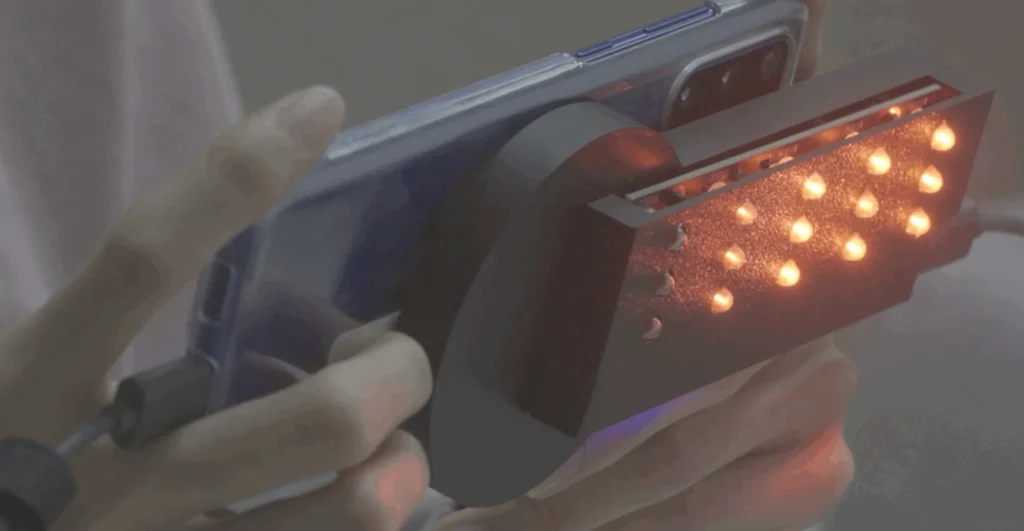
SweepLED gets rid of that guesswork. Rather than moving the light and your viewing angle together, it holds the phone’s camera steady and moves the LED light around it instead.
You may also like: New Infrared Lens Technology Could Bring Thermal Cameras to Smartphones and Cars
That distinction matters because a real camera lens has layers inside it: an aperture, a sensor, curved glass. As the light angle changes, that internal structure makes the reflection bend and shift in a specific, predictable pattern. A plain shiny surface can’t replicate that. It just reflects light the same simple way no matter where the light comes from.
How does SweepLED work?
SweepLED captures the entire light sweep in a short video, then feeds that footage into an AI model trained to catch those specific lens deformations, pinpointing exactly where a hidden camera is likely hiding.
The team tested it on 30 objects you would typically encounter in a hotel room or rental, and it caught hidden cameras with roughly 94% accuracy, checking each object in under five seconds.
You may also like: New Vibrating Microchip Could Make Smartphones Thinner, Faster, and More Efficient
For context, a recent UCL study found that people using off-the-shelf hidden camera detectors still missed 59% of the devices during testing. That makes SweepLED’s 94% lab result stand out, though real-world testing outside the lab still needs to happen.
The project comes from Professor Jun Han’s team in KAIST’s School of Computing, working with researchers from the National University of Singapore and Singapore Management University. They presented it at ACM MobiSys 2026 earlier this year. It’s not something you can buy yet, but the concept is simple enough that a real product could follow soon.