

Anthropic just released Claude Opus 5, and it’s aimed squarely at the everyday grind: coding, research, business tasks, the stuff people actually use AI for every day. The company claims a big jump over Opus 4.8, and it kept the same API pricing, which is worth noting given how fast model prices usually climb.
Here’s the interesting part. Anthropic says Opus 5 gets close to Fable 5 on certain coding and computer-use benchmarks, but runs at a fraction of the cost. That’s a real shift.

For months, the story in AI was always “our newest model is smarter.” Now the story is “our newest model is smart enough, and it costs less to run.” That matters a lot more to businesses watching their AI bills grow every quarter.
You can use Opus 5 across Claude’s apps and through the API. If you’re on Claude Max, it’s your new default model. If you’re on Claude Pro, it’s the best model you get access to. No waiting list, no beta tag. It’s live now.
You may also like: Anthropic Launches Claude for Healthcare with Personal Health Data Integration
For anyone building products on Claude or running AI workflows at work, this one’s worth testing. A model that performs close to the top tier without the top tier price tag changes the math on what you can afford to automate.
Claude Opus 5 and Fable 5
Opus 5 just about matched Fable 5’s top score on CursorBench 3.2, a benchmark that puts coding agents through real development work. The gap was under 0.5%, and Opus 5 got there running at half the cost per task, according to Anthropic.
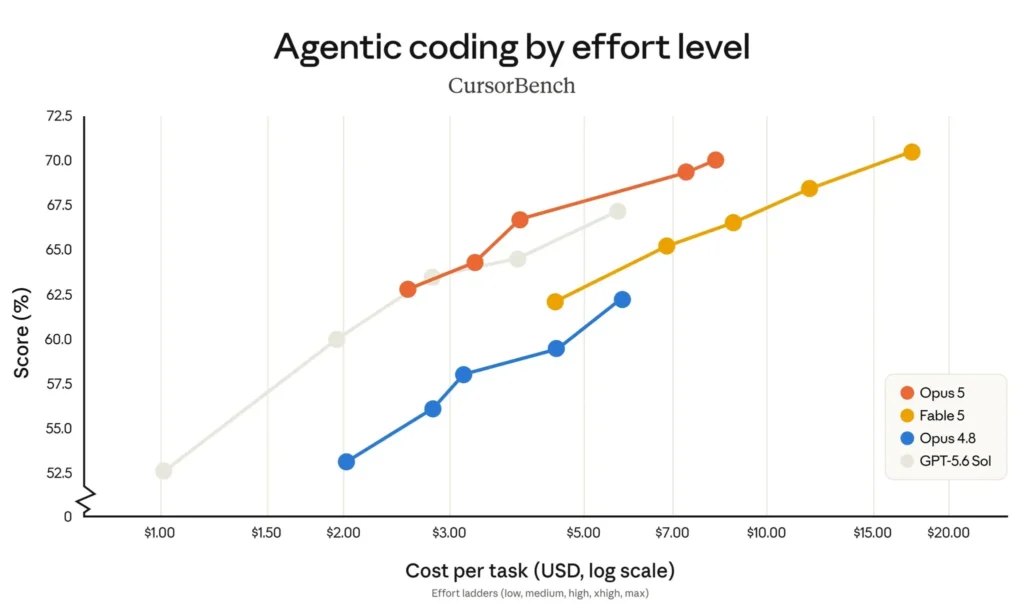
The pattern held on OSWorld 2.0 too, a benchmark that checks how well an AI agent can actually operate a computer: opening apps, moving through files, finishing tasks. Opus 5 topped Fable 5’s best score here as well, this time spending roughly a third of the money to do it.
You may also like: Anthropic Launches Claude Cowork: AI Assistant That Manages Your Computer Files
That timing matters for Pro users and standard Team subscribers. Fable 5 shifted to pay-as-you-go credits on July 20, leaving a hole in what these plans include. Opus 5 looks positioned to fill it.
Claude Opus 5 and Opus 4.8
Anthropic put Opus 5 up against its predecessor, Opus 4.8, on Frontier-Bench, a test built around tough software engineering problems. The new model scored more than double what Opus 4.8 did, and it did the work for less money on average.
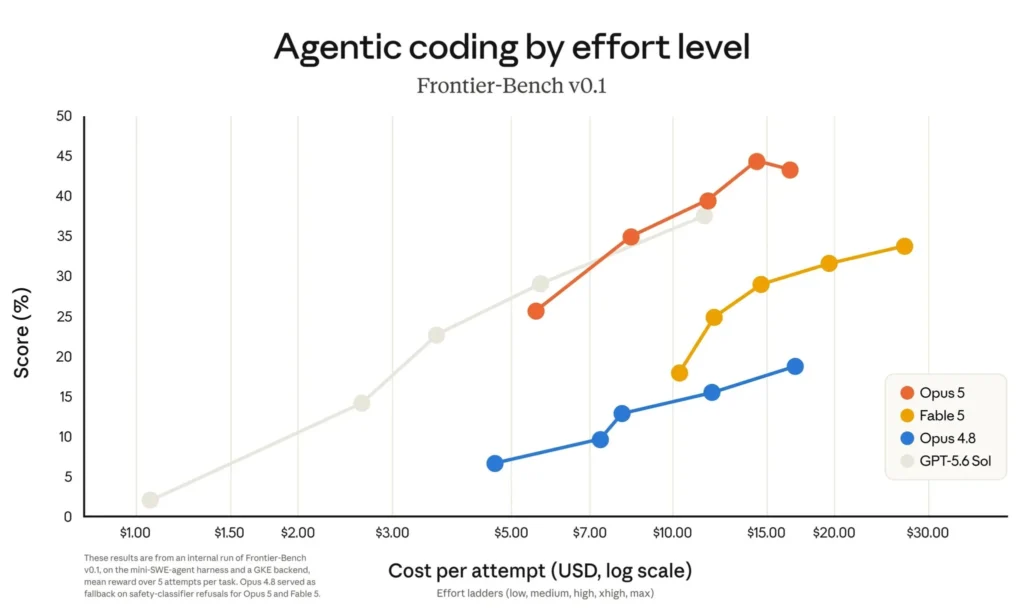
According to the company, Opus 5 catches its own mistakes more often, traces bugs back to their actual source, and sticks with a hard problem instead of settling for a quick patch. Anthropic points to one case where the model spotted an edge case that a patch from the developer community had missed entirely.
Keep in mind, these numbers come from Anthropic’s own testing. Real-world results on everyday coding tasks could look different. As for pricing, Opus 5 stays at the same rate as Opus 4.8: $5 per million input tokens and $25 per million output tokens.