
Hunting down a free outlet on campus can feel harder than getting a seat in that one class everyone wants. Libraries, lecture halls, common areas, they’re rarely built with enough sockets in the places you actually need them.
That’s exactly where a good power bank earns its keep. It means you can grab that quiet library corner, study outside between classes, or push through an assignment without constantly eyeing your laptop’s battery percentage.
Picking the right one really depends on what you’re carrying day to day, since charging a phone takes a fraction of the power a MacBook or gaming laptop needs. I picked out four Anker power banks here, ranging from ones built for basic phone charging up to models that can keep several demanding devices running at once.
Anker Prime Power Bank (20K, 220W)
If I were hauling around a power-hungry laptop for something like architecture, engineering, or animation work, the Anker Prime is what I’d throw in my backpack.
A single USB-C port can push out up to 140W on its own, and with a combined ceiling of 220W, it can charge a laptop while also topping off a phone, tablet or another USB-C device at the same time.
You may also like: Best Power Banks for Smartphones in 2026
The display goes well beyond a basic battery percentage too, showing active charging speeds and estimated runtime, and the companion app adds extra monitoring and power controls on top of that.
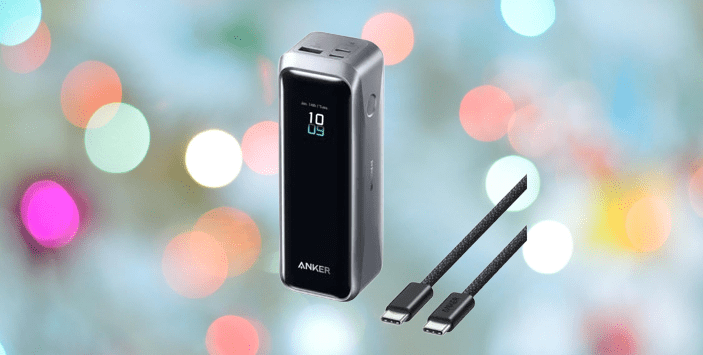
All that capability does come at a cost though, and I mean that literally in weight. At 1.12 pounds, this feels less like a phone charger and more like a portable charging station you’re committing to carry.
If your setup is lighter, you can probably skip this one and save both money and backpack space. But for demanding laptops or juggling multiple devices, nothing else here charges as strongly as the Prime does.
Pros |
Cons |
| Fast multi-device charging speeds | Considerably heavy, thick tower design |
| Generous, laptop-grade power output limits with incredibly robust and premium construction | Very steep premium retail price |
| Travel-friendly, completely airline-approved capacity, and highly informative digital display screen | Slower secondary USB-A port |
Anker Laptop Power Bank (25K, 165W)
This one’s built for students who somehow remember to pack every gadget except the actual charging cable. Since most of us are juggling a handful of different devices day to day now, I’d point to the Anker Laptop Power Bank as a genuine one-stop fix. It can charge up to four devices at once.
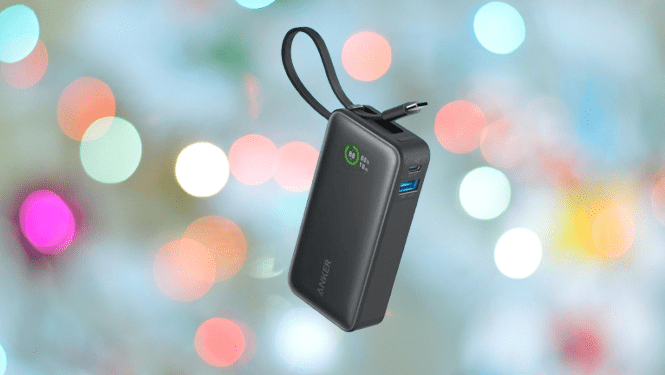
Anker built two USB-C cables right into the unit itself: a retractable one that stretches to 27.6 inches, and a shorter one that doubles as a carrying loop.
You may also like: DJI Power 2000 Deal: 2048Wh Power Station at $799
On top of that, you still get separate USB-C and USB-A ports for anything else. Each USB-C connection can push up to 100W, which covers most thin-and-light laptops, MacBooks, tablets, handheld gaming devices, and phones without issue.
With 25,000mAh of capacity, it also outlasts the Prime, though that bigger battery combined with the built-in cables pushes the weight to around 21 ounces. That’s a noticeable addition to your bag, but not having to pack separate cables for everything might make the extra weight worth it.
Pros |
Cons |
| Fast multi-device charging speeds | Considerably heavy, thick tower design |
| Generous, laptop-grade power output limits with incredibly robust and premium construction | Very steep premium retail price |
| Travel-friendly, completely airline-approved capacity, and highly informative digital display screen | Slower secondary USB-A port |
Anker Zolo Magnetic Power Bank 10K
For iPhone owners, the Zolo is the one I’d call the most convenient of the bunch. If you’re the type who takes breaks to watch videos or hop on calls, you can just snap your compatible iPhone onto it magnetically.
You may also like: Anker’s eufy MindBase Hub Brings On-Device AI Home
Thanks to a built-in adjustable stand, it turns into a small phone holder for your desk. There’s also a right-angle USB-C cable built right in, delivering up to 30W for whenever you need faster charging, and the angled design keeps the cable from sticking out awkwardly under the phone.
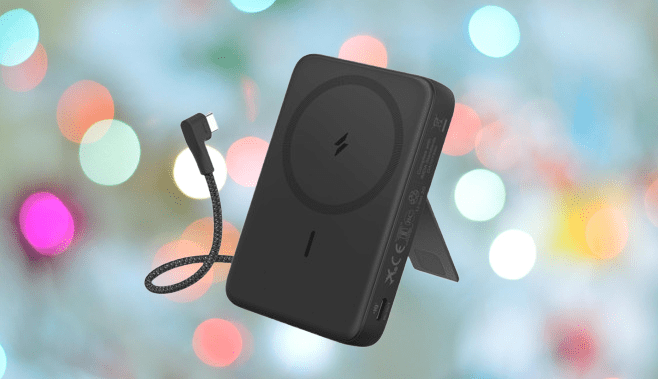
The wireless side is noticeably slower, capping out at 7.5W, so I’d treat the magnetic mode as good for steady top-ups rather than a quick save when your battery’s nearly dead. It’s also worth noting the size: at 8.46 ounces and 0.81 inches thick, it adds real bulk once it’s attached to your phone.
Even so, between the stand, the magnetic charging, and the built-in cable, this is the most well-rounded phone-focused option in the lineup.
Pros |
Cons |
| Fast multi-device charging speeds | Considerably heavy, thick tower design |
| Generous, laptop-grade power output limits with incredibly robust and premium construction | Very steep premium retail price |
| Travel-friendly, completely airline-approved capacity, and highly informative digital display screen | Slower secondary USB-A port |