
Your old phone battery might power your next electric car. Cornell University researchers built a recycling process that brings used lithium-ion cells back to 95% of their original capacity. On top of that, the method costs 56% less than current recycling approaches.
Most battery recycling today breaks cells down into raw materials, which takes a lot of energy and expense. This new technique works differently; it restores the battery’s structure rather than dismantling it, which is why the cost drops so sharply and the performance stays so high.
For consumers, it means the battery in your next phone or EV may have a previous life. For manufacturers, it opens a supply chain that doesn’t depend entirely on mining fresh materials. For the recycling industry, it changes what “good enough” looks like when it comes to reclaimed cells.
You may also like: Chinese Researchers Build $5 Sodium-Sulfur Battery That Rivals Lithium Performance
95% capacity isn’t a minor gap from new. In most real-world use cases, you wouldn’t notice the difference.
Lithium-ion Battery Recycling
Most recycling methods today treat a dead battery like scrap metal. You either melt it down at extreme heat or grind it into powder and run it through strong acids. Whatever survives that process has to be rebuilt from the ground up before it can go into a new battery. It’s expensive, wasteful, and energy-heavy.
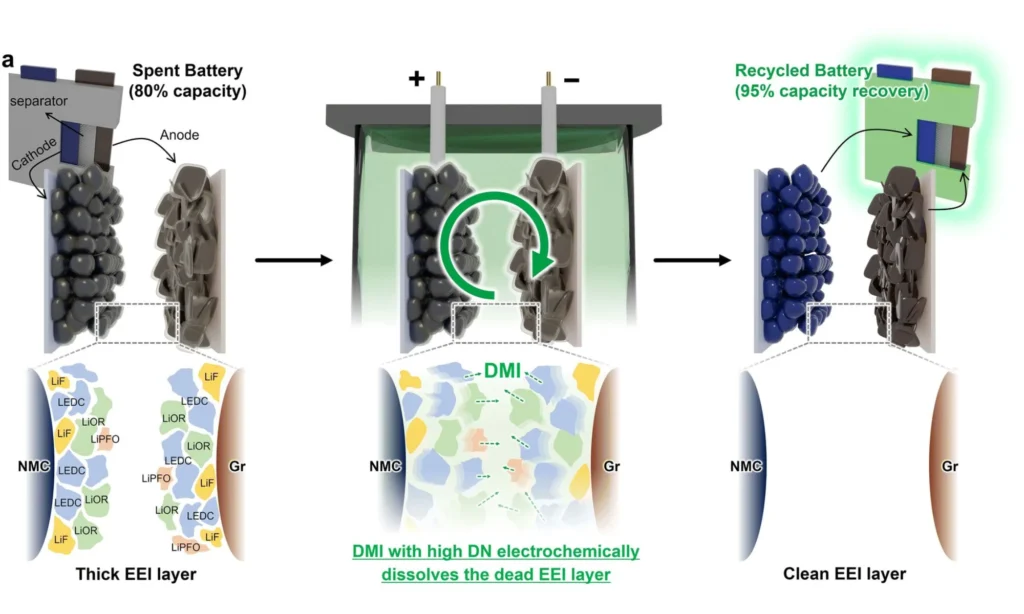
Cornell’s approach skips that entire chain. Their method, called DEER (direct electrode-to-electrode regeneration), pulls the electrodes out of a spent battery and soaks them in an electrochemical solution.
That solution targets and dissolves the insulating layer that builds up over time and causes capacity loss. Once that layer is gone, the electrodes are clean and structurally intact. They go straight into a new cell, no rebuilding required.
You may also like: Honor Silicon-Carbon Blade Battery: Everything We Know Ahead of the Magic V6 Launch
The difference matters because every step you eliminate in a manufacturing process cuts time, cost, and material waste. Traditional recycling throws away the part that still has value, the electrode structure itself, and starts over. DEER keeps it.
Why Cornell’s Battery Recycling Method Matters
The US imports most of its nickel and cobalt, two materials that go into every lithium-ion battery. Domestic recycling infrastructure hasn’t grown fast enough to offset that dependence. So when a battery reaches the end of its life, the materials often leave the supply chain entirely instead of cycling back in.
DEER tightens that loop because the process skips destructive breakdown steps, and more usable material stays in circulation. The Cornell team also found that it produces fewer harmful air pollutants and uses less water than conventional methods, which matters on an industrial scale.
You may also like: University of Houston Engineers Develop Thermal Diode to Prevent Device Overheating
The researchers are currently focusing on batteries at 70 to 80% of their original capacity. That’s the typical condition of an EV battery pack when a car owner trades it in or retires it. The next phase involves testing on larger, industrial-scale cells and addressing other types of degradation, including lithium loss over time.
If the process holds up at scale, three things follow: battery costs drop, pressure on raw material mining eases, and fewer spent cells pile up in landfills. None of those outcomes requires a breakthrough. They just require this one process to work consistently outside a lab.