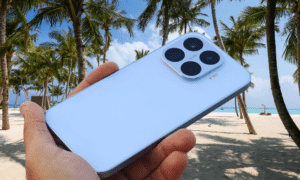

Does a second screen on the back of a phone make the device, or is it a gimmick that distracts from how dull the slab smartphone market has become?
That question has stuck with me since I started using the Xiaomi 18 Pro Max.
Xiaomi 18 Pro Max Full Specs
Xiaomi 18 Pro Max Design
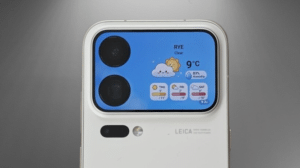
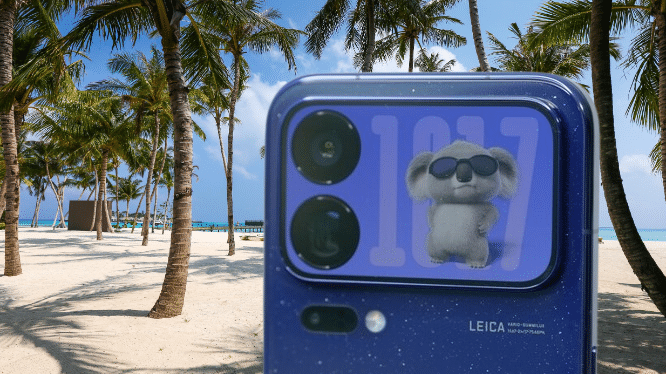
With a phone like this, the back is the place to start. The camera island is a touchscreen.
What you do with it is mostly up to you. Out of the box, it shows the time and works as a viewfinder, so you can take selfies with the rear camera. It also shows calendar events and notifications while the phone lies face down.
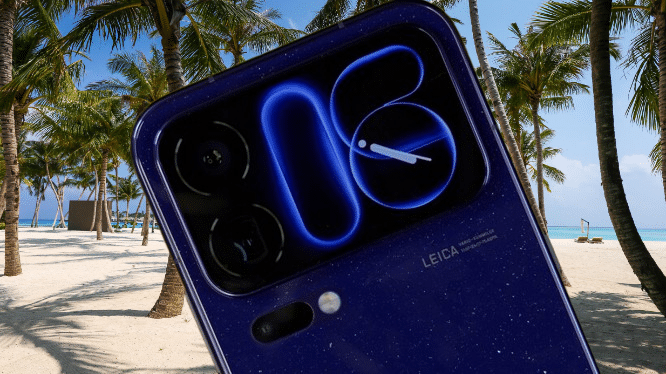
Spend a little time in the settings and it becomes more playful. It works much like the small cover screens on flip foldables such as the Galaxy Z Flip and the Moto Razr.
Is it useful? Yes, it can be. Leaving the phone face down with the weather or incoming alerts showing is handy. Its biggest strength is selfies. You can see yourself while using the rear camera, so you do not have to rely on the usually weaker front camera.
You may also like: Xiaomi 17 Ultra Review: Best Camera Phone of 2026
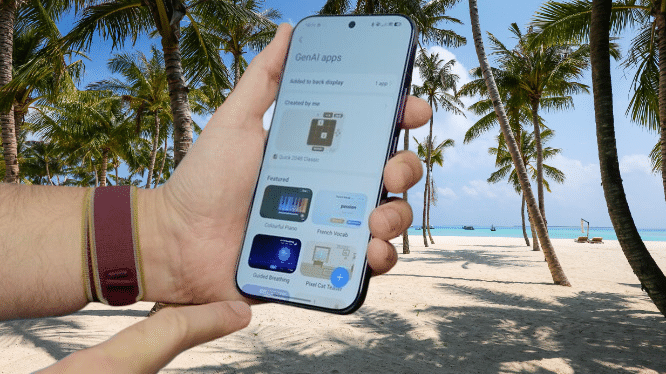
It has one more trick. Using generative AI, you can create mini apps and games from a simple description. The phone suggests some presets, or you can invent your own.
You can be as detailed as you like. It works best when you are specific about colors and textures. Vague prompts work too. When I asked for a game where you smash fruit and vegetables with a guitar, it built one, more or less.
I can see the secondary screen being useful for small tools. A coin toss game or a spin the bottle game would work. I asked it to build a daily Welsh card that shows a new multi-syllable Welsh word with its meaning. I stopped speaking Welsh every day years ago, and the card reminds me of longer words I had forgotten. It has been a handy tool for me.
It is AI, so it makes mistakes. The card kept showing the wrong day and date until I told it in the description not to show the date at all.
This will sound odd, but the phone reminds me of the Pixel series. It has nothing to do with the glittery back or the second screen. It comes down to the size, the shape and the finish of the metal edges.
You may also like: Xiaomi 18 Pro Review: Compact Flagship With a Rear Display
They are polished like the ones on the Pixel 11 Pro XL, and the rounded corners have a similar radius. The phone is nice to pick up and use.
The glossy back does make it slippery. Without a case, it slides off sofa arms into the gaps between cushions, and it can slip out of your pocket when you sit down. I recommend using a case.
You may also like: Xiaomi Redmi Note 15 Pro Plus 5G Review: Strong Battery and Sharp Display
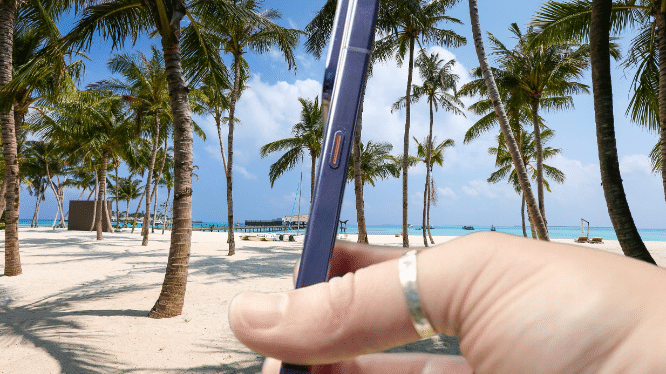
One last point is the AI button. It has an orange accent and looks like an important part of the phone, so you might expect a flexible shortcut. It is not. It is one of the most limited shortcut buttons I have seen on a smartphone. A long press or double press can launch only these functions:
- Silent Mode
- Do Not Disturb
- Device-wide privacy display
- Voice Notes
- AI Translate Conversation
- None
You cannot set it to open the torch or an app of your choice. I am sure you can find a practical use for it, but it needs to be far more versatile.
Xiaomi 18 Pro Max Screen
Phone displays have not changed much in a noticeable way for a few years. Peak brightness keeps climbing and PWM dimming keeps improving. The things you can see with your own eyes, such as sharpness, refresh rate and color support, have barely moved. Brands now look to other features to stand out.
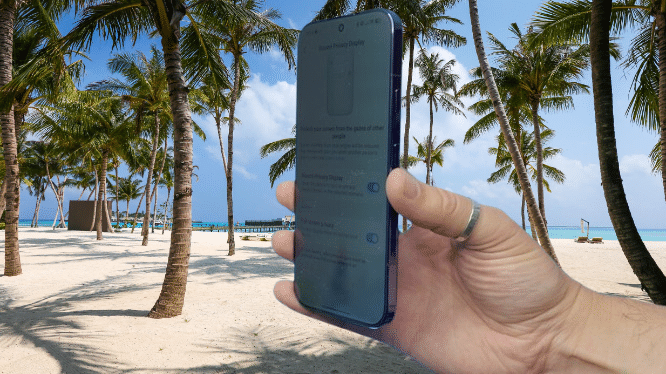
Following Samsung’s lead, Xiaomi added a Privacy Display to the 18 Pro Max. In theory, the screen goes dark when viewed from an angle, so someone glancing over your shoulder cannot read it unless they look at it head on.
You may also like: Nothing Phone 4a Pro Review: Worth Buying in 2026?
In practice, it is underwhelming, or at least less effective than the one on the Galaxy S26 Ultra. When I tested the angles, the screen only went dark at a very sharp angle. It does not seem to work at all when you view it from above or below. From a steep enough angle at the sides, the screen turns fully black, but at gentler angles it does little to hide anything.
I have no other complaints about the 6.9-inch AMOLED display. It is bright and sharp, with great color. Out of the box, it strikes a good balance between saturation and natural tones. It is a very good screen.
You also get plenty of extra controls if you want them. You can switch between DC and PWM dimming, and you can adjust color saturation and tuning to suit your taste.
Xiaomi 18 Pro Max Cameras
The rear display seems to have pushed one camera out of the camera island, which left less room for a lens and sensor. As a result, Xiaomi fitted the 18 Pro Max with a weak ultrawide sensor. It is much smaller than the ultrawide sensor on rivals, especially the Oppo Find X10 Pro Max, and well below the primary and telephoto sensors on this phone.
In bright daylight, you may not spot a problem unless you look closely. At night, the weaknesses show. The sensor struggles to gather enough light when it gets dark, and it handles highlights and shadows poorly.
Bright spots such as street lights blow out badly. Its colors and white balance also differ from the primary and zoom cameras. It feels like an afterthought, not a real part of the camera system.
You may also like: OnePlus 15R Review: Built for Battery Life, Durability, and Everyday Work
The other two cameras are a strength, especially the 200MP LOFIC primary sensor. This type of sensor handles bright highlights better and keeps texture in difficult light. I have been happy with how the photos look overall.
Much of that comes from the Leica tuning, which offers three profiles: Original, Vibrant and Authentic. The main difference between them is brightness and highlights, which also changes the shadows.
- Vibrant is the brightest and richest in color, and it suits autumn scenes well.
- Authentic is the darkest and moodiest, with the deepest shadows.
- Original sits in the middle, without the extra color saturation.
Whichever of the three profiles I picked, the photos never looked hyper-real. The camera kept highlights under control, and it did not lift the shadows so much that dark areas turned grey or foggy.
I have praised Master Mode on the Oppo Find X10 Pro Max, and I love its look. Still, I like having three fully automatic modes to choose from on the Xiaomi.
The zoom camera is decent too, with some limits. At 3.2x, its optical equivalent length, detail, sharpness, color, and shadows match the primary camera closely. At 6.4x, where it starts cropping into the sensor, photos still look good for the most part.
It copes well whether you zoom in on a distant landscape or use it as a rough macro lens for something close to the lens. It is a versatile camera.
Zoom beyond that range and things get rough. This is where AI processing takes over and tries to make sense of the scene and its details.
Details end up over-sharpened and over-smoothed, and they lose their natural look. They turn glassy and hazy. The more complex the texture, the harder it is for the processing to reproduce what is really there.
You may also like: Xiaomi 17T Pro Review: Big Battery, Familiar Design
A specific example: do not use it to zoom in on grey seals with mottled grey coats on a beach full of grey stones. You will want a dedicated telephoto lens with a teleconverter for that. At those lengths the photo looks AI-generated, and not a good one.
I am not a big fan of the selfie camera either. Results looked a bit soft and pale. It struggled with highlights and shadows, and it did not balance the light well between the foreground and background. You can switch to the rear cameras and use the rear display instead, which gives you much better selfies.
Xiaomi 18 Pro Max Performance
The Xiaomi 18 Pro Max is one of the first phones to launch with Qualcomm’s newest top-tier chip, the Snapdragon 8 Elite Extreme Gen 6. The name is a mouthful, and I miss the simpler numbering Snapdragon used to have. What it describes is an extremely powerful smartphone chipset.
How well the chip performs depends on how the manufacturer tunes the system around it and how well the phone cools. The ceiling is high, and it can handle just about anything you throw at it.
You may also like: OnePlus Pad Go 2 review: Better than all mid-range tablets
I played a good number of Destiny: Rising and Call of Duty on this phone. As expected, gameplay stayed smooth and responsive. I saw no noticeable lag or stuttering, even after 15 to 20 minutes of continuous play.
To get objective numbers, I ran 3DMark’s graphics tests. The frame rates are a clear step up from the previous generation of phones. The Xiaomi is not a dedicated gaming phone, so it does not reach the scores of the RedMagic 12 Pro, which uses the same processor.
In a single 3DMark loop, the Xiaomi roughly matches phones powered by the MediaTek Dimensity 9600 Pro, such as the Oppo Find X10 Pro Max and the Vivo X500 Pro Max. The gap shows up when you run the same scene over and over.
The stress test repeats the scene 20 times. The Xiaomi reached a similar peak to those two phones. When it throttled slightly to control heat, though, it settled at a much higher level than either the Oppo or the Vivo. That suggests the phone can hold stronger performance under stress, even if you play demanding games for a long time and it gets warm.
Xiaomi 18 Pro Max Software
Xiaomi’s software is typical for the brand, but it is less heavy-handed with bloat and Home Screen organization than usual.
It is nowhere near a Pixel-style experience. Like Oppo and Honor, Xiaomi borrows plenty from the iPhone in how the software looks, especially the glass-like texture all three brands now use.
Some parts still frustrate me. The biggest one is how it handles Home Screen wallpapers and ringtones. If you change wallpapers from the drop-down menu on the Home Screen, it pushes you into a cluttered Theme Store to buy paid content. It should make the preloaded options easy to reach instead.
You may also like: Infinix Note 60 Ultra Review: Pininfarina Design on a Budget
Otherwise, the software on my test phone is mostly free of bloat. There are only a handful of redundant apps, not a ton of them.
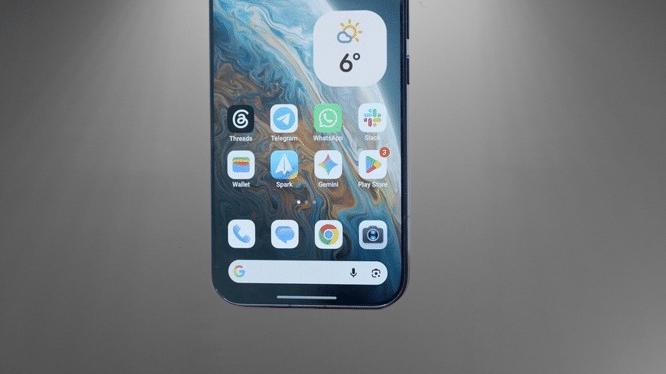
The approach to AI is measured too. You get the usual features: translating and transcribing voice memos, removing subjects from photos, and correcting or improving text.
Xiaomi 18 Pro Max Battery Life
Battery life is another solid area. In most years, a 7050mAh battery would look huge, but phones with more than 8000mAh have already appeared in 2026.
Even so, the capacity and software tuning here are enough that many people should get two days between charges. On days when I ran benchmarks and camera tests, I still could not drain a full battery in 24 hours.
On lighter days, with under three hours of screen time spent on social media, WhatsApp and reading, I often used only about 30 per cent by bedtime. If you are a heavy user who normally tops up during the day, I expect this phone to get you through a full busy day and still reach bedtime without a charge.
When you do need to charge, 100W speeds refill a large chunk of the battery quickly. The phone supports Xiaomi’s own 100W technology and 100W PPS, so a compatible third-party charger with enough power also delivers 100W.
You may also like: Nothing Phone 4a and 4a Pro Specs and Pricing Leak Ahead of March 5 Launch
I tested refill speeds with my Anker Prime 100W adapter. It took about 27 minutes to reach 50% and 73 minutes for a full charge. In truth, the battery hit 99% much sooner, and the last few minutes were trickle charging.
Xiaomi 18 Pro Max Verdict
The Xiaomi 18 Pro Max combines a useful rear touchscreen with excellent Leica-tuned main and telephoto cameras. Performance is top-notch, and the battery can last up to two days. The ultrawide camera is weak, the Privacy Display disappoints, and the AI button does too little. Even so, it is hard to fault.
Pros |
Cons |
| Excellent primary and telephoto zoom cameras with wonderful processing | Privacy display isn’t as good as it should be |
| Excellent performance and battery life | Weak ultrawide camera |
| Rear display makes taking great selfies super easy | AI Button on the side isn’t customisable enough |
Final Thoughts
Overall, the Xiaomi 18 Pro Max is a very good phone. It does not prove that two screens beat one. Whether you see the rear display as a gimmick depends on whether you find a use for it.
I liked using it as a viewfinder for selfies with the better cameras. Given the choice, though, I would shrink it and use the freed space in the camera island for a much better ultrawide camera.
Even so, the phone is hard to fault on performance, camera quality, battery life, and display.