
Your phone and electric car might stay cooler thanks to a new discovery. Engineers at the University of Houston built a thermal management system that acts like a one-way street for heat. Heat flows in a single direction, keeping devices from overheating.
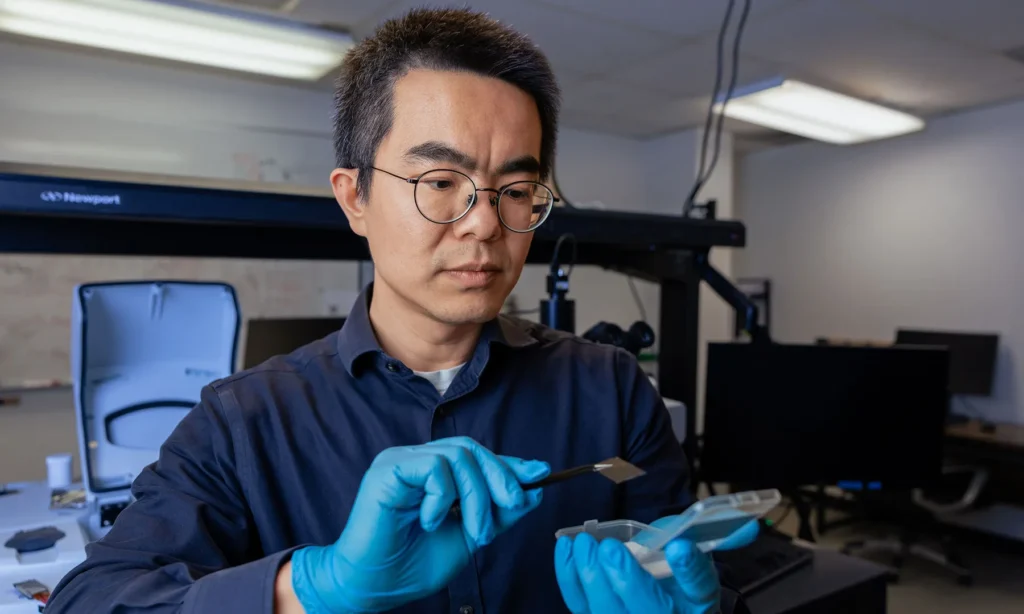
Bo Zhao leads the research team at the Cullen College of Engineering. His doctoral student, Sina Jafari Ghalekohneh, worked with him on the project. They call the underlying principle thermal rectification.
The technology targets hot spots in electronics. Phones, EVs, and similar devices generate intense heat in specific areas. This system controls those problem zones. Your battery could last longer, and your devices might run more reliably. The team published their research in Physical Review Research.
Most smartphones and portable devices have a heat problem. Standard materials allow heat to move freely in every direction. Heat from your battery or processor bounces around inside the device. It lingers in components or flows back into sensitive parts. This causes high temperatures, slower performance, and battery degradation.
You may also like: New Vibrating Microchip Could Make Smartphones Thinner, Faster, and More Efficient
The thermal diode works differently. It pushes heat forward while stopping it from flowing backward. Engineers gain better control over internal temperatures. Heat moves where it needs to go instead of spreading randomly throughout the device.
How Does the Thermal Diode Work?
The research team skipped traditional materials entirely. They built structures from semiconductor materials and placed them under a magnetic field.
This changes how energy moves at the microscopic level. Heat travels in one direction only, similar to how electrical diodes control current flow. The heat leaves sensitive areas, and they don’t return.
This approach gives engineers a new way to manage heat. The technology could help phones, electric vehicles, satellites, and AI systems handle thermal buildup. These devices all face serious heat problems during operation.
You may also like: Honor Silicon-Carbon Blade Battery: Everything We Know Ahead of the Magic V6 Launch
Overheating has always limited battery life and device reliability. High temperatures speed up battery wear and damage components. The thermal diode keeps parts at safe temperatures even when you push the device hard or use it in hot conditions. The heat moves out rather than building up inside.
The thermal diode currently exists only in computer simulations. Researchers need to build physical prototypes to test how it performs in real conditions. Lab models show promise, but real-world testing will prove whether the technology delivers.
Success means devices stay cooler and operate more safely. The heat moves away from vulnerable components so that your battery lasts longer and your device runs more reliably. Smartphones benefit, but so do electric vehicles, satellites, and other electronics prone to overheating.
You may also like: Negative Luminescence: The Unhackable Data Transmission
You won’t see this technology in stores tomorrow. It will take years before it reaches consumer products. Still, the breakthrough addresses a problem every device faces: too much heat in the wrong places.