
Skoda partnered with acoustic researchers at the University of Salford to build a bike bell that actually works on pedestrians wearing noise-canceling headphones.
They called it the DuoBell, and it solves a problem that anyone who cycles in a city knows well. Standard bells produce a single frequency. ANC headphones are specifically designed to filter out exactly that kind of predictable, steady sound. So the traditional ring gets eaten alive before it reaches the listener.

The DuoBell is fully mechanical and generates two tones simultaneously. The idea is that layered frequencies are harder for ANC technology to suppress than a single clean note. One tone alone gets blocked. Two tones together have a better chance of slipping through.
This is not a gimmick. Cities are seeing more cyclists and more pedestrians wearing ANC headphones at the same time. That combination creates a genuine safety gap that a product from 1877 was never built to handle.
You may also like: ChatGPT Is Now Available on Apple CarPlay
Skoda is an automaker, which makes this an unusual project on the surface. But car companies have thought about acoustics, road noise, and pedestrian safety for decades. Applying that thinking to a bike bell is a logical, if unexpected, move.
The Regular Bike Bell
ANC has come a long way. Early versions took the edge off background noise. Today’s best models, from Sony, Bose, and Apple, block out the outside world almost completely. You can stand next to a busy road and hear nothing but your music.
That works great on a plane. On a city street, it creates a problem.
In the UK and the EU, roughly half of all pedestrians now wear noise-canceling headphones while they walk. A traditional bike bell produces a short, sharp ring at a fixed frequency.
Modern ANC systems are built to detect and cancel exactly that kind of sound. The bell rings, the headphones suppress it, and the pedestrian never knows a cyclist is behind them.
Meanwhile, more people are cycling than ever. Cities across the world have seen a sustained rise in bike commuters over the past several years. ANC headphones, once a premium product, now ship at every price point. Both trends are accelerating at the same time.
You may also like: Nissan Brings Qi2 Wireless Charging to 2026 Pathfinder and Murano: Here’s What’s New
The numbers reflect what happens when those two trends collide. In London in 2024, incidents between cyclists and pedestrians who were not paying attention went up by 24%. That is not a small increase. It points to a structural problem, not a series of isolated accidents.
A bell that nobody can hear is not a safety tool. It is just a formality.
How DuoBell Outsmart ANC technology
The research behind the DuoBell started with a specific question: are there frequencies that ANC systems cannot effectively block?
The answer turned out to be yes. Acoustic testing identified a narrow window in the frequency spectrum, between 750 and 780 Hz, where ANC filters consistently underperform. The algorithms that handle most of the noise suppression work struggle in that range. So that is exactly where the DuoBell operates.
But the design does not stop there. The bell also includes a second resonator set to a higher frequency, which means it produces two distinct tones at once. On top of that, the hammer mechanism delivers strikes in rapid, irregular patterns rather than a clean, predictable ring.
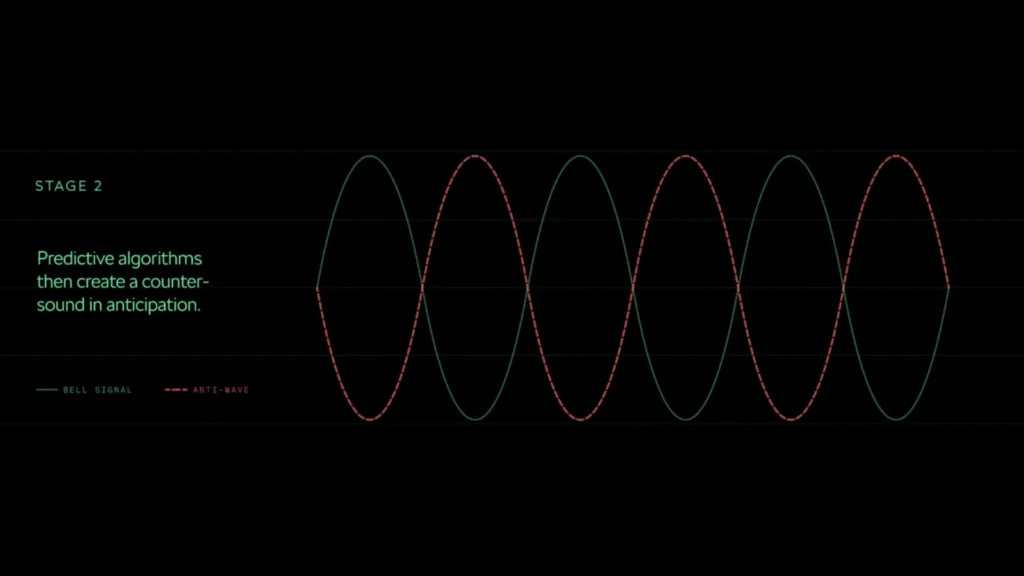
That last part matters more than it sounds. ANC technology works by recognizing a sound pattern and generating an opposing signal to cancel it. Give it something consistent and it handles it well. Give it something fast and erratic across two frequencies simultaneously, and it cannot process the cancellation quickly enough. The sound gets through.
The real-world results back this up. In testing, pedestrians wearing ANC headphones had up to 22 meters of additional reaction time when a cyclist used the DuoBell compared to a standard bell. At city cycling speeds, 22 meters is substantial. It is the difference between having time to step aside and not having it.
The whole thing is fully mechanical. No battery, no software, no connectivity. A physical hammer hitting a tuned resonator, designed around the specific weakness of the digital technology it needs to defeat.