
The vision, hearing, and movement of robots keep improving, but touch remains their weakest sense. At CES 2026, Ensuring Technology demonstrated new artificial skin that could give robots sensitivity approaching human levels. This technology helps robots actually feel the world rather than just detect obstacles through crude contact sensors.
The company’s tactile sensing technology enables robots to perceive pressure, texture, and contact with far greater nuance than simple touch sensors do.
Ensuring Technology unveiled two products, Tacta and HexSink, designed to solve a problem that has plagued robotics for decades.
Humans use touch constantly to grasp objects, apply appropriate force, and adjust instantly when something starts slipping from our grip.
We don’t think about these adjustments because our skin provides continuous feedback to our brain. Robots typically operate with minimal tactile feedback. They know when they’ve made contact with something, but they can’t feel how much pressure they’re applying or whether an object is starting to slide.
This creates real problems. Industrial robots drop fragile items because they grip too hard or too soft. Humanoid robots struggle with basic tasks like opening doors or handling tools because they can’t feel what’s happening.
Service robots have issues helping people because they may apply too much force, causing injury.
Ensuring Technology wants to close this gap by recreating sensitivity that works like how human skin works.
Our skin contains millions of sensors that detect pressure, vibration, temperature, and texture. These sensors continuously send information to our brains, which process it instantly and adjust our movements.
Artificial Skin Brings Human-Like Touch to Machines
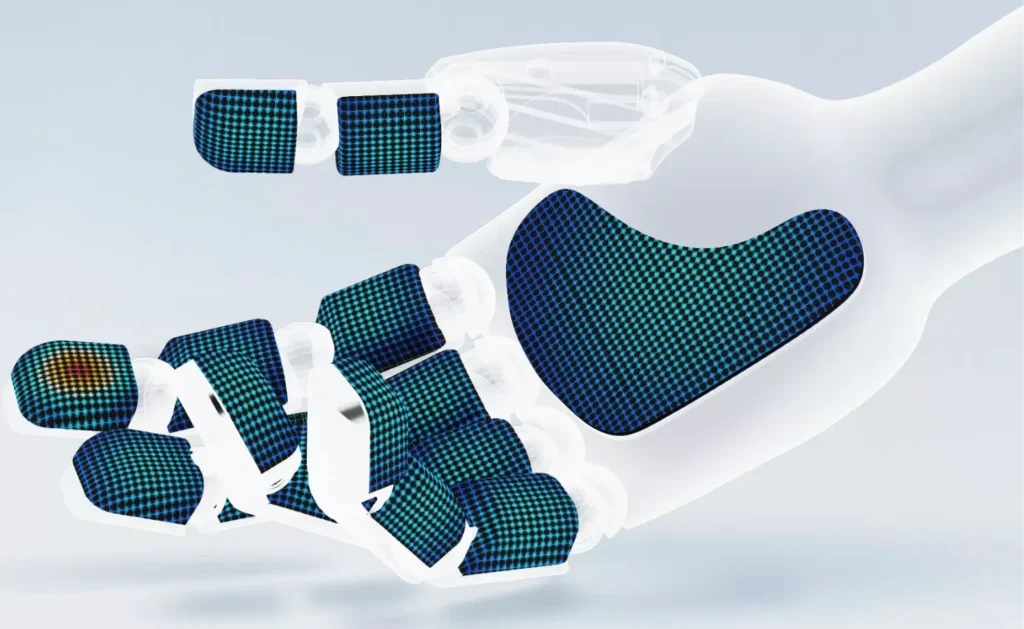
Tacta is a multi-dimensional tactile sensor built specifically for robotic hands and fingers. Each square centimeter contains 361 sensing elements, all collecting data at 1000 times per second.
Ensuring Technology claims this matches human touch sensitivity. Despite packing in so many sensors, Tacta measures just 4.5mm thick. It combines sensing, data processing, and edge computing into a single integrated module, eliminating the need for separate components.
At CES 2026, Ensuring Technology showed a robotic hand completely covered with Tacta sensors. The hand had 1,956 sensing elements distributed across the fingers and palm.
This creates a complete tactile awareness network similar to how human hands work. Every part of the hand can feel what it touches.
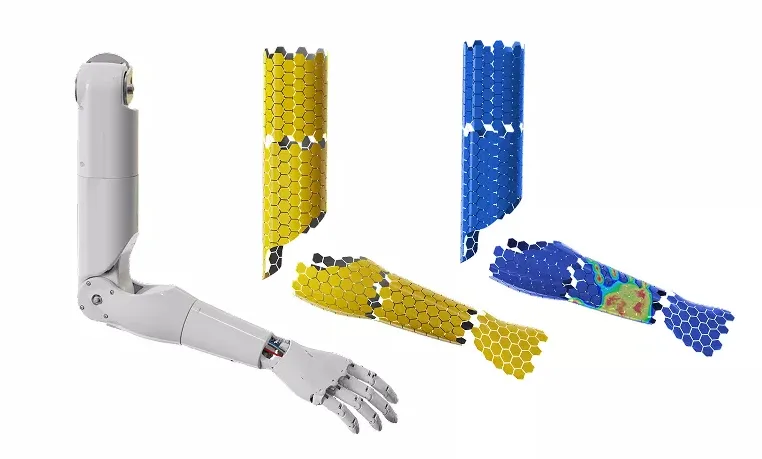
HexSkin expands this concept to larger surfaces. It uses a hexagonal tile design that can wrap around complex curved shapes. This makes it practical for humanoid robots with bodies featuring many different contours and angles.
You can’t just slap flat sensors on a robot shaped like a human. HexSkin’s flexible tile design solves this problem.
You may also like: Elon Musk Says Tesla Optimus Robots Will Go on Sale by End of 2027
CES 2026 featured numerous robots that demonstrate how quickly robotics is advancing and why better touch sensing matters so much.
LG unveiled its CLOiD home robot, designed to help with household chores such as laundry and breakfast.
Other companies displayed humanoid robots playing tennis with impressive coordination. Boston Dynamics brought Atlas, which demonstrated advanced balance and movement capabilities.
These robots already see and move remarkably well. But most still depend heavily on cameras and basic rigid sensors. They can detect when they’ve touched something, but can’t really feel it.
Adding a human-like touch through artificial skin could be the breakthrough that makes robots genuinely useful in homes and workplaces.