
Your phone screen looks like it produces a smooth, consistent glow across the entire display, but that’s not actually what’s happening.
Researchers at the University of Michigan have found that OLED screens emit light from tiny nanoscale hotspots scattered across the panel, and some of those hotspots flicker rather than maintain a steady output.
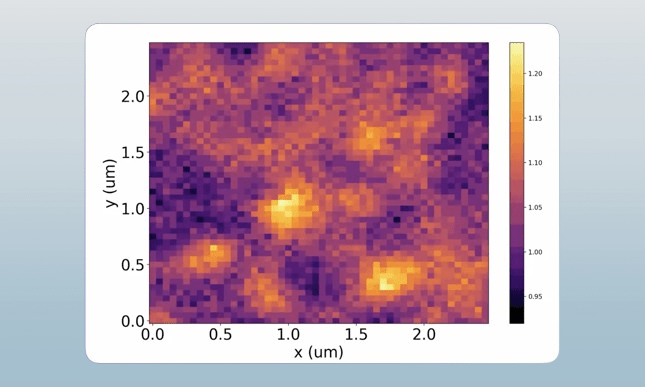
The finding goes beyond an interesting technical detail. Those hotspots have a direct impact on how long your screen lasts. Areas carrying more electrical current than the surrounding panel degrade faster, which means uneven light emission is quietly accelerating wear on your display.
Steve Forrest, one of the senior authors of the study published in Nature Photonics, put it plainly that areas under heavier load are likely to burn out sooner than the rest of the panel. That applies to the OLED screen on your phone and to OLED televisions running the same underlying technology.
The flickering from these hotspots doesn’t happen in unison, which is why your eyes read the screen as a steady, even light source. The individual flickers are out of sync with each other, and your visual system averages them out into what appears to be a constant glow.
You may also like: Negative Luminescence: The Unhackable Data Transmission
To make sure what they were seeing wasn’t a measurement error or a side effect of the imaging process itself, the research team verified the findings using superresolution optical fluctuation imaging. That cross-referencing step confirmed that the hotspots are a real physical phenomenon in the display, not an artifact introduced by the microscope or the observation method. The team is confident in what they found.
OLED screen hotspots research
The researchers used a simple analogy to explain what’s happening inside the panel. Picture the display material as a landscape with hills and valleys. The electrical charge that powers the screen naturally takes the path of least resistance, the same way water flows downhill and collects in valleys rather than spreading evenly across flat ground.
Two types of charge carriers move through the display in opposite directions: electrons and positively charged carriers called holes. Where these two streams meet, light-emitting molecules produce the photons that create the glow you see on screen.
You may also like: Honor Silicon-Carbon Blade Battery: Everything We Know Ahead of the Magic V6 Launch
The problem is that some valleys in the material run deeper than others, drawing far more charge traffic than the surrounding areas. The researchers estimate that charge density in these hotspots runs anywhere from 10 to 100 times higher than in the material around them. That concentration is what creates the uneven emission, and it’s what puts those areas under significantly more stress over time.
Flickering happens when charge carriers get temporarily caught in shallow dips in the energy landscape, similar to water pooling behind a dam.
When that blockage builds up, it redirects the flow of charge away from the hotspots that were previously active, cutting off their supply and causing them to go dark until the blockage clears and the flow resumes.
Can this be solved?
The research team believes the problem is solvable. Their proposed solution involves switching from the amorphous material currently used in organic displays to crystalline structures instead. The difference comes down to uniformity.
You may also like: University of Houston Engineers Develop Thermal Diode to Prevent Device Overheating
Amorphous materials have an irregular internal structure that creates the uneven energy landscape responsible for hotspot formation.
Crystalline materials are more consistent at the molecular level, which produces a flatter energy landscape where charge carriers spread more evenly across the panel rather than concentrating in specific areas.
If that approach works at a manufacturing scale, it could reduce hotspot formation significantly and extend the working lifespan of OLED displays in both phones and televisions.
The research is still at an early stage, but the proposed fix is grounded in a clear understanding of what’s causing the problem in the first place.