
Data storage and security are pressing problems, and the current tools we rely on are struggling to keep up with the scale of modern demands. Researchers around the world are working on approaches that go well beyond what today’s systems can do.
One of the more unexpected developments comes from UNSW Sydney and Monash University. A team there has built a system that hides data transmissions in plain sight, using a property called “negative luminescence.” The concept is unconventional, but the research behind it is serious, and the implications for secure data transfer could be significant.
What makes this system notable is not that it encrypts data, but that it makes the data transmission invisible in the first place. If an attacker can’t tell a message is being sent, there’s nothing obvious to intercept or target.
The method works by embedding signals into the thermal radiation that physical objects naturally emit at all times. Everything around you, walls, equipment, your own body, constantly radiates heat. This system uses the background thermal activity as cover.
You may also like: New Infrared Lens Technology Could Bring Thermal Cameras to Smartphones and Cars
To anyone observing from the outside, nothing unusual is happening. The signal looks identical to normal heat emissions. Only a receiver built to detect and decode the specific pattern can extract the actual message.
What is Negative Luminescence Data Transmission?
Every object emits infrared radiation, a faint heat signature that’s always present. Negative luminescence works by making that signature appear dimmer rather than brighter, which is the opposite of how most light-based systems behave.
Dr. Michael Nielsen, the lead author from UNSW’s School of Photovoltaic and Renewable Energy Engineering, describes the effect as a flashlight that can go darker than off. That’s physically impossible with visible light, but certain materials can produce exactly that behavior in the infrared range.
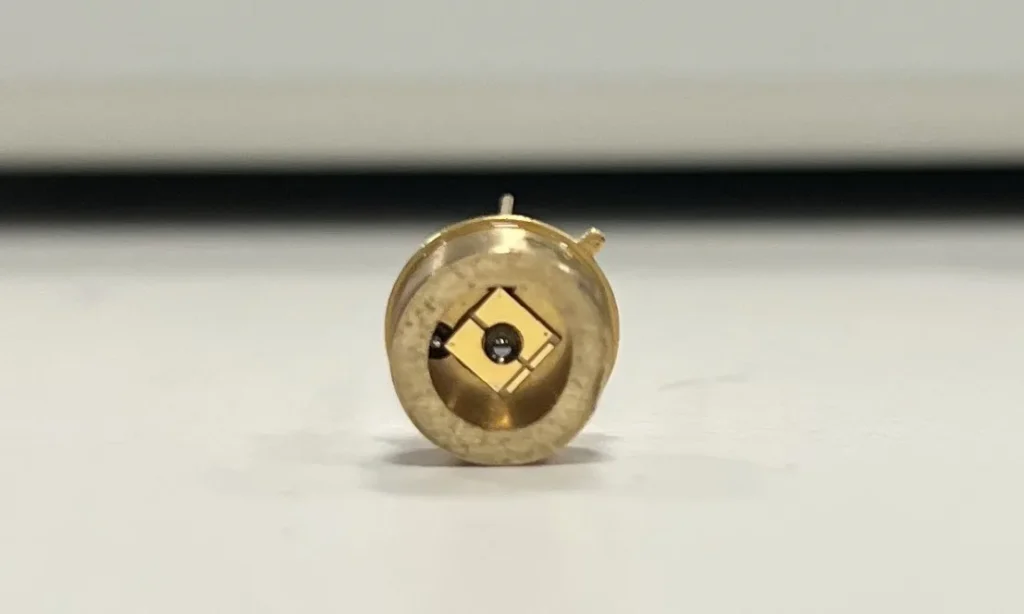
The team built a device called a thermoradiative diode to put this to practical use. The diode switches rapidly between states that are brighter and dimmer than the surrounding thermal background. That switching creates a pattern, and that pattern carries the data.
You may also like: OLED Screens Have Hotspots That Shorten Their Lifespan
From the outside, it looks like ordinary heat noise. Nothing stands out, nothing triggers suspicion, and nothing signals that a transmission is even taking place. The only way to read the message is to have the right equipment and know what to look for.
What does this mean in practice?
In lab testing, the system currently transfers data at around 100 kilobytes per second. That’s slow by modern standards, but it’s an early-stage result, and the researchers see a clear path to much faster speeds as the underlying hardware improves.
You may also like: University of Houston Engineers Develop Thermal Diode to Prevent Device Overheating
The more ambitious projection comes from colleagues at Monash University, who suggest that building the emitter from graphene could push transfer speeds into the hundreds of gigabytes per second range. That would put this technology on par with high-performance conventional systems, except with a security model that works on a completely different principle.
The main advantage here is structural. Most secure communication relies on making data hard to decode. This approach makes the transmission itself hard to detect.
For environments where sensitive data needs to move without drawing attention, that’s a meaningful difference, and one that gets more relevant as conventional encryption faces growing pressure from advancing computing power.