
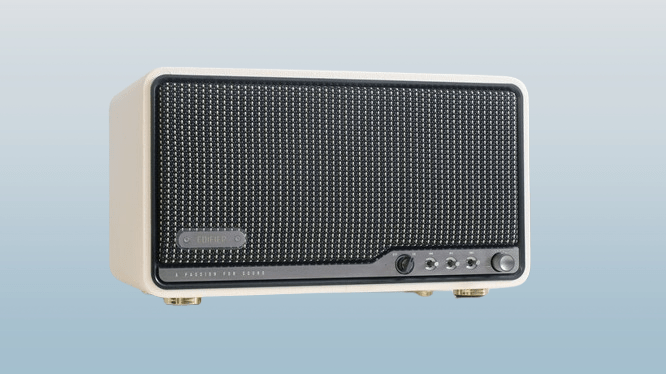
The Edifier S300 is the biggest tabletop wireless speaker Edifier makes right now. It has a retro look, but the tech inside is up to date. You get Apple AirPlay support and high-bit-rate Bluetooth codec compatibility, which puts it in good company for a speaker at this size.
It fills a room well, and compared to the smaller ES300, the larger woofer actually delivers the bass depth that the smaller model couldn’t quite reach.
That said, you’ll need to spend some time with the EQ settings to get the sound where you want it. The bass is aggressive out of the box, and without any adjustment, it can overpower the rest of the audio. The good news is that Edifier includes an EQ tool in its app, so dialing things in isn’t difficult, just necessary.
The sound won’t satisfy anyone chasing audiophile-level detail. But the S300 regularly drops below its $300 retail price, sometimes by a significant margin. At a discount, the minor sound shortcomings are much easier to overlook.
Edifier S300 Wireless Speaker Specs
Edifier S300 Wireless Speaker Design
The Edifier S300 has a bold retro look that you wouldn’t necessarily associate with a brand like Edifier, which has built its reputation mostly on affordable, no-frills speakers. This is a different direction for them, and it works.
You may also like: Marshall Woburn III Now $499: Best Bluetooth Speaker for Living Room Audio
The design is deliberate. You get a chunky two-tone woven grille and an outer shell wrapped in synthetic leather. It comes in three colors: ivory, brown, and black.
The ivory version has a clean, vintage feel to it. Worth noting, the leather finish is an actual soft material, not a plastic shell with a texture pattern pressed into it. It feels like the real thing when you touch it, even if it isn’t.
The retro styling on the S300 is committed, maybe a little too committed in a few spots. Brands like Ruark pull off vintage design with more restraint. The S300 goes a step further with two decorative metal plates screwed into the body, both stamped with the Edifier logo and serving no practical function.
In photos, they look like they could easily tip into gimmicky territory. In person, though, they’re less distracting than you’d expect.
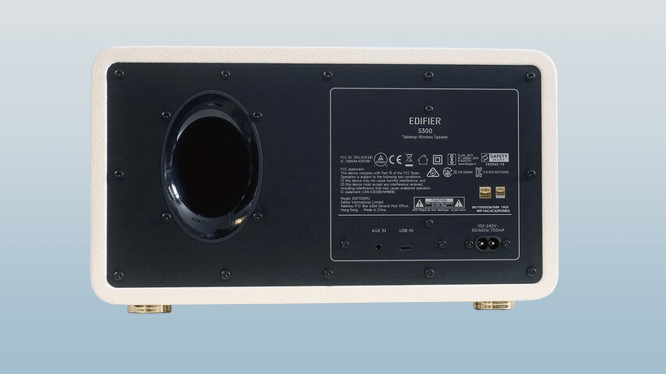
When you flip the speaker over, you’ll find four rubber feet with gold caps on them. It’s a small detail, but it fits the overall aesthetic without feeling out of place.
The S300 has a full row of physical controls along the front bottom edge, something the smaller models in the range don’t offer. They lean into the retro theme just as hard as the rest of the design.
The power button is a rotary dial with two positions. It has a smooth, deliberate resistance when you turn it and a satisfying click when it engages.
There’s an orange LED ring around it that glows like something out of an old valve amplifier. You can’t switch the light off, which might bother you if you listen in a completely dark room, but in normal conditions, it’s subtle enough to ignore.
For playback, you get three small flick switches that handle track skipping and play/pause. Each one is a two-way toggle, even for functions that only have one outcome, like pausing.
That’s a little redundant from a purely functional standpoint. But these controls aren’t really about efficiency. They’re about how they feel under your fingers and how they look on the speaker. On both counts, they deliver.
The volume knob is well-made, with a knurled grip that gives you something to hold onto and a satisfying click as you turn it. You can also control volume through the app if you prefer, so both options stay available at the same time. Press the knob in, and it doubles as a source selector, which keeps the front panel clean without adding extra buttons.
You may also like: Sonos Arc Ultra and Sub 4 Deal: Get Premium Sound System for $1,599
A small multi-color LED sits next to the power dial and changes color depending on which input you’re using. It’s a simple solution that tells you everything you need to know at a glance, no screen required.
Edifier S300 Wireless Speaker Features
You get four input options: Bluetooth, USB, 3.5mm aux, and AirPlay. The AirPlay support makes the S300 a more natural fit for iPhone users. Android users miss out on both Spotify Connect and Google Cast, which limits how conveniently they can stream to it.
That said, this is more of a convenience gap than a sound quality one. Bluetooth performance on the S300 is about as good as it gets at this level. LDAC is supported alongside standard SBC, and through the Edifier app, you can switch between 96KHz, 48KHz, and a non-LDAC mode.
During testing with a codec analyzer, AAC and SBC both showed up as active in that last mode, even though Edifier leaves AAC off the official spec sheet entirely.
Testing with an OPPO Find X, the difference in latency between LDAC and the basic codec mode was noticeable. LDAC kept things tight enough to watch video content without the audio feeling out of sync.
In the AAC/SBC mode, the delay was obvious enough to be distracting during anything with dialogue. That said, your results will depend on your device and how it handles the connection.
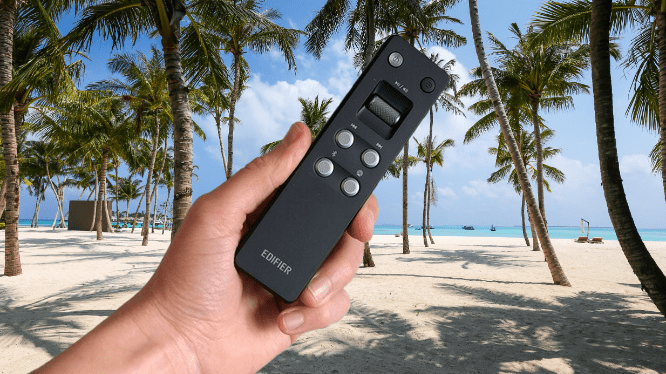
In the box, you get a remote control with a scroll wheel for volume rather than the usual up/down buttons, a USB-C to USB-C cable, and a 3.5mm audio cable.
You may also like: Klipsch Nashville Portable Bluetooth Speaker with 24-hour battery life
The power cable is a standard figure-of-eight lead, which means no external power brick sitting on your shelf or behind your furniture. It’s a small thing, but a welcome one.
Edifier S300 Wireless Speaker Sound Quality
Inside the S300, you’ll find a 5.5-inch woofer sitting at the center, flanked by two 1.25-inch titanium dome tweeters, one on each side. The tweeter placement gives the sound a basic stereo spread, which is a reasonable setup for a speaker this size. The grille hides most of the driver’s layout, so you won’t see any of it unless you take the cover off.
Right out of the box, the bass is excessive. Even with the speaker positioned away from walls and with plenty of room around the rear port, the low end dominates everything else.
The default tuning follows a sharp V-shape: heavy bass on one end, a noticeable treble boost on the other, with the midrange sitting somewhere in the middle, trying to survive. The treble push feels like an attempt to compensate for all that bass rather than a deliberate tonal choice.
Edifier clearly built the 5.5-inch woofer as a selling point, and you can hear that in how the speaker is tuned from the factory setting. The problem is that more bass doesn’t always mean better bass, and in this case, it gets in the way of everything else.
The heavy-bass default tuning borders on comical. There’s genuine weight to the low end, and that part is enjoyable, but the overall balance is off enough to be a problem for everyday listening.
The fix is in the Edifier Home app. The default sound profile is called Dynamic, and it behaves a lot like the punchy, overblown presets you see on TVs displayed in retail stores. It’s tuned to impress at first listen, not to hold up over time.
You may also like: Tiny IKEA Kallsup speaker is insanely cheap
Switch away from it and things improve considerably. The app also offers Monitor, Voice, and a custom EQ mode where you set your own parameters. All three are noticeably better balanced than the Dynamic default, and any of them would be a more sensible starting point for regular use.
Pull the bass back through EQ, and the S300 becomes a genuinely good listen. You’re not stripping out the low end, just bringing it under control. There’s still plenty of punch there, more than you’d reasonably expect from a speaker this size.
The low-end reach is real. Edifier rates the bass floor at 48Hz, and while that figure comes with the usual caveats around measurement standards, you can hear that this isn’t a speaker built around a small driver.
It goes deep, and when the track calls for it, it hits hard. The only place it starts to thin out is at the very lowest sub-bass frequencies, which is perfectly normal for a tabletop speaker in this category.
The driver setup gives the S300 a clear sonic character, and not entirely in a good way. Treble and bass are both present in abundance, but the midrange is where things get thin.
When you listen to a male vocalist with a lower register, the lack of body in that frequency range becomes obvious. The upper mids and lower treble also lack the smoothness you’d want for longer listening sessions.
The S300 is a fun speaker built for volume and impact. It suits background music and social settings well. But if you’re sitting down and actually paying attention to what you’re hearing, the limitations show up.
Comparing it to the Edifier S880DB Mark II makes this clearer. The S880DB doesn’t go as deep in the bass, but it handles vocals with a more natural tone and keeps the overall sound better balanced.
Imaging is also stronger on the S880DB when you set it up properly. The S300 wins on raw low-end output, but the S880DB is the more complete and honest-sounding speaker of the two.
Edifier S300 Wireless Speaker Verdict
The Edifier S300 is built for people who want a speaker that looks different and plays loud. The bass needs taming through the app before it sounds its best, but once you do that, it delivers exactly what it’s designed for.
You may also like: Samsung Music Studio 5 and 7 Speakers: Will Pricing Mistakes Doom Them Again?
If you’re after a speaker with character, presence, and enough low-end to fill a room, the S300 fits in for you. But if you’re chasing accuracy and tonal balance above everything else, look elsewhere.
Pros | Cons |
| Powerful low-bass for its size | Overpowering bass in default mode |
| Distinctive design | Wi-Fi transmission is only for the Apple crowd |
| Comes with a remote control | Not the most refined sound |
Final Thoughts
The Edifier S300 is not trying to disappear into your room. Where brands like Sonos lean into clean, understated design, the S300 goes the opposite direction with its retro styling and physical controls. It has a personality, and it commits to it.
The speaker is on the larger side for a tabletop unit, and the bass output reflects that. But you’ll need to move away from the default sound mode before any of that becomes enjoyable.
Out of the box, power takes over, and balance takes a back seat. Spend a few minutes in the app, adjust the EQ, and the picture changes considerably.
Android users do get the short end of the stick here. No Spotify Connect, no Google Cast, no Wi-Fi streaming. That’s a real usability gap.
The saving grace is that Bluetooth quality on the S300 is good, so the sound you’re getting over Bluetooth isn’t a compromise; just the connection method is less convenient than what iPhone users get.