
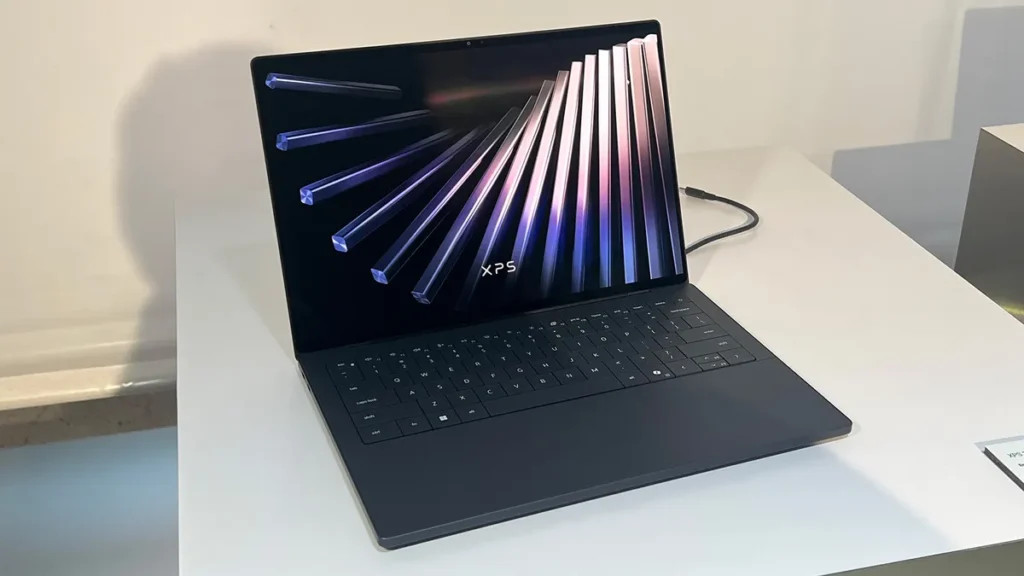
Dell has renewed its XPS laptop lineup, and the XPS 14 2026 and XPS 16 2026 immediately stand out as two of the most impressive laptops I have used so far this year. The redesign feels overdue, but it was clearly worth the wait.
Dell has moved away from the traditional, work-focused look of earlier models and replaced it with a cleaner, more modern design that feels far more versatile.
While long-term performance will ultimately decide how good these laptops really are, first impressions are strong.
The new design comes with an improved look and feel, making the devices feel more refined and premium in everyday use. Based on hands-on time alone, the XPS 14 and XPS 16 are the best-looking and best-feeling versions Dell has produced yet.
Pros
- Fantastic redesign
- No more virtual Function keys
- Lightweight and solid feel
Cons
- No discrete graphics option
- The trackpad could be defined more
- Limited configurations at launch
As CES 2026 begins, one of the biggest laptop announcements arrives almost immediately with the return of the Dell XPS 14 and XPS 16. Their reappearance stands out as an early highlight of the show and signals a clear shift in direction for Dell’s laptop strategy.
Last year, Dell made a bold move by restructuring its entire laptop lineup. The company grouped its devices under the Dell, Dell Pro, and Dell Pro Max names, each split into Base, Plus, and Premium tiers across different sizes.
The change drew mixed reactions, and many longtime users were not convinced by the new naming and positioning.
This redesign may be due to feedback, sales results, or a broader rethink. Dell has now brought back the XPS name. This return is not just about branding. The new XPS lineup comes with a noticeable redesign that addresses the issues seen in recent generations.
At first look, the laptops feel cleaner, more refined, and better aligned with what people expect from the XPS line.
Both the XPS 14 and XPS 16 are powered by Intel’s new Core Ultra 300 series processors. That choice brings a major change. For now, Dell is moving away from offering discrete graphics in the XPS lineup.
This places a lot of responsibility on Intel’s latest chips to deliver strong performance for both creative tasks and everyday productivity.
You may also read: Dell Precision 5 and 7 Series 2026: Specs and Price
It is still too early to say whether this new approach strikes the right balance. Real-world performance will tell the full story later. For now, though, the Dell XPS 14 and XPS 16 feel like a confident and well-executed return for one of Dell’s most recognizable laptop families.
Dell XPS 14 and Dell XPS 16: Specs
| Header Cell – Column 0 | Dell XPS 14 | Dell XPS 16 |
|---|---|---|
| Processor | Up to Intel Core Ultra X9 388H | Up to Intel Core Ultra X9 388H |
| Graphics | Intel Arc Graphics, Intel Graphics | Intel Arc Graphics, Intel Graphics |
| NPU | Up to 50 TOPS | Up to 50 TOPS |
| Memory | Up to 64GB LPDDR5x-9600 | Up to 64GB LPDDR5x-9600 |
| Storage | Up to 4TB PCIe 5.0 | Up to 4TB PCIe 5.0 |
| Display | Up to 14-inch 2.8K (2880 x 1800) OLED InfinityEdge touch display, 400-nits typical, 500-nits peak brightness, 100% DCI-P3 color gamut, VESA DisplayHDR True Black 500 | Up to 16-inch 3.2K (3200 x 2000) OLED InfinityEdge touch, 400-nits typical, 500-nits peak brightness, 100% DCI-P3 color gamut, VESA DisplayHDR True Black 500 |
| Wireless | Wi-Fi 7, Bluetooth 6.0 | Wi-Fi 7, Bluetooth 6.0 |
| Ports | 3x Thunderbolt 4, 1x 3.5mm Universal Audio jack | 3x Thunderbolt 4, 1x 3.5mm Universal Audio jack |
| Battery | 70WHr | 70WHr |
| Webcam | 8MP / 4K HDR w/ Windows Hello | 8MP / 4K HDR w/ Windows Hello |
| Dimensions (W x D x H) | 12.19 x 8.26 x 0.58 ins | 309.5 x 209.7 x 14.6mm | 13.88 x 9.35 x 0.58 ins | 352.6 x 237.47 x 14.6mm |
| Weight | 3.0 lbs | 1.36kg | 3.65 lbs | 1.65kg |
Dell XPS 14 and Dell XPS 16: Price and Availability
The new Dell XPS 14 and XPS 16 are set to launch. At release, both models will be available only in the United States, with wider international availability planned for later.
Pricing starts at $2,049.99 for the XPS 14 and $2,199.99 for the XPS 16. These launch prices apply to a limited set of configurations. Dell has confirmed that more affordable options will follow, along with releases in other regions such as the UK and Australia. However, the company has not yet shared exact dates or pricing for those markets.
Dell has not disclosed full details about the initial configurations, so it is difficult to judge how these prices compare to earlier XPS models. Memory costs remain high, which could push prices higher.
You may also like: M5 Pro and M5 Max MacBook Pro Could Launch January 28 With Creator Studio
At the same time, Dell’s scale gives it more flexibility to manage component costs through volume deals. A clearer picture of overall value will emerge once more configurations are available and real-world pricing settles over the coming weeks and months.
Dell XPS 14 and Dell XPS 16: Design
The most noticeable change with the Dell XPS 14 and XPS 16 is the redesign. Both laptops are thinner, lighter, and feel more solid than earlier generations. The updated look immediately makes them feel more modern.
Even the branding plays a role here. They swapped the Dell logo for the XPS logo on the lid, which gives the laptops a cleaner identity and moves them away from a traditional office aesthetic toward something that feels more like a true ultrabook.
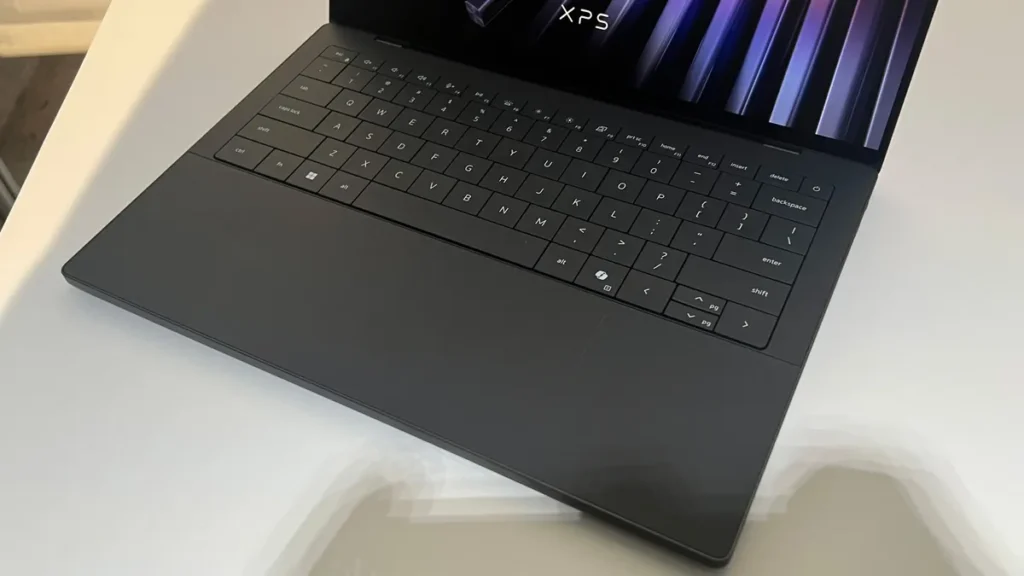
During the short time I spent using them, the keyboards felt comfortable. The keys offered decent travel and did not feel cramped or stiff. That said, extended typing sessions are the real test, and it will take longer use to know how they hold up over several hours of work.
Port selection should meet the needs of most users. You get three Thunderbolt ports along the sides, along with a combined headphone and microphone jack. Some people may miss USB-A ports, but given the industry shift toward USB-C, Dell’s decision makes sense and keeps things simple and fast.
The webcam is an 8MP 4K HDR unit, which feels appropriate for laptops at this level. Audio comes from multiple speakers hidden along both sides of the chassis; the speaker delivered up to 10W of sound.
In a noisy demo environment, the speakers were easy to hear and surprisingly loud. Sound quality will need more controlled testing before making a final judgment.
Both laptops feature OLED displays that look excellent at first glance. The 16-inch model naturally feels more spacious, but the 14-inch screen is still comfortable for most tasks. The lighting conditions during testing were not ideal, so judging precise color accuracy would be unfair. Even so, nothing stood out as a weakness.
For me, the most important improvements are tied to usability. Physical function keys are back, replacing the touch-based row used in previous models. The trackpad also has a more visible outline instead of blending completely into the glass surface.
The earlier design created unnecessary accessibility issues. While the trackpad outline could still be more defined, these changes alone make the new XPS models far easier and more pleasant to use.
Dell XPS 14 and Dell XPS 16: Performance
I did not get the chance to run performance benchmarks on the XPS 14 or XPS 16, so I cannot say how they compare to earlier XPS models yet.
What is clear is that the absence of discrete graphics could be a drawback for some buyers, especially when you put these laptops side by side with systems like the Dell 14 Premium that comes with an Nvidia RTX 4050, which I tested last year.
With that being said, I have not fully tested Intel’s new Panther Lake processors either. Until that happens, it is too early to judge how much performance Intel’s integrated graphics and overall platform can deliver.
There is still a chance the new XPS models could perform better than expected. We should have a clearer picture once proper testing is done.
Final Thoughts
I was not nearly as bothered by last year’s XPS rebranding as some others were, but I know the return of the XPS name will be welcome news for a lot of longtime fans.
What matters more to me is the actual redesign of these laptops. The return of proper Function keys and a clearly defined trackpad fixes issues that should never have existed in the first place.
Those changes alone make the XPS 14 and XPS 16 the laptops I am most eager to spend real time testing in the coming weeks. If Intel’s Panther Lake chips deliver the performance they promise, these two models could end up being the laptops to beat in 2026.