
Bluesound has been in the soundbar space since 2016, but for most of that time, their lineup looked nearly the same year after year. Large, uniform designs were the standard right up until 2021, with little differences between models.
That changed in late 2025 when Bluesound introduced two new products, the Pulse Cinema and the Pulse Cinema Mini. Both carry a design that finally aligns with Bluesound’s wireless multiroom speakers, giving the whole ecosystem a more cohesive look.
More importantly, the Mini marks the first time Bluesound has built something specifically for smaller TVs and tighter living spaces.
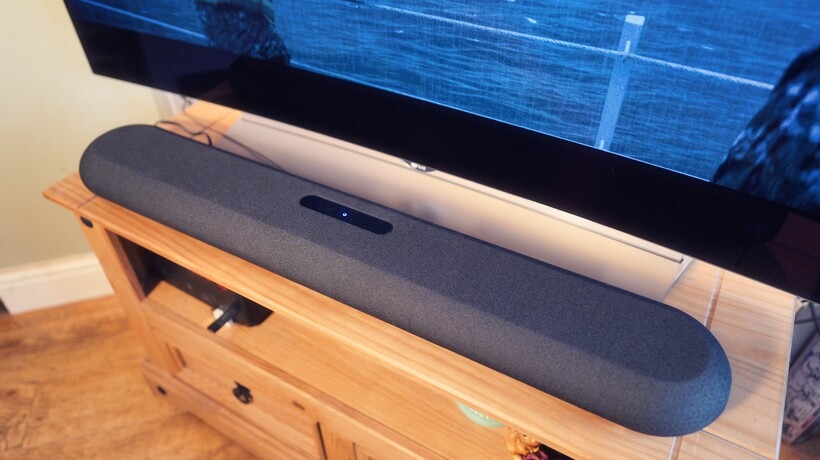
The Pulse Cinema Mini is the one I’ve been testing. It’s built to sit low and take up minimal space, but Bluesound isn’t positioning it as a compromise. The goal is compact form, full performance.
Bluesound Pulse Cinema Mini Specs
Bluesound Pulse Cinema Mini Design
You will notice the build quality immediately when picking up the Pulse Cinema Mini for the first time. It feels good and substantial in your hands, which is exactly what you want from a premium audio product.
The shape is smooth and rounded, somewhere between a bar and an oval, with soft edges that keep it from looking too clinical.
You may also like: Marantz AV 30 and AMP 30: Premium Home Theater Components Explained
A fabric grille wraps the entire front face, while the bottom is finished in smooth matte black, on the black model I tested. The tan version swaps that out for a white underside.
It’s a clean, understated look. Nothing about it demands attention, and honestly, that’s the right call for a soundbar. You want it to sit quietly under your TV and disappear into the room. The design does exactly that.
At just over 33 inches long, the Pulse Cinema Mini pairs best with TVs in the 40 to 50-inch range. I ran it alongside a 55-inch set on a fairly compact stand, and it looked perfectly proportioned. The full-size Pulse Cinema, at 47 inches, would have overhangs my stand on both sides, so the Mini was clearly the right fit for my setup.
Bluesound includes a wall mount in the box, which is a welcome touch. If your TV is wall-mounted, you can put this bar straight up without sourcing any additional hardware. The box also comes with all the cables you’ll need: the power cable, HDMI, and even an Ethernet cable. Nothing to hunt down separately.
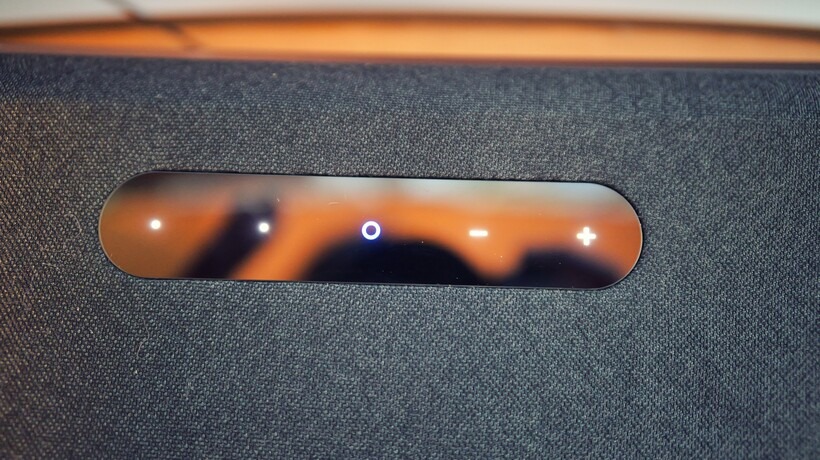
The physical controls are kept to a minimum. A gloss black strip runs along the top of the bar, with a status indicator sitting in the center. Capacitive-touch buttons sit on either side of it and light up when your hand gets close.
The buttons on the right handle volume up and down. The ones on the left are programmable through the BluOS app, so you can assign them to whatever function you use most.
There’s no remote in the box, which might catch you off guard if you’re used to traditional soundbars. But Bluesound operates more like Sonos in this regard, and Sonos has never bundled a remote either. If you want one, the RC1 remote is available separately.
You may also like: Marshall Woburn III Now $499: Best Bluetooth Speaker for Living Room Audio
In practice, the omission isn’t much of an issue. The BluOS app on your phone handles all the key settings, and it also lets you program the soundbar to respond to your existing TV remote’s IR signals.
I had my TV remote controlling the soundbar’s volume in just a few minutes. Once that’s set up, you barely notice there’s no dedicated remote at all.
Bluesound Pulse Cinema Mini Features and Ports
Bluesound sits in the same category as Sonos, and that means the Pulse Cinema Mini isn’t just a soundbar. It’s a starting point.
If you want to build out a full home theatre setup, you can add wireless rear speakers and a wireless subwoofer down the line without running a single cable between them. I tested the Mini on its own, but the option to expand is there when you’re ready for it.
With any multiroom system, the app is what makes or breaks the daily experience. BluOS holds up well. It’s fast, simple to navigate, and connects to most major streaming services without stress. It doesn’t feel like an afterthought, which is more than you can say for some competitors in this space.
Where Bluesound pulls ahead of Sonos is in how seriously it takes audio quality. It supports 24-bit/192kHz high-res streaming across its entire product range, which puts it a step above what Sonos offers.
The BluOS platform also powers hardware from NAD, PSB, and Cyrus, brands that sit firmly in the high-end audio market. That kind of integration says a lot about where Bluesound positions itself.
Since I only had the one unit, I can’t give a full account of how the multiroom side performs across multiple rooms. But everything within my testing worked without a single problem.
The BluOS app connects to the soundbar immediately; connecting it to my network took no effort, and I was playing music from Spotify within minutes of unboxing it.
You may also like: Klipsch Nashville Portable Bluetooth Speaker with 24-hour battery life
The app isn’t without its quirks, though. Finding the sound profile settings took longer than it should have. They’re not where you’d naturally look, and it required more digging around than felt necessary.
There’s also a strange one, which is that turning off spatial audio causes the soundbar to reboot. The app does warn you before it happens, but it’s still an odd behavior for what should be a simple toggle.
On the profiles themselves, you get three options: Music, Movie, and Late Night. Each one lets you switch the Surround Upmixer, Virtualizer, and Volume Leveler on or off individually, and you can assign a different profile to each input or source. The difference between profiles is genuinely noticeable, which is a good thing.
What’s missing is a custom EQ. For a product aimed at people who care about audio quality, the lack of any fine-tuning controls feels like a gap. The presets cover the basics, but having the option to adjust specific frequencies would have made this a much more complete package.
The Pulse Cinema Mini supports Dolby Atmos decoding, but there are no up-firing drivers inside. That means any height effect you hear is created through DSP processing rather than sound physically bouncing off your ceiling.
It can be surprisingly convincing in the right content, but it’s not the same as having actual upward-facing speakers. Worth keeping that in mind if immersive audio is a priority for you.
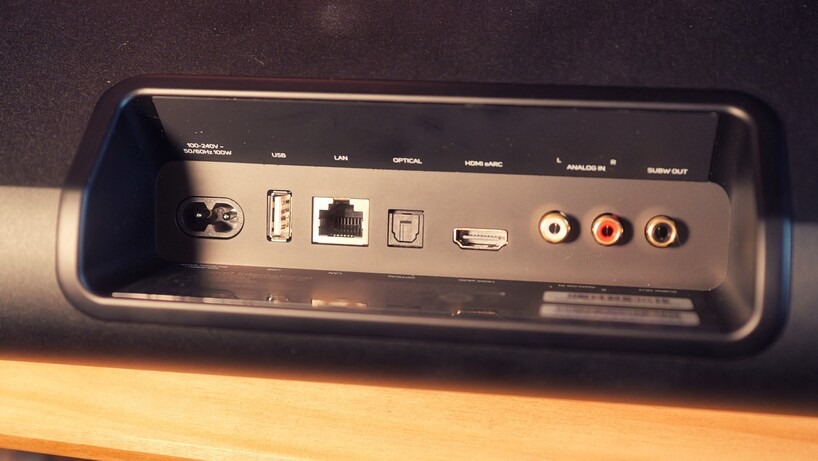
The connection options are good. eARC and optical are the two main ways to hook it up to your TV, which covers most setups.
Beyond that, you get an analogue phono input and a USB-A port for direct media playback. There’s also an RCA output for connecting a traditional wired subwoofer, which is a useful addition for anyone who already owns one and doesn’t want to invest in a wireless option straight away.
Bluesound Pulse Cinema Mini Sound Quality
For a bar of its size, the Pulse Cinema Mini does an impressive job of spreading sound across a room. My usual setup runs through an older Sonos Playbase, and switching to the Bluesound was a noticeable step up. The sound felt wider and more three-dimensional in a way that the Playbase simply doesn’t match.
I put it through its paces with the Golden Gate Bridge scene from Godzilla (2014), which is a good stress test for any soundbar. That scene layers soft rain, sharp gunfire, and deep, guttural roars all at once, and the Mini handled every layer cleanly. The room felt genuinely filled with sound rather than just pointed at you from one direction.
Volume-wise, it has more in reserve than you’d expect from something this compact. At around 60 to 70 percent volume, my living room felt closer to a cinema than a lounge. It’s the kind of output that makes you forget you’re listening to a soundbar.
The detail and dynamic range on Bluesound Pulse Cinema Mini are genuinely impressive, but there is one clear weakness, which is the sub-bass. The mid-bass punches well, but below that, there’s not much happening.
If you want the kind of low-end rumble that you feel in your chest at the cinema, the Mini on its own won’t get you there. A subwoofer is the only real solution.
Going wireless is the convenient route, but it comes at a cost. Bluesound’s Pulse Sub+ retails at $999, which essentially doubles what you’ve already spent on the soundbar. That’s a significant ask.
The more budget-friendly path is the RCA output I mentioned earlier. Hook up any wired subwoofer through that port, and you can fill in that missing low-end without spending anywhere near $999.
It means dealing with a cable, but for most people, that’s a reasonable trade-off to get a more complete sound without a much larger outlay.
You may also like: Tiny IKEA Kallsup speaker is insanely cheap
Out of curiosity, I paired the Mini with my old 8-inch subwoofer, and the difference was striking. The combination pushed the system into territory that genuinely competed with much more expensive home theatre setups. If a true cinema experience is what you’re after, a subwoofer isn’t optional. It’s the missing piece.
My one other gripe is on the software side. Watching Interstellar, I kept wanting to bring the dialogue up a little relative to the rest of the mix. To be honest, that’s a well-documented issue with the film itself, not a fault with Bluesound.
The problem is that BluOS gives you no way to address it. Many competing soundbars let you boost the centre channel independently or apply a dedicated vocal enhancement preset.
BluOS offers neither right now. It’s a gap that would be simple to fix with a software update, and I hope Bluesound adds it down the line.
Music listening tells the same story as movies. The Pulse Cinema Mini performs well, as long as the music you’re playing doesn’t lean heavily on deep low-end frequencies.
Kuzich’s Innervisions was a highlight. The detail across the mix is excellent, the mids have real punch to them, and the soundstage stretches wider than you’d expect from a bar this size. It’s the kind of listening experience that keeps you engaged.
Switch to dubstep or drum and bass, and the limitations surface quickly. Those genres are built around sub-bass, and the Mini simply can’t reproduce it without help. The bar works hard, but the rumble and weight those genres depend on just isn’t there without a subwoofer in the chain.
Verdict
The Pulse Cinema Mini delivers a surprisingly wide and immersive sound for its size, making it a good choice for movies and TV. Wireless multiroom support and high-res streaming make it even more appealing. Just know that without a subwoofer, you won’t get the full low-end impact this system is capable of.
Pros |
Cons |
| Dynamic and immersive sound | Needs a sub to sound its best |
| Dolby Atmos decoding | It’s expensive |
| Great connectivity with high-res and MQA support | No charger in the box |
Final Thoughts
The Pulse Cinema Mini is a good product. It’s compact, but it produces a wide, detailed sound that punches well above what its size suggests. Pair that with built-in streaming support and wireless multiroom capability, and the overall package is hard to dismiss.
It impressed me more as a home cinema tool than a music system, though it still outperforms most soundbars when you’re just listening to music.
The one consistent caveat throughout my testing remains the same: if you want the full experience, budget for a subwoofer. Without one, you’re leaving a meaningful part of the performance on the table.
The price isn’t easy to overlook, and it climbs further once you factor in a sub. But if you’re already bought into the BluOS ecosystem, or planning to be, the Mini fits naturally into that setup.
You can find better value elsewhere, but finding a soundbar this compact that matches this level of clarity and soundstage width is a harder task than it might seem.